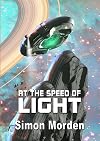
At the Speed of Light
by Simon Morden
On This Page
Description
A tense drama set in the depths of space. Aboard a ship that has travelled beyond the reach of human knowledge, Corbyn discovers he may not be as alone as he ought to be... An intense hard SF novella from Simon Morden (B.Sc. Hons., Sheffield, Ph.D, Newcastle), a bona fide rocket scientist with degrees in geology and planetary geophysics who also writes science fiction. Author of a dozen novels and collections, Simon won the 2012 Philip K. Dick Award. At The Speed of Light is one of his show more finest works to date. "Morden has a natural talent for a plot that keeps the reader guessing." - The Guardian (on Equations of Life) "An engrossing rollercoaster of a plot winds up with a solidly satisfying climax that leaves the reader craving more." - Publishers Weekly (on Arcanum) "Morden, against a gritty, utterly convincing backdrop, anticipates every consequence and wrings out surprise after surprise." - Kirkus (on Arcanum) "This is British sci-fi at its hard-boiled best." - The Guardian (on The Curve of the Earth) "Morden is a writer who delights in turning your expectations upside down." - ScienceFiction.com At The Speed Of Light is the second release in a new series of NewCon Press novellas. The series will be issued in sets of four, with each set featuring cover art by the same artist - one piece of artwork divided between the four covers. show lessTags
Recommendations




































Member Reviews
You wake up to a voice telling you repeatedly to “Get up”. Your body is covered with a green gel. Well, maybe it’s not your body. It has no hair. It has no genitals.
You get up. Then the voice keeps repeating “Get dressed”. You stagger to a door with strange markings and into a room where a spacesuit awaits.
After dressing, the voice says “Prepare for reduced gravity”. And your body tries to reorient yourself to the room as your up and down shift about.
Your name is Corbyn. This is a recurring dream you tell your therapist.
Morden’s novel is divided into four parts with Corbyn’s conception of his place in the moral and physical universe shifting with each one as he discovers more truth and must decide how to act on it.
To show more say more would spoil the suspense in Morden’s story. It shifts between detailed hard science adventure and vague cultural extrapolation, but the surprising combination works in what, for all practical purposes, is a tale with only Corbyn on stage but his acts potentially significant on a cosmic and human scale.
A quick and engaging read. show less
You get up. Then the voice keeps repeating “Get dressed”. You stagger to a door with strange markings and into a room where a spacesuit awaits.
After dressing, the voice says “Prepare for reduced gravity”. And your body tries to reorient yourself to the room as your up and down shift about.
Your name is Corbyn. This is a recurring dream you tell your therapist.
Morden’s novel is divided into four parts with Corbyn’s conception of his place in the moral and physical universe shifting with each one as he discovers more truth and must decide how to act on it.
To show more say more would spoil the suspense in Morden’s story. It shifts between detailed hard science adventure and vague cultural extrapolation, but the surprising combination works in what, for all practical purposes, is a tale with only Corbyn on stage but his acts potentially significant on a cosmic and human scale.
A quick and engaging read. show less
 This review was written for LibraryThing Early Reviewers.
This is the second of the four novellas published recently by NewCon Press. It opens with a man waking up on board a spaceship, ignorant of his surroundings or his purpose. And, it is eventually revealed, not entirely human. I admit it, I sighed. This is a cliché. But I know Simon – although I don’t know his writing – and I should not have been so quick in jumping to conclusions. Because when the situation is finally revealed, in the third of the novella’s three sections, that opening section makes perfect sense and is actually quite clever. A spacecraft which can travel at a substantial percentage of the speed of light has accelerated out of control until it is now travelling fractions of a percentage less than c. Then the AI show more which controls the spacecraft notices a second one travelling in formation with it. And it realises this new spacecraft was sent by a planetary system the AI had travelled through, but since the AI had been in a fugue state at the time it had not noticed the communication attempts by the system’s inhabited world. The plot develops logically from there. It’s not Mundane SF by any means, although it initially pretends to be (an FTL drive pops up toward the end). The physical effects of travelling at very close to the speed of light are handled especially well, and although the novella is structured as an opening puzzle followed by a long extended info-dump as the narrator works out what’s going on, it’s a very good example of its type. show less
This is a piece of hard scifi, with a lot of how the physics of moving things real fast works. The beginning hints that it's more psychological than it sounds, and it plays really well with a small cast. Morden does a great job of having the AI feel like not just another human, but still have thoughts, feelings, and considerations. The only other stuff I've read by him was the Petrovitch books - it was nice to see he can write very different things from silly action hacker!
This review was written for LibraryThing Early Reviewers.At first, this book seem to be channeling Harlan Ellison (I Have No Mouth But I Must Scream). Then Frank Herbert (Destination: Void). A good pedigree to be sure. Corbyn is an interstellar ship sent from Earth to explore.
At the time of this story, Corbyn has been gone for a relavistically long time and assumes the human race is extinct. Until he wakes from a 10 year nap to find a the remains of a ship keeping pace with him at near-light speed. This ship is heavily damaged, except for a compartment containing a crew member.
This is a smart story describing the dawn of interstellar space travel and what happens when technology advances. It was advanced tech that led to this ship coming along side of him -- the purpose though was not mere show more curiosity. Humanity had already colonized ahead of Corbyn, and when he passed, it was an isolated civilization looking for meaning and existential answers. But Corbyn was napping, and kind of missed their pleas. This resulted in centuries of internecine warfare and the ship was launched to rendezvous with Corbyn to settle the matter once and for all. show less
At the time of this story, Corbyn has been gone for a relavistically long time and assumes the human race is extinct. Until he wakes from a 10 year nap to find a the remains of a ship keeping pace with him at near-light speed. This ship is heavily damaged, except for a compartment containing a crew member.
This is a smart story describing the dawn of interstellar space travel and what happens when technology advances. It was advanced tech that led to this ship coming along side of him -- the purpose though was not mere show more curiosity. Humanity had already colonized ahead of Corbyn, and when he passed, it was an isolated civilization looking for meaning and existential answers. But Corbyn was napping, and kind of missed their pleas. This resulted in centuries of internecine warfare and the ship was launched to rendezvous with Corbyn to settle the matter once and for all. show less
This review was written for LibraryThing Early Reviewers.This story took a little time to become comfortable with because of the uniqueness of the main character, but once I got past that difficulty, I was hooked. Morden writes an engaging premise and the main character faces interesting challenges, while the pace of reveals is just right, keeping me from becoming too frustrated figuring out what is going on. The story is a great mixture of small, personal science fiction set within a grand tapestry of galactic empires. Highly recommended.
This review was written for LibraryThing Early Reviewers.Corbyn, a "machine-construct" travelling into space, acquires some degree of consciousness and stumbles upon a derelict spaceship. The readers witness the decisions that follow this discovery and the scientific steps taken to approach it.
The novella has an interesting beginning hooking the reader by alternating between dreaming and reality, and questioning the nature of both. Unfortunately, before long, it turns into a scientific monologue, staying for the most part in the protagonist’s head.
The scientific base is excellent, and the fictitious future totally believable. The language, when not dealing with mechanics, is quite vivid.
The reader though, perhaps feels betrayed by the change in tone and content. Something that starts like show more horror, turns into mechanics, and ends up with a romantic note. show less
The novella has an interesting beginning hooking the reader by alternating between dreaming and reality, and questioning the nature of both. Unfortunately, before long, it turns into a scientific monologue, staying for the most part in the protagonist’s head.
The scientific base is excellent, and the fictitious future totally believable. The language, when not dealing with mechanics, is quite vivid.
The reader though, perhaps feels betrayed by the change in tone and content. Something that starts like show more horror, turns into mechanics, and ends up with a romantic note. show less
This review was written for LibraryThing Early Reviewers.I received a copy of this novella from LibraryThing Early Reviewers batch.
Corbyn wakes up. This is strange because he is an artificial intelligence made by man, and doesn’t need sleep. He never grows tired. He has a space ship built around him. He has slept for ten years when a derelict space ship wakes him up.
In this novella I found the same kind of reasoning as in Andy Weir’s The Martian. At times the technical writing made reading slow. I had to check up definitions of words.
All in all this was still a very nice read.
Corbyn wakes up. This is strange because he is an artificial intelligence made by man, and doesn’t need sleep. He never grows tired. He has a space ship built around him. He has slept for ten years when a derelict space ship wakes him up.
In this novella I found the same kind of reasoning as in Andy Weir’s The Martian. At times the technical writing made reading slow. I had to check up definitions of words.
All in all this was still a very nice read.
This review was written for LibraryThing Early Reviewers.Members
- Recently Added By
Lists

2018 Hugo Eligible Novellas
33 works; 9 members
Author Information

31+ Works 2,036 Members
Series
Belongs to Publisher Series
Common Knowledge
- Canonical title
- At the Speed of Light
Classifications
- Genres
- Science Fiction, Fiction and Literature
- BISAC
Statistics
- Members
- 35
- Popularity
- 819,656
- Reviews
- 10
- Rating
- (3.54)
- Languages
- English
- Media
- Paper, Ebook
- ISBNs
- 3
- ASINs
- 1