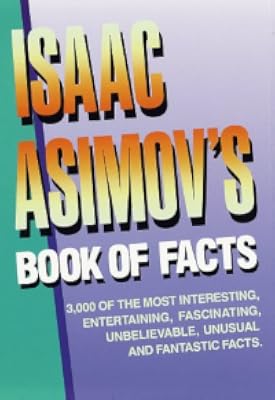
Isaac Asimov's Book of Facts
by Isaac Asimov
On This Page
Description
Within the pages ofIsaac Asimov's Book of Factsare many hours of entertaining and informative reading—little-known facts that will make you exclaim, time and again, "I didn't know that!" Here are some of the intriguing facts you will find in this book: -Emperor Caligula appointed his favorite horse as a consul of Rome. -Eskimos use refrigerators to keep food from freezing. -For distances of up to 150 feet, an alligator can outrace a man. -In 1896, two men rowed across the Atlantic. -The show more number of possible ways of playing just the first four moves on each side in a game of chess is 318,979,564,000. -Jimmy Carter was the first U.S. president to be born in a hospital. show lessTags
Recommendations















Member Reviews
Isaac Asimov, the science-fiction writer who also happened to be one of the most widely educated men of our times, has written dozens of fascinating books on technical, scientific, and historical topics. Here, in this large volume of what is essentially fascinating bits of trivia, he distills the essence of many of those works in a delightful candy store of cool things to know that, probably, most of us didn't know before. It's less a book for reading in bed or on the beach and more one for reading in a room full of plumbing. One can pick it up and put it down a minute later and feel one has gained by the experience. It took me several years to work through it, and I was sorry when it ended. I recommend it.
A bunch of widely varied, and in some cases, wildly out of date facts here from Asimov. I particularly like his confident declaration that the Channel Tunnel will never be constructed.
I enjoy reading books filled with sorted or random facts and lists. Check out my library. I have an assortment. Not sure if Isaac Asimov really had his fingers in the selection of the book's content. However, the reading is actually pretty interesting. Some repeated information from other books, but mostly fresh material (for a book published in 1979).
I'm a sucker for trivia and this is my favorite book of all time. Even though Mr. Asimov has moved on from this reality, I wish there was some kind of update for this book. Maybe there is and I don't know about it.
Always remember and never forget - what happens when an irresistible force meets an immovable object.
Always remember and never forget - what happens when an irresistible force meets an immovable object.
Loved this as a young teenager. Don't know why my mother bought it for me, must have been free or on sale somewhere, but I loved it.
Ratings
Members
- Recently Added By
Author Information

2,396+ Works 292,724 Members
Isaac Asimov was born in Petrovichi, Russia, on January 2, 1920. His family emigrated to the United States in 1923 and settled in Brooklyn, New York, where they owned and operated a candy store. Asimov became a naturalized U.S. citizen at the age of eight. As a youngster he discovered his talent for writing, producing his first original fiction at show more the age of eleven. He went on to become one of the world's most prolific writers, publishing nearly 500 books in his lifetime. Asimov was not only a writer; he also was a biochemist and an educator. He studied chemistry at Columbia University, earning a B.S., M.A. and Ph.D. In 1951, Asimov accepted a position as an instructor of biochemistry at Boston University's School of Medicine even though he had no practical experience in the field. His exceptional intelligence enabled him to master new systems rapidly, and he soon became a successful and distinguished professor at Columbia and even co-authored a biochemistry textbook within a few years. Asimov won numerous awards and honors for his books and stories, and he is considered to be a leading writer of the Golden Age of science fiction. While he did not invent science fiction, he helped to legitimize it by adding the narrative structure that had been missing from the traditional science fiction books of the period. He also introduced several innovative concepts, including the thematic concern for technological progress and its impact on humanity. Asimov is probably best known for his Foundation series, which includes Foundation, Foundation and Empire, and Second Foundation. In 1966, this trilogy won the Hugo award for best all-time science fiction series. In 1983, Asimov wrote an additional Foundation novel, Foundation's Edge, which won the Hugo for best novel of that year. Asimov also wrote a series of robot books that included I, Robot, and eventually he tied the two series together. He won three additional Hugos, including one awarded posthumously for the best non-fiction book of 1995, I. Asimov. "Nightfall" was chosen the best science fiction story of all time by the Science Fiction Writers of America. In 1979, Asimov wrote his autobiography, In Memory Yet Green. He continued writing until just a few years before his death from heart and kidney failure on April 6, 1992. (Bowker Author Biography) show less
Some Editions
Awards and Honors
Common Knowledge
- Original title
- Isaac Asimov's Book of Facts
- Original publication date
- 1979; 1992 (Hastings House edition) (Hastings House edition)
- Important places
- Chunkybuttfunky
- First words
- I've always been slightly drunk with facts, and almost all of my more than two hundred books have dealt, at least incidentally, with facts.
Classifications
- Genres
- Reference, Nonfiction, General Nonfiction, Science & Nature
- DDC/MDS
- 031.02 — Computer science, information & general works Encyclopedias & books of facts Guiness Records, Ripley's Believe It or Not Miscellanies and Factbooks
- LCC
- AG6 .A84 — General Works Dictionaries and other general reference works Dictionaries and other general reference works
- BISAC
Statistics
- Members
- 512
- Popularity
- 58,440
- Reviews
- 6
- Rating
- (3.91)
- Languages
- 5 — English, German, Portuguese, Spanish, Swedish
- Media
- Paper
- ISBNs
- 17
- ASINs
- 8