On This Page
Description
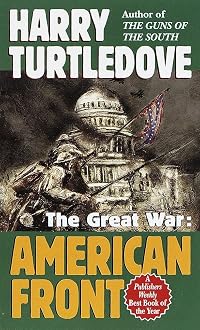
Harry Turtledove is the master of alternate history. In American Front he envisions World War I as it may have been if fought on American soil. The United States and Germany clash with the Confederacy, France, and Britain as the machines of modern warfare litter the landscape with carnage. Meanwhile, oppressed southern blacks head toward a fateful confrontation.Tags
Recommendations







Member Reviews
I will admit to having this book and its successor on my shelves at one point in time.
I will not concede to finding anything of value in this book, other than an interesting premise and set-up that includes the idea of "the South won a particular battle in the American Civil War and as a result there are three nations on the Northern American continent: Canada, the United States, and the Confederate States."
I question the pages of continual racial slurs Turtledove writes and his need to continuously mention that African Americans were not seen as fully human at the time of the Great War. Neither were poor white men, or women, or Native peoples, and yet their stories are told with "women get dinner on the table for their menfolk" with show more no sexist dialogue, inner turmoil, or similar verbal assaults. Page after page of racial slurs unbalanced by any other group's similar slurs is less historical fiction and more racially-charged opinion. show less
I will not concede to finding anything of value in this book, other than an interesting premise and set-up that includes the idea of "the South won a particular battle in the American Civil War and as a result there are three nations on the Northern American continent: Canada, the United States, and the Confederate States."
I question the pages of continual racial slurs Turtledove writes and his need to continuously mention that African Americans were not seen as fully human at the time of the Great War. Neither were poor white men, or women, or Native peoples, and yet their stories are told with "women get dinner on the table for their menfolk" with show more no sexist dialogue, inner turmoil, or similar verbal assaults. Page after page of racial slurs unbalanced by any other group's similar slurs is less historical fiction and more racially-charged opinion. show less
My reaction to reading this novel in 1999. Spoilers follow.
Turtledove uses his usual technique of a multitude of characters to provide a variety of views in this novel about the American front of an alternate WWI. This technique, with its rapid alternation between viewpoint characters, makes this thick book read fast, but I had a few quibbles.
First, with the exception of Woodrow Wilson, George Armstrong Custer, Theodore Roosevelt (Wilson and Roosevelt are presidents of the Confederacy and USA, respectively), and Leonard Wood – all briefly glimpsed and none viewpoint characters – we see no historical characters, just fictional ones. Some of the internal dialogue of characters verges close, but doesn't cross the line, of excessive show more folksiness. Also, we get few scenes of combat and then those scenes are not that detailed. Also, we get no viewpoint characters who are combatants from European powers.
Still, Turtledove uses his characters well to show most aspects of the war (including the scenes of Cherokees, solid members of the CSA, fighting with Confederate officers) and not just naval and land and air combat but the various ways civilians react including sabotage, espionage, and collaboration when conquered. But the most powerful and disturbing bits are the visions of a USA, under the influence of its German ally (it’s amusing to hear Roosevelt’s support of German culture given our history), become, since the Second War Between the States, a bureaucratic, paper-laden tyranny. Second is the influence of Marxism in both the US and CSA. In How Few Remain, Lincoln spread the word of Marx and, it’s revealed here, his actions ultimately lead to the socialists splitting off from the Republicans. They have to decide, in typical Marxist fashion, that Britain and France ae more reactionary than the Kaiser. In the CSA, slaves and Southern factory workers in the aristocratic South (the most dislikeable character is a rich Southern belle named Anne Colleton) understandably embrace Marxism, and the novel ends with the beginning of an armed black uprising. show less
Turtledove uses his usual technique of a multitude of characters to provide a variety of views in this novel about the American front of an alternate WWI. This technique, with its rapid alternation between viewpoint characters, makes this thick book read fast, but I had a few quibbles.
First, with the exception of Woodrow Wilson, George Armstrong Custer, Theodore Roosevelt (Wilson and Roosevelt are presidents of the Confederacy and USA, respectively), and Leonard Wood – all briefly glimpsed and none viewpoint characters – we see no historical characters, just fictional ones. Some of the internal dialogue of characters verges close, but doesn't cross the line, of excessive show more folksiness. Also, we get few scenes of combat and then those scenes are not that detailed. Also, we get no viewpoint characters who are combatants from European powers.
Still, Turtledove uses his characters well to show most aspects of the war (including the scenes of Cherokees, solid members of the CSA, fighting with Confederate officers) and not just naval and land and air combat but the various ways civilians react including sabotage, espionage, and collaboration when conquered. But the most powerful and disturbing bits are the visions of a USA, under the influence of its German ally (it’s amusing to hear Roosevelt’s support of German culture given our history), become, since the Second War Between the States, a bureaucratic, paper-laden tyranny. Second is the influence of Marxism in both the US and CSA. In How Few Remain, Lincoln spread the word of Marx and, it’s revealed here, his actions ultimately lead to the socialists splitting off from the Republicans. They have to decide, in typical Marxist fashion, that Britain and France ae more reactionary than the Kaiser. In the CSA, slaves and Southern factory workers in the aristocratic South (the most dislikeable character is a rich Southern belle named Anne Colleton) understandably embrace Marxism, and the novel ends with the beginning of an armed black uprising. show less
Alternate history novels based on a Confederate victory in the Civil War are not new, in fact Harry Turtledove has stated that his inspiration this Great War series came from a magazine article written by MacKinlay Kantor. What sets The Great War: American Front apart is its scope.
Half the fun of alternate history fiction is the intellectual exercise of wondering how life would be different if something in the past has changed. Here, in light of the CSA victory related in the previous novel, "How Few Remain", the CSA is a stalwart ally of France and England while the twice humiliated and isolated USA is surrounded by hostile nations to the north and south and has turned to Imperial Germany for support. Naturally, when Archduke Franz show more Ferdinand is assassinated North America is immediately thrown into conflict, Presidents Teddy Roosevelt of the US and Woodrow Wilson of the CS quickly declare war. There is no long period of isolationism that protected the intact United States in our history. Turtledove is very erudite in theorizing how the cultures of the two Americas has changed and adapted based on their two diverging roads, from the dashing French flair of the Rebel cavalry officers to the German inspired General Staff, mandatory conscription, and industrial might of the Yankee war machine.
But this story has drama as well. Turtledove brings us dozens of narratives from nearly every faction involved in the North American conflict. Some readers may have trouble keeping track of the broad panorama. Fortunately there is a Turtledove Wiki out there that can help. I admire the way he refuses to choose sides in this conflict; this is not wish fulfillment fiction. He makes an effort to make both sides of the conflict ugly and brutal; this is NOT an alternate reality you want to live in. For example, he makes it clear that many of the Yankees are just as racist as the Southerners, perhaps more so because so few blacks live in this USA, and because of resentments over loosing the War of Secession. I doubt that it would really be as bad as he makes it out to be; the abolitionist movements was going strong back in the 1860’s and was of such religious fervor that I doubt it would just dry up after loosing the war.
Yet at the same time you find sympathetic characters on all sides. I found myself worrying about the young married couple down in Birmingham just as I felt for the Boston fisherman and his family. The two groups that are perhaps the most sympathetic are the Canadian families (one group in Manitoba and another in Quebec) who must find ways to survive under a brutal occupation by the US Army. The characters are of many backgrounds, races, and political persuasions. Being that I am fascinated by this time period of our history, I found this to be very gripping and immersive. The ending will certainly leave you hanging, mostly because this is just the first book in a three-novel story arc that is part of an overall eleven novel series. If you have the patience and perseverance you will be rewarded by a richly plotted and imagined story an America ripped apart by war. show less
Half the fun of alternate history fiction is the intellectual exercise of wondering how life would be different if something in the past has changed. Here, in light of the CSA victory related in the previous novel, "How Few Remain", the CSA is a stalwart ally of France and England while the twice humiliated and isolated USA is surrounded by hostile nations to the north and south and has turned to Imperial Germany for support. Naturally, when Archduke Franz show more Ferdinand is assassinated North America is immediately thrown into conflict, Presidents Teddy Roosevelt of the US and Woodrow Wilson of the CS quickly declare war. There is no long period of isolationism that protected the intact United States in our history. Turtledove is very erudite in theorizing how the cultures of the two Americas has changed and adapted based on their two diverging roads, from the dashing French flair of the Rebel cavalry officers to the German inspired General Staff, mandatory conscription, and industrial might of the Yankee war machine.
But this story has drama as well. Turtledove brings us dozens of narratives from nearly every faction involved in the North American conflict. Some readers may have trouble keeping track of the broad panorama. Fortunately there is a Turtledove Wiki out there that can help. I admire the way he refuses to choose sides in this conflict; this is not wish fulfillment fiction. He makes an effort to make both sides of the conflict ugly and brutal; this is NOT an alternate reality you want to live in. For example, he makes it clear that many of the Yankees are just as racist as the Southerners, perhaps more so because so few blacks live in this USA, and because of resentments over loosing the War of Secession. I doubt that it would really be as bad as he makes it out to be; the abolitionist movements was going strong back in the 1860’s and was of such religious fervor that I doubt it would just dry up after loosing the war.
Yet at the same time you find sympathetic characters on all sides. I found myself worrying about the young married couple down in Birmingham just as I felt for the Boston fisherman and his family. The two groups that are perhaps the most sympathetic are the Canadian families (one group in Manitoba and another in Quebec) who must find ways to survive under a brutal occupation by the US Army. The characters are of many backgrounds, races, and political persuasions. Being that I am fascinated by this time period of our history, I found this to be very gripping and immersive. The ending will certainly leave you hanging, mostly because this is just the first book in a three-novel story arc that is part of an overall eleven novel series. If you have the patience and perseverance you will be rewarded by a richly plotted and imagined story an America ripped apart by war. show less
An interesting (or horrifying) alternate history novel about World War 1. Set after the events of How Few Remain, this book tells the tale of a house divided during the Great War. The beginning explains how the CSA has won secession from the Union with the help from the United Kingdom. What remains of the USA allies itself with Kaiser's Germany in World War 1 in an effort to destabilize the British Empire and reclaim the southern states. The book carries on with a host of characters that have to deal with the horrors of trench warfare as the US and the CS duke it out in another great war.
Read if you like How Few Remain.
Read if you like How Few Remain.
Some of the ideas here are interesting, but the writing is clunky and the pacing is absolutely glacial. There are too many characters for any of them to get all that much development.
I read "Guns of the South" first and was intrigued, so I read "How Few Remain". The concept is fascinating. The South wins the Civil War and the former United States remains permanently divided into 2 nations: the CSA and the USA. Following the War of Rebellion, a constant state of hostility exists between the CSA and the USA. In "American Front", the CSA and USA are on opposite sides of the Great War and North America sees the same horrors of trench warfare as Europe. My main complaint is that the author introduces too many characters and jumps frequently from one set of characters to another and from one venue to another. There's no opportunity to know the characters very well and care about them, and they seem cartoonish and show more one-dimensional. "Guns of the South" is a much better read. show less
There are plenty alternate history tales based on the South winning the Civil War. The ones I have read usually deal with thus and such battle or focus on the war itself. This book, however, looks at what might have happened fifty years later. The year is 1914. Archduke Ferdinand has been assassinated in Sarajevo, and the nations of Europe are busy declaring war on each other. The Confederate States of America honors it's alliance with England and France and declares war on the Central Powers. Unfortunately, its northern neighbor has an allaince with Germany, making it one of those Central Powers. So World War I comes to North America and the book follows its progress, if you could call it that. Mr. Turtledove tells the tale through show more vignettes of ordinary people--soldiers and civilians, Northerners and Southerners. It's a great panorama, as disparate people are slowly drawn together and the book reaches its climax. Unfortunately, the climax, while it wraps up some of the stories, doesn't bring the end of the war itself. That's good for Mr. Turtledove, since I now have an interest in reading the book's sequel. Ah, well. Until then, I'll just have to keep this one on my shelf.
--J. show less
--J. show less
Members
- Recently Added By
Author Information

279+ Works 43,221 Members
Harry Turtledove was born in Los Angeles, California on June 14, 1949. He received a Ph.D. in Byzantine history from UCLA in 1977. From the late 1970's to the early 1980's, he worked as a technical writer for the Los Angeles County Office of Education. He left in 1991 to become full-time writer. His first two novels, Wereblood and Werenight, were show more published in 1979 under the pseudonym Eric G. Iverson because his editor did not think people would believe that Turtledove was his real name. He used this name until 1985 when he published Herbig-Haro and And So to Bed under his real name. He has received numerous awards including the Homer Award for Short Story for Designated Hitter in 1990, the John Esthen Cook Award for Southern Fiction for Guns of the Southand in 1993, and the Hugo Award for Novella for Down in the Bottomlands in 1994. (Bowker Author Biography) show less
Series


Common Knowledge
- Canonical title
- The Great War: American Front
- Original publication date
- 1999-05-01 (1st ed Mass Market) (1st ed Mass Market); 1998-05-12 (1st ed Hardcover) (1st ed Hardcover)
Classifications
Statistics
- Members
- 1,115
- Popularity
- 22,847
- Reviews
- 14
- Rating
- (3.47)
- Languages
- English, French
- Media
- Paper, Audiobook, Ebook
- ISBNs
- 13
- ASINs
- 6