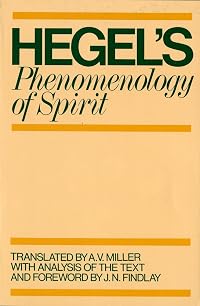
The Phenomenology of Mind
by Georg Wilhelm Friedrich Hegel
On This Page
Description
"The Phenomenology of Spirit, first published in 1807, is G. W. F. Hegel's remarkable philosophical text that examines the dynamics of human experience from its simplest beginnings in consciousness through its development into ever more complex and self-conscious forms. The work explores the inner discovery of reason and its progressive expansion into spirit, a world of intercommunicating and interacting minds reconceiving and re-creating themselves and their reality. The Phenomenology of show more Spirit is a notoriously challenging and arduous text that students and scholars have been studying ever since its publication. In this long-awaited translation, Peter Fuss and John Dobbins provide a succinct, highly informative, and readily comprehensible introduction to several key concepts in Hegel's thinking. This edition includes an extensive conceptual index, which offers easy reference to specific discussions in the text and elucidates the more subtle nuances of Hegel's concepts and word usage. This modern American English translation employs natural idioms that accurately convey what Hegel means. Throughout the book, the translators adhered to the maxim: if you want to understand Hegel, read him in the English. This book is intended for intellectuals with a vested interest in modern philosophy and history, as well as students of all levels, seeking to access or further engage with this seminal text"-- show lessTags
Recommendations












Member Recommendations
Member Reviews
This is the third translation of the Phenomenology that I’ve read, starting with Baillie’s translation (which dates back to 1910), then the Miller translation from 1977, and now this new one from Terry Pinkard. No translation will make the Phenomenology readable. There’s actually something to be said for reading multiple translations, to get more perspectives on what Hegel is doing.
What makes the Phenomenology hard is, at its core, the revolution that Hegel is attempting in philosophy, both in philosophical method and in the philosophical positions he takes.
I wouldn’t deny either that Hegel just was not a writer with understandability at the top of his priorities. The Phenomenology in particular reads as if it were written as show more much for self-clarification as for communication. This stands to reason, given that this was Hegel’s first major philosophical work, written when his thought was very much still in formation.
Hegel is inventing a new philosophical method. Even in Plato’s dialogues, often characterized as “dialectical” in method, a question is taken up, a position (or more than one) examined, objections raised, refinements made and/or a new position proposed, and a result presented. With the Phenomenology, Hegel superficially does something similar. He undertakes one motivating question: what is knowledge? And he examines innumerable positions, historically taken, finding each lacking or failing, but each leading to the next, which is also found to be lacking or failing, but leading again to another. It is the entire “movement” from initial position to ultimate position that is the argument.
His method presents a philosophical position as an outcome. “Wrong” positions are part of the process of reaching each new position. As far as I’m aware, Hegel is the first to place historical genealogy at the heart of philosophical thinking — no philosophical position is what it is outside the context of its historical genealogy.
That method has implications not just for philosophical thought, but for what thinking and knowledge themselves are, and for the very nature of conceptual thinking entirely. Thought and rationality, from Hegel’s perspective, are inherently socio-historical in nature. To say that everyone is a product of their age is a superficiality that covers an important Hegelian insight — not a simple relativistic one, but one that does volatilize and historicize concepts and standards of argument, presaging modern debates on conceptual schemes, constructivism, scientific revolutions, and the nature of meaning.
For Hegel himself, the stages or “moments” of the development of knowledge are a progression, not a wandering from historical era to era or an unordered jumble.
That sense of order is, I think, a key to understanding why Hegel’s actual position, which is often oversimplified as “rationalist” or “idealist,” is itself so revolutionary.
No actual position taken by a philosopher is really simple. But Hegel’s idealism stands out from the crowd. Idealism can be construed as a relatively straightforward metaphysical claim that reality is made up of some sort of mental stuff — a world constructed of thoughts or ideas. As an epistemological position, idealism can leave the metaphysical question of what the world in itself is ultimately composed of open. Kant arguably does this, with an account of knowledge as knowledge of a world formed by rational cognition, but any world of “things-in-themselves” outside the reach of understanding.
Hegel’s own idealism brings another level of complexity altogether, I think. What is most distinctive is that, for Hegel, idealism is something that has to be achieved — it isn’t simply “true.”
The Phenomenology begins with a naive account of knowledge as “Sensuous-Certainty” (in Pinkard’s translation). “Sensuous-Certainty” is a kind of simple model of knowing, a philosophical position but also a stage in the evolution of what knowing is, that doesn’t stand up to scrutiny. Its failure to stand up isn’t the result (again referring to Hegel’s method) of holding up an independent standard of validity against the position and finding it lacking. It fails to stand up to its own tests — it doesn’t make the kind of sense of knowledge that it tries to make. It collapses.
To advance beyond that collapse, knowledge as “Sensuous Certainty” has to evolve. And this pattern of movement from stage to stage, of the “shapes” that knowledge takes, repeats. Each stage develops in response and in continuity with the previous stage, and each tests itself, only to find itself lacking but leading on to the next stage, the next shape that knowing takes.
That’s the sense in which I think that idealism, as an epistemological position in the Phenomenology, has to achieve itself. Knowledge must change and evolve to the point at which it becomes possible. Knowing must become something that, borrowing an Hegelian term, is “adequate” to its object. And this adequacy itself it not so different from a Kantian-inspired insight that for the world to be intelligible to us, it must be made intelligible by and for us. In rough Hegelian jargon, knowing must recognize itself in its object.
Just about the first half of the Phenomenology is that evolution of what knowing is, and it progresses towards Hegel’s nuanced idealist epistemology. But then Hegel makes an interesting turn. Pinkard, in his Introduction, calls attention to this turn, even saying that Hegel appears to have thought the work complete before making it but then deciding otherwise.
The succeeding parts of the book are much more tied to historical periods and events than the previous ones. In the previous sections we could recognize, often explicitly by name, philosophical positions taken in historical contexts, e.g.., stoicism. But now entire historical periods step onto the stage — the Enlightenment, the French Revolution, . . .
I think that this turn is part of another distinctive sense in which Hegel’s idealism is something that must be achieved. Knowing, in Hegel’s epistemological idealism, has become knowledge of the knower itself, us. In making knowledge of ourselves adequate to ourselves, we undertake the task of making knowledge of ourselves knowledge of ourselves as we really are, as opposed to misperceptions or misrepresentations of ourselves. To do so requires that we square ourselves and the world we create around us with an adequate conception of ourselves.
Trying to shed at least some of the awkward, jargony dressing, Hegel’s epistemology has joined the knower and the object of knowing together — to reach knowledge of the world, the knower must recognize himself in the world. This world contains both the world of nature — familiar objects — and the world that is explicitly of human making — the world of morality, politics, art, and religion. In order for us, the knowers, to recognize ourselves in that human-made world, that human-made world must adequately reflect us.
If you’re still following my tortured reconstruction, you can understand why then Hegel takes us on a journey through an evolution of the human-made world. Each stage now takes us through a self-understanding, as embodied in the social-political-moral world, that again stands or falls on its own. These self-understandings are not just thoughts per se but actual historical stages in which we, historically, build those social-political-moral worlds — doing so is our attempt to understand ourselves, and, to put it in terms that draw Hegel closer to the existentialists who come after him, become ourselves.
The Phenomenology thus becomes something much bigger and more ambitious than it looked like it was going to be, and probably bigger and more ambitious than Hegel had initially planned. We set out with the question, what is knowledge? And we were led to a theory of human history, morality, politics, art, and religion. What had been an “introduction” to a philosophical system looks like a system in itself.
I can’t pretend to do justice to Hegel — the Phenomenology is difficult to understand, but rewarding to try. Hopefully, on reading Pinkard’s translation, my review might be helpful.
I won’t try to evaluate Pinkard’s translation as a translation. That would be pretty arrogant, in my own case. I do think that every translation, including Baillie’s, is helpful. Each gives you some sometimes subtly different views on what Hegel is saying, and in the case of the Phenomenology in particular, it’s probably more helpful to get multiple provocations to explore what Hegel is thinking than it is to strive after something definitive. show less
What makes the Phenomenology hard is, at its core, the revolution that Hegel is attempting in philosophy, both in philosophical method and in the philosophical positions he takes.
I wouldn’t deny either that Hegel just was not a writer with understandability at the top of his priorities. The Phenomenology in particular reads as if it were written as show more much for self-clarification as for communication. This stands to reason, given that this was Hegel’s first major philosophical work, written when his thought was very much still in formation.
Hegel is inventing a new philosophical method. Even in Plato’s dialogues, often characterized as “dialectical” in method, a question is taken up, a position (or more than one) examined, objections raised, refinements made and/or a new position proposed, and a result presented. With the Phenomenology, Hegel superficially does something similar. He undertakes one motivating question: what is knowledge? And he examines innumerable positions, historically taken, finding each lacking or failing, but each leading to the next, which is also found to be lacking or failing, but leading again to another. It is the entire “movement” from initial position to ultimate position that is the argument.
His method presents a philosophical position as an outcome. “Wrong” positions are part of the process of reaching each new position. As far as I’m aware, Hegel is the first to place historical genealogy at the heart of philosophical thinking — no philosophical position is what it is outside the context of its historical genealogy.
That method has implications not just for philosophical thought, but for what thinking and knowledge themselves are, and for the very nature of conceptual thinking entirely. Thought and rationality, from Hegel’s perspective, are inherently socio-historical in nature. To say that everyone is a product of their age is a superficiality that covers an important Hegelian insight — not a simple relativistic one, but one that does volatilize and historicize concepts and standards of argument, presaging modern debates on conceptual schemes, constructivism, scientific revolutions, and the nature of meaning.
For Hegel himself, the stages or “moments” of the development of knowledge are a progression, not a wandering from historical era to era or an unordered jumble.
That sense of order is, I think, a key to understanding why Hegel’s actual position, which is often oversimplified as “rationalist” or “idealist,” is itself so revolutionary.
No actual position taken by a philosopher is really simple. But Hegel’s idealism stands out from the crowd. Idealism can be construed as a relatively straightforward metaphysical claim that reality is made up of some sort of mental stuff — a world constructed of thoughts or ideas. As an epistemological position, idealism can leave the metaphysical question of what the world in itself is ultimately composed of open. Kant arguably does this, with an account of knowledge as knowledge of a world formed by rational cognition, but any world of “things-in-themselves” outside the reach of understanding.
Hegel’s own idealism brings another level of complexity altogether, I think. What is most distinctive is that, for Hegel, idealism is something that has to be achieved — it isn’t simply “true.”
The Phenomenology begins with a naive account of knowledge as “Sensuous-Certainty” (in Pinkard’s translation). “Sensuous-Certainty” is a kind of simple model of knowing, a philosophical position but also a stage in the evolution of what knowing is, that doesn’t stand up to scrutiny. Its failure to stand up isn’t the result (again referring to Hegel’s method) of holding up an independent standard of validity against the position and finding it lacking. It fails to stand up to its own tests — it doesn’t make the kind of sense of knowledge that it tries to make. It collapses.
To advance beyond that collapse, knowledge as “Sensuous Certainty” has to evolve. And this pattern of movement from stage to stage, of the “shapes” that knowledge takes, repeats. Each stage develops in response and in continuity with the previous stage, and each tests itself, only to find itself lacking but leading on to the next stage, the next shape that knowing takes.
That’s the sense in which I think that idealism, as an epistemological position in the Phenomenology, has to achieve itself. Knowledge must change and evolve to the point at which it becomes possible. Knowing must become something that, borrowing an Hegelian term, is “adequate” to its object. And this adequacy itself it not so different from a Kantian-inspired insight that for the world to be intelligible to us, it must be made intelligible by and for us. In rough Hegelian jargon, knowing must recognize itself in its object.
Just about the first half of the Phenomenology is that evolution of what knowing is, and it progresses towards Hegel’s nuanced idealist epistemology. But then Hegel makes an interesting turn. Pinkard, in his Introduction, calls attention to this turn, even saying that Hegel appears to have thought the work complete before making it but then deciding otherwise.
The succeeding parts of the book are much more tied to historical periods and events than the previous ones. In the previous sections we could recognize, often explicitly by name, philosophical positions taken in historical contexts, e.g.., stoicism. But now entire historical periods step onto the stage — the Enlightenment, the French Revolution, . . .
I think that this turn is part of another distinctive sense in which Hegel’s idealism is something that must be achieved. Knowing, in Hegel’s epistemological idealism, has become knowledge of the knower itself, us. In making knowledge of ourselves adequate to ourselves, we undertake the task of making knowledge of ourselves knowledge of ourselves as we really are, as opposed to misperceptions or misrepresentations of ourselves. To do so requires that we square ourselves and the world we create around us with an adequate conception of ourselves.
Trying to shed at least some of the awkward, jargony dressing, Hegel’s epistemology has joined the knower and the object of knowing together — to reach knowledge of the world, the knower must recognize himself in the world. This world contains both the world of nature — familiar objects — and the world that is explicitly of human making — the world of morality, politics, art, and religion. In order for us, the knowers, to recognize ourselves in that human-made world, that human-made world must adequately reflect us.
If you’re still following my tortured reconstruction, you can understand why then Hegel takes us on a journey through an evolution of the human-made world. Each stage now takes us through a self-understanding, as embodied in the social-political-moral world, that again stands or falls on its own. These self-understandings are not just thoughts per se but actual historical stages in which we, historically, build those social-political-moral worlds — doing so is our attempt to understand ourselves, and, to put it in terms that draw Hegel closer to the existentialists who come after him, become ourselves.
The Phenomenology thus becomes something much bigger and more ambitious than it looked like it was going to be, and probably bigger and more ambitious than Hegel had initially planned. We set out with the question, what is knowledge? And we were led to a theory of human history, morality, politics, art, and religion. What had been an “introduction” to a philosophical system looks like a system in itself.
I can’t pretend to do justice to Hegel — the Phenomenology is difficult to understand, but rewarding to try. Hopefully, on reading Pinkard’s translation, my review might be helpful.
I won’t try to evaluate Pinkard’s translation as a translation. That would be pretty arrogant, in my own case. I do think that every translation, including Baillie’s, is helpful. Each gives you some sometimes subtly different views on what Hegel is saying, and in the case of the Phenomenology in particular, it’s probably more helpful to get multiple provocations to explore what Hegel is thinking than it is to strive after something definitive. show less
It’s hard to judge a translation of The Phenomenology. Did I understand better? Well, it’s almost as if every time I read the book, it’s the first time. So much strikes me as new and impenetrable. Every time I read it the scope of my not-understanding shifts. Maybe it decreases, but maybe I just come to understand that there’s more that I don’t understand.
Since this is the latest translation of the book, I read it from the standpoint of translation, although it’s impossible, for me at least, not to be drawn into re-thinking my understanding of Hegel’s project here. I’ll talk about that first, and then I’ll get to some comments about the translation.
What is Hegel’s core insight in The Phenomenology? I think his show more insight comes in response to the same question that motivated Kant’s thought — how is it that we (subjects) understand a world (objects) that, at least at first pass, appears utterly different from us? Why is the way in which we understand and “know” reality successful, given the world’s apparently utter otherness?
And, famously, for Kant the answer was that we supply the conditions of the world’s knowability — the structures, if we can accept that unKantian word — that tie perceptions into coherent, intelligible experience.
Hegel’s insight takes Kant’s answer much farther. The world is knowable because it is not alien to us, because what it is, its intelligible structure, is exactly the structure of human reason. But not, as for Kant, as something contributed by a knowing subject to the world, rather as something constitutive of the world itself. The world simply IS rational, whereas for Kant it was (merely) experienced as rational.
For Kant, that implied a leftover that wasn’t knowable — the world as “thing-in-itself,” independently of the conditions of knowledge provided by knowing subjects becomes something outside the knowable, in fact entirely unintelligible.
For Hegel, there is no leftover, no world as “thing-in-itself” to be contrasted with the knowable world, since the conditions of knowledge inhere in the world itself.
This line of argument certainly makes Hegel an “idealist” in some sense, in that the stuff of mind and the stuff of the world are one and the same — the world is “ideal” in that it is made of the same stuff as the knower.
But Hegel’s idealism isn’t so simple. This is where one of Hegel’s unique contributions comes into play — his historicism. The knower must become a knower — knowing isn’t simply given to us. And hence in the early chapters of The Phenomenology, we see an evolving conception of knowledge in action. Knowing fails, and it evolves itself in its failures.
In the succeeding chapters, this evolving conception of knowledge becomes truly historical, in that it must test itself against the world of its own making — the human world of communities, cultures, religions, sciences, and politics. In that evolution, both sides evolve, as the knower evolves both what knowing is and the (human) reality that it knows.
“Absolute Knowing” then at the end of the process presents us with both an evolved sense of what knowing is and an evolved world that is known.
That known world is, despite our classifying Hegel as an “idealist,” fully real, solid, and tangible. This is not Berkeley’s idealism, or even Fichte’s (as Hegel often implicitly points out). What has happened is that each side of knowledge, the knower and the known, has evolved to become fully conformable with the other. As Hegel is commonly quoted, “The real is the rational, and the rational is the real” (see the Preface to Hegel’s The Philosophy of Right for the quote).
A very interesting and provocative takeaway from Hegel’s treatment of knowledge in The Phenomenology (particularly in the Preface) is, to put it in catchy Hegel-ish style, all knowledge is also theory of knowledge — in the sense that knowing something requires knowing what the activity of knowing that something is. This is in fact the task he puts before himself in The Phenomenology — to in Hegelian terms, make knowledge adequate to its object.
Hegel contrasts knowing as “external” to its object with what he calls “science.” Knowing as external to its object is an application of something (a measuring device, a categorization scheme, or even rules of inference or calculation) to the object. Knowing a thing as “science” begins with the discovery of what it is to know such a thing as it comes to be itself and builds knowledge in accordance with what it is to know such a thing.
For example, world history might be “known” any number of ways. You can count centuries, list populations, categorize events, etc. Or, more preferably, you could begin with an investigation of what historical knowledge is, how someone in the present apprehends something in the past at all, and then build a knowledge of the past on that basis.
Knowing world history as “science” (for Hegel) means discerning the conceptual movement that world history actually is. This is what he attempts in his own Lectures on the Philosophy of History. There is no accounting there of dates and even little of events as such, but rather an account of the rational, conceptual flow that history follows, in Hegel’s understanding at least.
Okay, that’s enough on the content of Hegel’s thought. I had to do that. But now, the translation.
One problem with translations of Hegel is to decide who you are translating for. Translating for a “Hegel scholar” is one thing, and translating for someone reading the book for the first time is another. The latter is a special problem for Hegel’s work, given its inherent complexity and its uncomfortable style. Reading Hegel for the first time is a climb up a very steep ramp. The question is whether this translation helps.
I think it might. Have a look below at one sentence I chose from the concluding chapter on “Absolute Knowing”. It’s just one sentence, and I’m not a German scholar, but we can use it to illustrate some points.
Here is the German: “Die Bewegung, die Form seines Wissens von sich hervorzutreiben, is die Arbeit, die er als wirkliche Geschichte vollbringt.”
Here is the Fuss and Dobbins translation that I’m reviewing: “The process of advancing the form of its self-knowledge is the work that spirit accomplishes as actual history.”
And here are the available previous translations that I have read (I haven’t read Inwood's translation yet) :
Pinkard — “The movement of propelling forward the form of its self-knowing is the work which spirit accomplishes as actual history.”
Miller — “The movement of carrying forward the form of its self-knowledge is the labour which it accomplishes as actual History.”
Baillie — “The process of carrying forward this form of knowledge of itself is the task which spirit accomplishes as actual History.”
Notice a couple of things. While German word order just doesn’t transfer to English, Fuss and Dobbins did their best to transform Hegel’s chunky style into a relatively simple English sentence. For example, they translate “hervorzutreiben” simply as “advancing.” The other three attempt to render the word in a way that retains some of the nuance of the term’s components but that becomes awkward — “carrying forward” or “propelling forward.” From a scholarly perspective, Fuss and Dobbins may be letting something drop from the term, but they do, I think, make the overall sentence more readable.
Notice also that Fuss and Dobbins don’t mess with the typically Hegelian construction, “die Form seines Wissens von sich.” That would be sacrilege, as well as probably misleading to a student of Hegel. In fact, all four translations follow a pretty literal read.
It’s interesting that Pinkard here and elsewhere indulges a more dynamic way of speaking, using the present participle “knowing” for “Wissens” while the others all translate it as a straightforward noun, “knowledge.” He also chooses a more forceful word, “propelling” in translating “hervorzutreiben” than Miller or Baillie.
Okay enough wonkiness. The point is that Fuss and Dobbins do attempt to smooth Hegel out a bit for the reader. It doesn’t make The Phenomenology readable. Nothing could do that and still be The Phenomenology.
Like I said in a review of the Pinkard translation, I think if you are a student of Hegel, it’s worth reading more than one, even all, of the translations, to get various grips on the content.
I’m glad Fuss and Dobbins had their go at it. show less
Since this is the latest translation of the book, I read it from the standpoint of translation, although it’s impossible, for me at least, not to be drawn into re-thinking my understanding of Hegel’s project here. I’ll talk about that first, and then I’ll get to some comments about the translation.
What is Hegel’s core insight in The Phenomenology? I think his show more insight comes in response to the same question that motivated Kant’s thought — how is it that we (subjects) understand a world (objects) that, at least at first pass, appears utterly different from us? Why is the way in which we understand and “know” reality successful, given the world’s apparently utter otherness?
And, famously, for Kant the answer was that we supply the conditions of the world’s knowability — the structures, if we can accept that unKantian word — that tie perceptions into coherent, intelligible experience.
Hegel’s insight takes Kant’s answer much farther. The world is knowable because it is not alien to us, because what it is, its intelligible structure, is exactly the structure of human reason. But not, as for Kant, as something contributed by a knowing subject to the world, rather as something constitutive of the world itself. The world simply IS rational, whereas for Kant it was (merely) experienced as rational.
For Kant, that implied a leftover that wasn’t knowable — the world as “thing-in-itself,” independently of the conditions of knowledge provided by knowing subjects becomes something outside the knowable, in fact entirely unintelligible.
For Hegel, there is no leftover, no world as “thing-in-itself” to be contrasted with the knowable world, since the conditions of knowledge inhere in the world itself.
This line of argument certainly makes Hegel an “idealist” in some sense, in that the stuff of mind and the stuff of the world are one and the same — the world is “ideal” in that it is made of the same stuff as the knower.
But Hegel’s idealism isn’t so simple. This is where one of Hegel’s unique contributions comes into play — his historicism. The knower must become a knower — knowing isn’t simply given to us. And hence in the early chapters of The Phenomenology, we see an evolving conception of knowledge in action. Knowing fails, and it evolves itself in its failures.
In the succeeding chapters, this evolving conception of knowledge becomes truly historical, in that it must test itself against the world of its own making — the human world of communities, cultures, religions, sciences, and politics. In that evolution, both sides evolve, as the knower evolves both what knowing is and the (human) reality that it knows.
“Absolute Knowing” then at the end of the process presents us with both an evolved sense of what knowing is and an evolved world that is known.
That known world is, despite our classifying Hegel as an “idealist,” fully real, solid, and tangible. This is not Berkeley’s idealism, or even Fichte’s (as Hegel often implicitly points out). What has happened is that each side of knowledge, the knower and the known, has evolved to become fully conformable with the other. As Hegel is commonly quoted, “The real is the rational, and the rational is the real” (see the Preface to Hegel’s The Philosophy of Right for the quote).
A very interesting and provocative takeaway from Hegel’s treatment of knowledge in The Phenomenology (particularly in the Preface) is, to put it in catchy Hegel-ish style, all knowledge is also theory of knowledge — in the sense that knowing something requires knowing what the activity of knowing that something is. This is in fact the task he puts before himself in The Phenomenology — to in Hegelian terms, make knowledge adequate to its object.
Hegel contrasts knowing as “external” to its object with what he calls “science.” Knowing as external to its object is an application of something (a measuring device, a categorization scheme, or even rules of inference or calculation) to the object. Knowing a thing as “science” begins with the discovery of what it is to know such a thing as it comes to be itself and builds knowledge in accordance with what it is to know such a thing.
For example, world history might be “known” any number of ways. You can count centuries, list populations, categorize events, etc. Or, more preferably, you could begin with an investigation of what historical knowledge is, how someone in the present apprehends something in the past at all, and then build a knowledge of the past on that basis.
Knowing world history as “science” (for Hegel) means discerning the conceptual movement that world history actually is. This is what he attempts in his own Lectures on the Philosophy of History. There is no accounting there of dates and even little of events as such, but rather an account of the rational, conceptual flow that history follows, in Hegel’s understanding at least.
Okay, that’s enough on the content of Hegel’s thought. I had to do that. But now, the translation.
One problem with translations of Hegel is to decide who you are translating for. Translating for a “Hegel scholar” is one thing, and translating for someone reading the book for the first time is another. The latter is a special problem for Hegel’s work, given its inherent complexity and its uncomfortable style. Reading Hegel for the first time is a climb up a very steep ramp. The question is whether this translation helps.
I think it might. Have a look below at one sentence I chose from the concluding chapter on “Absolute Knowing”. It’s just one sentence, and I’m not a German scholar, but we can use it to illustrate some points.
Here is the German: “Die Bewegung, die Form seines Wissens von sich hervorzutreiben, is die Arbeit, die er als wirkliche Geschichte vollbringt.”
Here is the Fuss and Dobbins translation that I’m reviewing: “The process of advancing the form of its self-knowledge is the work that spirit accomplishes as actual history.”
And here are the available previous translations that I have read (I haven’t read Inwood's translation yet) :
Pinkard — “The movement of propelling forward the form of its self-knowing is the work which spirit accomplishes as actual history.”
Miller — “The movement of carrying forward the form of its self-knowledge is the labour which it accomplishes as actual History.”
Baillie — “The process of carrying forward this form of knowledge of itself is the task which spirit accomplishes as actual History.”
Notice a couple of things. While German word order just doesn’t transfer to English, Fuss and Dobbins did their best to transform Hegel’s chunky style into a relatively simple English sentence. For example, they translate “hervorzutreiben” simply as “advancing.” The other three attempt to render the word in a way that retains some of the nuance of the term’s components but that becomes awkward — “carrying forward” or “propelling forward.” From a scholarly perspective, Fuss and Dobbins may be letting something drop from the term, but they do, I think, make the overall sentence more readable.
Notice also that Fuss and Dobbins don’t mess with the typically Hegelian construction, “die Form seines Wissens von sich.” That would be sacrilege, as well as probably misleading to a student of Hegel. In fact, all four translations follow a pretty literal read.
It’s interesting that Pinkard here and elsewhere indulges a more dynamic way of speaking, using the present participle “knowing” for “Wissens” while the others all translate it as a straightforward noun, “knowledge.” He also chooses a more forceful word, “propelling” in translating “hervorzutreiben” than Miller or Baillie.
Okay enough wonkiness. The point is that Fuss and Dobbins do attempt to smooth Hegel out a bit for the reader. It doesn’t make The Phenomenology readable. Nothing could do that and still be The Phenomenology.
Like I said in a review of the Pinkard translation, I think if you are a student of Hegel, it’s worth reading more than one, even all, of the translations, to get various grips on the content.
I’m glad Fuss and Dobbins had their go at it. show less
So the story goes: I was talking about this critical theory reading group we started with this professor in my department, Alex Dick, and he said something like "well, of course you can't understand Deleuze without reading Hegel" and I happen to have read a little Hegel and said so in an I-resent-the-imputation voice, and he was all "You've read The Phenomenology of Spirit?" And I guess I thought of The Philosophy of History, which I have read--maybe because they both begin with "ph"--and I was all "oh, yeah" and realized my error a second later but did not correct myself. And as part of a general life programme of scrupulous honesty, to punish myself for saying the thing that was not I actually went out and bought The Phenomenology of show more (in my copy) Mind and settled in to read it as a self-flagellation thing.
And flagellation it was. The Philosophy of History had its moments, and if many of them were unintentional comic high art, like his description of Chinese and Indian civilizations, the grim hierarchy and the teeming masses, others had undeniable value. The dialectic, the zeitgeist, world-historical peoples. Even if you think it's a pile of shit the way Hegel expresses these ideas, you can't deny their importance--and I have mellowed a bit as regard the expression, because he was dealing with Plato's problem--trying to come up with analytical language of a sort which did not yet exist.
But as for the present volume, I can't see that there's much to love for utility, or that anyone else has tried to love with the exception of some other philosophers of latter but equal obscurity. And what there might be is totally obscured by this problem of language. We are looking at a hypothetical interplay between two ways of realizing concepts or conceptualizing entities--one potential, unsaturated, a priori, progressive, simple, naive, grounded in (without getting into the subject/object problem) itself; the other actual, overdetermined, realized, complete, complex, ideological, representing itself to itself and the world. That much I get. Discard any terms you find unhelpful. But to tack onto this already overabstracted structure the labels "an sich" and "fuer sich", opaque as anything, and translate each of them with a million different terms and individual terms with both of them in different contexts is just risible, caricature-ready.
The other day I failed to finish my first book, a volume of Hegel criticism. This is not as bad as that; Hegel can put together a sentence, even if you have no idea what it means. But its great project is either almost entirely worthless in itself or is made worthless by presentation (and take a look through my LibraryThing; I have some, though not infinite, tolerance for philosophese and theorese). And there are light moments, like the 25-page digression contra phrenology (Hegel using Hegelian philosophy to combat phrenology is almost too delightful as unintentional self-parody) or the liturgical quality, the hermetic meaninglessness to the incantatory end section on religion and art (although the "Oriental Light" thing will always more make me think of Pynchon's "Kirghiz Light" as, in my paraphrase of Hegel, a transcendent enjoyment of the mysteries of being. But they are too few. I didn't "not finish" this--that is, I looked at every page, and usually even started again after the first time my eyes glazed over (though not usually the second).
Overall, my standing commission of $40 or all the beer you can drink to whoever can make me an ASCII graphic of me giving Hegel the finger still stands, waiting to be claimed. show less
And flagellation it was. The Philosophy of History had its moments, and if many of them were unintentional comic high art, like his description of Chinese and Indian civilizations, the grim hierarchy and the teeming masses, others had undeniable value. The dialectic, the zeitgeist, world-historical peoples. Even if you think it's a pile of shit the way Hegel expresses these ideas, you can't deny their importance--and I have mellowed a bit as regard the expression, because he was dealing with Plato's problem--trying to come up with analytical language of a sort which did not yet exist.
But as for the present volume, I can't see that there's much to love for utility, or that anyone else has tried to love with the exception of some other philosophers of latter but equal obscurity. And what there might be is totally obscured by this problem of language. We are looking at a hypothetical interplay between two ways of realizing concepts or conceptualizing entities--one potential, unsaturated, a priori, progressive, simple, naive, grounded in (without getting into the subject/object problem) itself; the other actual, overdetermined, realized, complete, complex, ideological, representing itself to itself and the world. That much I get. Discard any terms you find unhelpful. But to tack onto this already overabstracted structure the labels "an sich" and "fuer sich", opaque as anything, and translate each of them with a million different terms and individual terms with both of them in different contexts is just risible, caricature-ready.
The other day I failed to finish my first book, a volume of Hegel criticism. This is not as bad as that; Hegel can put together a sentence, even if you have no idea what it means. But its great project is either almost entirely worthless in itself or is made worthless by presentation (and take a look through my LibraryThing; I have some, though not infinite, tolerance for philosophese and theorese). And there are light moments, like the 25-page digression contra phrenology (Hegel using Hegelian philosophy to combat phrenology is almost too delightful as unintentional self-parody) or the liturgical quality, the hermetic meaninglessness to the incantatory end section on religion and art (although the "Oriental Light" thing will always more make me think of Pynchon's "Kirghiz Light" as, in my paraphrase of Hegel, a transcendent enjoyment of the mysteries of being. But they are too few. I didn't "not finish" this--that is, I looked at every page, and usually even started again after the first time my eyes glazed over (though not usually the second).
Overall, my standing commission of $40 or all the beer you can drink to whoever can make me an ASCII graphic of me giving Hegel the finger still stands, waiting to be claimed. show less
There is absolutely no way I can review this work in any meaningful way without writing a book on this book.
In this regard, I'm stuck in Hegel's own back yard, trying to observe a thing, understanding that I cannot fully understand the thing, but postulating anyway, only to revise after new information comes to light, and postulating again, revising again, postulating again, and revising again until I approach the Truth of what he's saying while never quite arriving at the Truth.
So much of what is spoke of in this towering castle of cards is aimed at understanding the Geist, the whole conceptualization of Consciousness. Doing it, he had to work from Kant and build an entire edifice from practically nothing at all.
So, of course, he show more goes in some culturally obvious directions that make modern philosophers cringe. For example, he not only works through the cultural bias angle, but he also goes through the entire Religiosity angle, attempting to divorce spirit from religion and winding up at the point where people can have morals without the Church.
With me so far? Well, that's only two angles among many, and we really need a BIG Venn diagram to work out his entire phenomenology.
Just so you know, this BARELY scratches the surface:
I found myself scratching my head at how dense and obscure it was in all the "In itself"s and wanted to strangle him for the needlessly recursive recapitulations.
And yet, for all the things that I, in my own culturally biased way, dismiss in Hegel as being a blind fool, I can still appreciate WHAT HE ACCOMPLISHED.
He basically formulated a non-working AI template.
Cool, right? He worked from what he believed to be base principles, (religion being one of them, including God as an outside restrictive force,) to build a Mind. Or Spirit. Or Geist. The definition always errs toward the Whole Ball of Wax.
He also got pretty close to nearly formulating a complete formal-logic construct. :)
Of course, it's wrong. But we learned a LOT from Hegel. The Hegelian Dialect is something we all use today, bringing up Thesis and Antithesis, figuring out what went wrong, then doing it all over again until we reach The Truth.
Mad props.
Oh, for you weird fanboys out there, I should mention that while I was reading this, I noticed a very cool thing. Asimov worked out his own formulations of all these same points in Hegel's Phenomenology of Spirit in his Robot books. He explained the questions and anti-questions in a much more enjoyable, if not quite as thorough, way.
My appreciation for Asimov just went through the roof. show less
In this regard, I'm stuck in Hegel's own back yard, trying to observe a thing, understanding that I cannot fully understand the thing, but postulating anyway, only to revise after new information comes to light, and postulating again, revising again, postulating again, and revising again until I approach the Truth of what he's saying while never quite arriving at the Truth.
So much of what is spoke of in this towering castle of cards is aimed at understanding the Geist, the whole conceptualization of Consciousness. Doing it, he had to work from Kant and build an entire edifice from practically nothing at all.
So, of course, he show more goes in some culturally obvious directions that make modern philosophers cringe. For example, he not only works through the cultural bias angle, but he also goes through the entire Religiosity angle, attempting to divorce spirit from religion and winding up at the point where people can have morals without the Church.
With me so far? Well, that's only two angles among many, and we really need a BIG Venn diagram to work out his entire phenomenology.
Just so you know, this BARELY scratches the surface:
I found myself scratching my head at how dense and obscure it was in all the "In itself"s and wanted to strangle him for the needlessly recursive recapitulations.
And yet, for all the things that I, in my own culturally biased way, dismiss in Hegel as being a blind fool, I can still appreciate WHAT HE ACCOMPLISHED.
He basically formulated a non-working AI template.
Cool, right? He worked from what he believed to be base principles, (religion being one of them, including God as an outside restrictive force,) to build a Mind. Or Spirit. Or Geist. The definition always errs toward the Whole Ball of Wax.
He also got pretty close to nearly formulating a complete formal-logic construct. :)
Of course, it's wrong. But we learned a LOT from Hegel. The Hegelian Dialect is something we all use today, bringing up Thesis and Antithesis, figuring out what went wrong, then doing it all over again until we reach The Truth.
Mad props.
Oh, for you weird fanboys out there, I should mention that while I was reading this, I noticed a very cool thing. Asimov worked out his own formulations of all these same points in Hegel's Phenomenology of Spirit in his Robot books. He explained the questions and anti-questions in a much more enjoyable, if not quite as thorough, way.
My appreciation for Asimov just went through the roof. show less
My rating for this book is both more and less than it deserves. To start, Hegel is probably the most difficult of all philosophers to read/understand. I’ve had professors say that Hegel’s Phenomenology is like a phone book from Mars. His influence though as one of the last Western metaphysicians is not to be overlooked, for philosophy is moving in what I would call a backwards progression today. Metaphysics is seeing a resurgence, which is often the result of epistemological dead-lock, and so Hegel offers some warning to that backwards slide. If one takes Wittgenstein’s critique of that which can be conceived from the perspective of language/logic, Hegel is nipped from the very first section in his preliminary discussion of show more Universals.
His is an interesting and insightful piece though – both philosophically and culturally. Though his dialectical method is dubious at best in certain sections (though I am not by far claiming to fully comprehend everything that he speaks of), he has exerted a great influence in social thought. He not only was the springboard for Marx and Engels, but also provided the necessary sociological insights that led to fascist ideology and organicist ideals. As a matter of fact, in social philosophy WWII is sometimes referred to as the war between left wing and right wing Hegelians. I think that there is a rather simple explanation for this. Due to his dialectical method, anyone can so choose to pick the sections which they find support their position, all the while ignoring the evolutionary character of Hegel’s project. The most intimidating section, on lordship and bondage, can be taken in many ways. The part that is often ignored though is its progression into the moral consciousness that was what Hegel supported: the sublation between the opposing moments that find their particular actualization in the individual who confronts absolute Spirit.
Rather than continue on with a cultural analysis here though, my biggest distrust of the Phenomenology of Spirit lies in its lack of determination. Hegel’s goal was essentially to prove that the Kantian noumena and phenomena could in fact co-exist, that we were not separate from the world in-and-of-itself, i.e. that we are not confined to phenomenal reality alone. Yet, given the cultural and individualistic importance/role in the realization of Spirit, we are given very little to go buy in realizing this. It is presented merely as a progression that Spirit alone knows and will find its justification only in its end. He resorts back to an intuitive justification within the moral individual. Granted, Hegel does not claim to know what this end is himself, he is not presenting a theology and does not try to place himself over and above the Historicity of his philosophy, nevertheless it places a tenuous hole in which the future misapplications of his philosophy have placed themselves. In end of fact, Hegel gives us almost nothing. It’s a project that leads to no further understanding of the Kantian noumenal/phenomenal division that he set forth to dirempt. So far as one wishes to read a philosophy which could justify a secularized vision of religion/morality in the conjunction of universal and particular re-interpretations of what it means to have a “soul,” Hegel gives you just that, but it is no less vulnerable to the theological criticisms, and if one is looking for such a philosophy you would be best suited to read Kierkegaard. show less
His is an interesting and insightful piece though – both philosophically and culturally. Though his dialectical method is dubious at best in certain sections (though I am not by far claiming to fully comprehend everything that he speaks of), he has exerted a great influence in social thought. He not only was the springboard for Marx and Engels, but also provided the necessary sociological insights that led to fascist ideology and organicist ideals. As a matter of fact, in social philosophy WWII is sometimes referred to as the war between left wing and right wing Hegelians. I think that there is a rather simple explanation for this. Due to his dialectical method, anyone can so choose to pick the sections which they find support their position, all the while ignoring the evolutionary character of Hegel’s project. The most intimidating section, on lordship and bondage, can be taken in many ways. The part that is often ignored though is its progression into the moral consciousness that was what Hegel supported: the sublation between the opposing moments that find their particular actualization in the individual who confronts absolute Spirit.
Rather than continue on with a cultural analysis here though, my biggest distrust of the Phenomenology of Spirit lies in its lack of determination. Hegel’s goal was essentially to prove that the Kantian noumena and phenomena could in fact co-exist, that we were not separate from the world in-and-of-itself, i.e. that we are not confined to phenomenal reality alone. Yet, given the cultural and individualistic importance/role in the realization of Spirit, we are given very little to go buy in realizing this. It is presented merely as a progression that Spirit alone knows and will find its justification only in its end. He resorts back to an intuitive justification within the moral individual. Granted, Hegel does not claim to know what this end is himself, he is not presenting a theology and does not try to place himself over and above the Historicity of his philosophy, nevertheless it places a tenuous hole in which the future misapplications of his philosophy have placed themselves. In end of fact, Hegel gives us almost nothing. It’s a project that leads to no further understanding of the Kantian noumenal/phenomenal division that he set forth to dirempt. So far as one wishes to read a philosophy which could justify a secularized vision of religion/morality in the conjunction of universal and particular re-interpretations of what it means to have a “soul,” Hegel gives you just that, but it is no less vulnerable to the theological criticisms, and if one is looking for such a philosophy you would be best suited to read Kierkegaard. show less
From the few references I've come across of Hegel and knowing that Hegel himself was an influence on figures such as Marx, Stirner, Adorno and Bakunin, I can't help but feel that Hegel's philosophy is vastly misunderstood and it may very well be due to an extremely shallow and disheartening interpretation of his work as some kind of trivialization of our existence. This is probably one of the most enlightening pieces of philosophy I've read and I think there's perhaps one thing that's best to keep in mind while reading it: contradiction.
Hegel's approach to Phenomenology, to the Spirit, is contradictory in itself but only in its circular closure – what we are must be some reconciliation between the consciousness, the objective self and show more everything beyond us (the universal substance). However, before we are to have self-consciousness, we must have experience through sensuous-movement within the substance, that is, we must interact with the world. With more movement within this other, our differentiation is something apparently objective and explicit. We are us, they are them, and whatever we are to them seems to be beyond our control. This is self-consciousness and the formation of the Unhappy Self-consciousness. To stop here is, as Hegel posits, is the stoic self-consciousness that accepts itself as whatever it is which the other has molded it into; the experiences are accepted by the Unhappy Self-consciousness as something helpless and merely a false sense of Spirit; an empty Spirit.
Hegel goes through many motions, and I am uncertain whether these were intentional, for the sake of the most general readership, but the constant recognition of this desire to be something, the power of, as Hegel calls it, picture-thinking and its ability to staunch any personal reflection upon it; that the Unhappy-consciousness is something which takes these picture-thoughts, an admixture of thoughtless memories and unreconciled ideals, as the substance of reality, as the universal substance and this is precisely where the Spirit should loft itself up rather than close itself off into some self-imposed prison of stoic dormancy.
The problem with these picture-thoughts is precisely that they have not been abstracted, they have not been reconciled into their constituent parts insofar as they exist within the universal substance. The way Hegel sees it (or as I see him seeing it) is that the Spirit must determine the actual universal substance for itself and in this process of understanding, of obtaining the knowledge of the disjoint and atomic nature of the substance, it is here where the Spirit begins to divest itself of any invariant and indivisible mass and so it begins to extol the universal substance and loft itself ever higher as self-consciousness relieves itself of picture-thinking's excesses. The invariance of Self is revealed as farce the moment the self-consciousness recognizes itself as the contradictory being that it is – to retain the dead weight of picture-thought as History of Self drags upon the Spirit in an attempt to bring it to the ground.
The Self is something entirely individual and the Spirit is entirely universal. Neither can exist without the other and it is in this contradiction that any other supposed fixed-knowledge of self-consciousness cannot hold itself against. The power of picture-thinking is imposed by our immediate, sensuous-consciousness, and the only way to get beyond the immediacy and objectivity of this self-imposed constraint is to define it. The Self can only be seen through its content, what it knows to be true on its own conviction and not that of the picture-thought nor on the account of some other imposing upon us. The Self is Scientific it is personal knowledge of experience and the expropriation of self from History, a reintegration of self into substance and, through the sensuous-consciousness, the immediate consciousness, a differentiation back into self. The Notion of the substance is ability to reason and to see the substance for what it is: forever changing universality. Something that cannot be known in totality, something without absolute Truth but it is all we've got to work with.
So the Natural Religion, as Hegel phrases it, is this understanding of Self as a mirror of its experience and eventual supersession of this experience, this Historical self-consciousness, by the Spirit. show less
Hegel's approach to Phenomenology, to the Spirit, is contradictory in itself but only in its circular closure – what we are must be some reconciliation between the consciousness, the objective self and show more everything beyond us (the universal substance). However, before we are to have self-consciousness, we must have experience through sensuous-movement within the substance, that is, we must interact with the world. With more movement within this other, our differentiation is something apparently objective and explicit. We are us, they are them, and whatever we are to them seems to be beyond our control. This is self-consciousness and the formation of the Unhappy Self-consciousness. To stop here is, as Hegel posits, is the stoic self-consciousness that accepts itself as whatever it is which the other has molded it into; the experiences are accepted by the Unhappy Self-consciousness as something helpless and merely a false sense of Spirit; an empty Spirit.
Hegel goes through many motions, and I am uncertain whether these were intentional, for the sake of the most general readership, but the constant recognition of this desire to be something, the power of, as Hegel calls it, picture-thinking and its ability to staunch any personal reflection upon it; that the Unhappy-consciousness is something which takes these picture-thoughts, an admixture of thoughtless memories and unreconciled ideals, as the substance of reality, as the universal substance and this is precisely where the Spirit should loft itself up rather than close itself off into some self-imposed prison of stoic dormancy.
The problem with these picture-thoughts is precisely that they have not been abstracted, they have not been reconciled into their constituent parts insofar as they exist within the universal substance. The way Hegel sees it (or as I see him seeing it) is that the Spirit must determine the actual universal substance for itself and in this process of understanding, of obtaining the knowledge of the disjoint and atomic nature of the substance, it is here where the Spirit begins to divest itself of any invariant and indivisible mass and so it begins to extol the universal substance and loft itself ever higher as self-consciousness relieves itself of picture-thinking's excesses. The invariance of Self is revealed as farce the moment the self-consciousness recognizes itself as the contradictory being that it is – to retain the dead weight of picture-thought as History of Self drags upon the Spirit in an attempt to bring it to the ground.
The Self is something entirely individual and the Spirit is entirely universal. Neither can exist without the other and it is in this contradiction that any other supposed fixed-knowledge of self-consciousness cannot hold itself against. The power of picture-thinking is imposed by our immediate, sensuous-consciousness, and the only way to get beyond the immediacy and objectivity of this self-imposed constraint is to define it. The Self can only be seen through its content, what it knows to be true on its own conviction and not that of the picture-thought nor on the account of some other imposing upon us. The Self is Scientific it is personal knowledge of experience and the expropriation of self from History, a reintegration of self into substance and, through the sensuous-consciousness, the immediate consciousness, a differentiation back into self. The Notion of the substance is ability to reason and to see the substance for what it is: forever changing universality. Something that cannot be known in totality, something without absolute Truth but it is all we've got to work with.
So the Natural Religion, as Hegel phrases it, is this understanding of Self as a mirror of its experience and eventual supersession of this experience, this Historical self-consciousness, by the Spirit. show less
The Gathering Storm over the "New' in Philosophy:, November 20, 2004
Will Phenomenology and Logic ever agree?
Hegel has many a story to tell in this most amazing book. The most important, at least for our era, is the story of a final and complete reconciliation between all members of the human family. How could that, given the almost countless differences between myriad human groups, ever be achieved? Hegel achieves it by arguing (and dialectically showing) that everything partial, ambiguous and irrational in history is burned away in the process of that history until ...what? Until all that remains is all that could possibly (Hegel means theoretically and practically, logically and existentially) remain. There are, as you might guess, show more several non-trivial difficulties with a position as profound as this.
To begin, until the promised 'utopian' end-state finally and completely arrives different people interpret this end state differently. This is why Hegel reminds us that philosophy can only equal Science (of Wisdom) at the end of this phenomenal and historical process. Until then, and this is important, each and every understanding of Hegel necessarily remains mired in partiality, ambiguity and irrationality. (- This is also true, I would argue, of the ones that base themselves on (Hegel's) Logic.) But this, the ambiguity of speculative or dialectical Logic & Phenomenology, leads to other difficulties. For instance, this end state has been taken by `Hegelians' in either a religious or atheistic manner. But until world history catches up to the `necessities' of the Logic, whatever they may be, even something as fundamental as this necessarily remains ambiguous. Another problem, is Hegel himself at the end of this process (at least as far as Logic/System are concerned) or is he the beginning of the end of this process?
In fact, one can say, with perhaps only a little exaggeration, that the Logic itself waits, or seems to wait, on human history to turn the final page. But that is the problem with this `biography of Spirit' - does the hand that turns the page also write `new' pages? Is the Logic (and System, the full account of reality) changed too by the (seemingly endless) `phenomenological' ruses of human history? For if the `new' occurs in this sense (Logically) then there is no System at all. If you object that the Logic (or the Hegelian System) forbids the new (at least in Logic & System) then you will find yourself in the uncomfortable position of explaining how Hegel himself could introduce a new operator (the speculative or, if you prefer, the dialectic) into Logic.
For, while the `new' in history can be explained (or so Hegelians maintain) by the Logic, by the self-contained Circularity of the System, all this collapses, or so one suspects, if the new can also happen in the Logic. ...How does (or could) one explain, from within the System, the irruption of the new within the Logic? One cannot. This is why Kojeve (correctly and, from his point of view, necessarily) reminded us, in his great commentary on the Phenomenology, that Hegel "definitely reconciles himself with all that is and has been, by declaring that there will never more be anything new on earth." It is this `declaration' by Hegel that is the great stumbling block of the System. Did the new come to an end in Jena almost 200 years ago? Is the Logic the only thing that no longer develops in the Hegelian System? We all need to read the Phenomenology and the Logic together, each in the light of the other, again.
To reiterate all this in a different manner; for Hegel, one can indeed say that the System never encounters anything new. There is indeed only this great circularity of the Concept. But this is only correct from the standpoint of the Logic. From the standpoint of the Phenomenology (and History) the new does indeed emerge out of the ruins of the old. The `new' can perhaps be best understood as what's left after as much of the superfluous (the partial and ambiguous) and the unreasonable are subtracted (or burned away in the Golgotha of Spirit, the hell of history) as possible. It is only at the end of this process, the beginning of that end is the publication of the Phenomenology, that Logic and Being are precisely the same. Or, to put it yet another way, the only thing that doesn't change in Hegel is the System. Everything else, possibly even the Logic understood as the schematics of Spirit, moves. For Kojeve (and possibly Hegel) when movement finally stops (the End of History) one has the System entire. ...This is perhaps why Merleau-Ponty, in the Adventures of the Dialectic, calls this position of Kojeve an `idealization of death.'
As an aside I want to point out that the earlier mention of Kojeve should remind us of his great sparring partner, Leo Strauss, the great explicator of the esoteric. The political esoteric he writes about (and demonstrates in his commentaries on Plato, Al-Farabi, Maimonides, Machiavelli, Hobbes, Spinoza, Nietzsche) is the only real methodological rival of Dialectics, at least for political philosophy. By way of comparison I will briefly say that Esotericism excludes nothing; everything comes back. There is no progress or change, not even through some exclusion of the negated. There is, of course, the hidden - but the hidden always returns, as the greatest modern esotericism, the one we find in Nietzsche, affirms. In esotericism the 'negated' (or hidden) remains, indeed, if it didn't remain esotericism would have no reason for continuing in its esoteric manner. This esoteric says there never was anything fundamentally new while the Hegelian Dialectic teaches that the new emerges until, and only until, Logic and Phenomenology are exactly the same. All that the esoteric requires is (exoteric) myth; all that the dialectical requires is Science. Each particular myth dies, but the necessity of myth is unending; while Science (in the Hegelian sense) seemingly can never reach birth. ...This is the impasse that the great methodological war of our time has brought us to: undying myths vs. unreachable Science.
There is so much more to say about this book and the vistas it has opened to philosophy. I will say only this, the Phenomenology is easily one of the most important texts in the history of philosophy; read it at your peril. show less
Will Phenomenology and Logic ever agree?
Hegel has many a story to tell in this most amazing book. The most important, at least for our era, is the story of a final and complete reconciliation between all members of the human family. How could that, given the almost countless differences between myriad human groups, ever be achieved? Hegel achieves it by arguing (and dialectically showing) that everything partial, ambiguous and irrational in history is burned away in the process of that history until ...what? Until all that remains is all that could possibly (Hegel means theoretically and practically, logically and existentially) remain. There are, as you might guess, show more several non-trivial difficulties with a position as profound as this.
To begin, until the promised 'utopian' end-state finally and completely arrives different people interpret this end state differently. This is why Hegel reminds us that philosophy can only equal Science (of Wisdom) at the end of this phenomenal and historical process. Until then, and this is important, each and every understanding of Hegel necessarily remains mired in partiality, ambiguity and irrationality. (- This is also true, I would argue, of the ones that base themselves on (Hegel's) Logic.) But this, the ambiguity of speculative or dialectical Logic & Phenomenology, leads to other difficulties. For instance, this end state has been taken by `Hegelians' in either a religious or atheistic manner. But until world history catches up to the `necessities' of the Logic, whatever they may be, even something as fundamental as this necessarily remains ambiguous. Another problem, is Hegel himself at the end of this process (at least as far as Logic/System are concerned) or is he the beginning of the end of this process?
In fact, one can say, with perhaps only a little exaggeration, that the Logic itself waits, or seems to wait, on human history to turn the final page. But that is the problem with this `biography of Spirit' - does the hand that turns the page also write `new' pages? Is the Logic (and System, the full account of reality) changed too by the (seemingly endless) `phenomenological' ruses of human history? For if the `new' occurs in this sense (Logically) then there is no System at all. If you object that the Logic (or the Hegelian System) forbids the new (at least in Logic & System) then you will find yourself in the uncomfortable position of explaining how Hegel himself could introduce a new operator (the speculative or, if you prefer, the dialectic) into Logic.
For, while the `new' in history can be explained (or so Hegelians maintain) by the Logic, by the self-contained Circularity of the System, all this collapses, or so one suspects, if the new can also happen in the Logic. ...How does (or could) one explain, from within the System, the irruption of the new within the Logic? One cannot. This is why Kojeve (correctly and, from his point of view, necessarily) reminded us, in his great commentary on the Phenomenology, that Hegel "definitely reconciles himself with all that is and has been, by declaring that there will never more be anything new on earth." It is this `declaration' by Hegel that is the great stumbling block of the System. Did the new come to an end in Jena almost 200 years ago? Is the Logic the only thing that no longer develops in the Hegelian System? We all need to read the Phenomenology and the Logic together, each in the light of the other, again.
To reiterate all this in a different manner; for Hegel, one can indeed say that the System never encounters anything new. There is indeed only this great circularity of the Concept. But this is only correct from the standpoint of the Logic. From the standpoint of the Phenomenology (and History) the new does indeed emerge out of the ruins of the old. The `new' can perhaps be best understood as what's left after as much of the superfluous (the partial and ambiguous) and the unreasonable are subtracted (or burned away in the Golgotha of Spirit, the hell of history) as possible. It is only at the end of this process, the beginning of that end is the publication of the Phenomenology, that Logic and Being are precisely the same. Or, to put it yet another way, the only thing that doesn't change in Hegel is the System. Everything else, possibly even the Logic understood as the schematics of Spirit, moves. For Kojeve (and possibly Hegel) when movement finally stops (the End of History) one has the System entire. ...This is perhaps why Merleau-Ponty, in the Adventures of the Dialectic, calls this position of Kojeve an `idealization of death.'
As an aside I want to point out that the earlier mention of Kojeve should remind us of his great sparring partner, Leo Strauss, the great explicator of the esoteric. The political esoteric he writes about (and demonstrates in his commentaries on Plato, Al-Farabi, Maimonides, Machiavelli, Hobbes, Spinoza, Nietzsche) is the only real methodological rival of Dialectics, at least for political philosophy. By way of comparison I will briefly say that Esotericism excludes nothing; everything comes back. There is no progress or change, not even through some exclusion of the negated. There is, of course, the hidden - but the hidden always returns, as the greatest modern esotericism, the one we find in Nietzsche, affirms. In esotericism the 'negated' (or hidden) remains, indeed, if it didn't remain esotericism would have no reason for continuing in its esoteric manner. This esoteric says there never was anything fundamentally new while the Hegelian Dialectic teaches that the new emerges until, and only until, Logic and Phenomenology are exactly the same. All that the esoteric requires is (exoteric) myth; all that the dialectical requires is Science. Each particular myth dies, but the necessity of myth is unending; while Science (in the Hegelian sense) seemingly can never reach birth. ...This is the impasse that the great methodological war of our time has brought us to: undying myths vs. unreachable Science.
There is so much more to say about this book and the vistas it has opened to philosophy. I will say only this, the Phenomenology is easily one of the most important texts in the history of philosophy; read it at your peril. show less
Members
- Recently Added By
Published Reviews
Omtale :
Boken er den første komplette norske utgave av Hegels hovedverk. Den fremstiller menneskeåndens utvikling og historie som en lang rekke erfaringer, eventyr eller episoder, i et forsøk på å finne seg selv, og erkjenne verden og sin plass i den ved å utprøve muligheter og høste nederlag, etterfulgt av nye erfaringer og nye erkjennelser.
Boken er den første komplette norske utgave av Hegels hovedverk. Den fremstiller menneskeåndens utvikling og historie som en lang rekke erfaringer, eventyr eller episoder, i et forsøk på å finne seg selv, og erkjenne verden og sin plass i den ved å utprøve muligheter og høste nederlag, etterfulgt av nye erfaringer og nye erkjennelser.
added by kirstenlund
Lists

100 Books to Read in a Lifetime (That Are Older Than 200 Years)
415 works; 174 members

Filosofía - Clásicos
217 works; 1 member

Literary Works Read in College
316 works; 15 members

How to Read a Book's Recommended Reading List
309 works; 10 members

Philosophy, Politics and Economics
61 works; 1 member
My List
302 works; 1 member

Philosophy
9 works; 1 member

el
1,139 works; 1 member

Philosophy
23 works; 1 member
Author Information

891+ Works 16,656 Members
Born the son of a government clerk in Stuttgart, Germany, George Wilhelm Friedrich Hegel received his education at Tubingen in theology. Arguably the most influential philosopher of the nineteenth century, Hegel's lectures---most notably at the University of Berlin from 1818 to his death---deeply influenced not only philosophers and historians but show more generations of political activists of both the Right and Left, champions of the all-powerful nation-state on the one hand and Karl Marx on the other. His lectures at Berlin were the platform from which he set forth the system elaborated in his writings. At the heart of Hegel's philosophy is his philosophy of history. In his view, history works in a series of dialectical steps---thesis, antithesis, synthesis. His whole system is founded on the great triad---the Idea as thesis, Nature as antithesis, and the Spirit as synthesis. The Idea is God's will; Nature is the material world, including man; Spirit is man's self-consciousness of the Idea, his coming to an understanding of God's will. The formation over time of this consciousness is History. Spirit does not exist in the abstract for Hegel, but is comprehended in "peoples," cultures, or civilizations, in practice states. Hegelian Freedom is only possible in organized states, where a National Spirit can be realized. This National Spirit, a part of the World Spirit, is realized in History largely through the actions of World Historical Individuals, heroes such as Napoleon, who embody that Spirit. A profound misunderstanding of this doctrine led many German intellectuals to subvert it into a narrow, authoritarian nationalism that glorified the "state" as an end in itself. Although Hegel saw his philosophy as universal, applicable throughout the world, the focus and inspiration of his thought was European. And in his own even smaller world, he was content to support and work for the Prussian state, which he believed to be the highest development of history up to that time. (Bowker Author Biography) show less
All Editions
Some Editions
Awards and Honors
Series
Belongs to Publisher Series
Work Relationships
Is contained in
Is replied to in
Has as a reference guide/companion
Has as a study
Common Knowledge
- Canonical title
- The Phenomenology of Mind
- Original title
- Phänomenologie des Geistes
- Original publication date
- 1807
- First words
- It is customary to preface a work with an explanation of the author's aim, why he wrote the book, and the relationship in which he believes it is to stand to other earlier or contemporary treatises on the same subject.
- Last words
- (Click to show. Warning: May contain spoilers.)Only "from the chalice of this realm of spirits / foams forth for Him his own infinitude."
- Disambiguation notice*
- Phänomenologie des Geistes (1807)
*Some information comes from Common Knowledge in other languages. Click "Edit" for more information.
Classifications
Statistics
- Members
- 3,835
- Popularity
- 4,139
- Reviews
- 27
- Rating
- (3.80)
- Languages
- 18 — Catalan, Chinese, Danish, Dutch, English, Finnish, French, German, Greek, Hungarian, Italian, Japanese, Norwegian (Bokmål), Portuguese, Romanian, Russian, Spanish, Swedish
- Media
- Paper, Audiobook, Ebook
- ISBNs
- 123
- UPCs
- 1
- ASINs
- 44