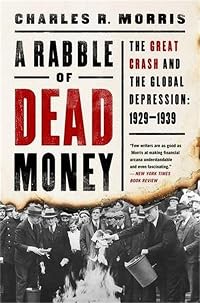
A Rabble of Dead Money: The Great Crash and the Global Depression: 1929–1939
by Charles R. Morris
On This Page
Description
The Great Crash of 1929 profoundly disrupted the United States' confident march toward becoming the world's superpower. The breakneck growth of 1920s America--with its boom in automobiles, electricity, credit lines, radio, and movies--certainly presaged a serious recession by the decade's end, but not a depression. The totality of the collapse shocked the nation, and its duration scarred generations to come. In this lucid and fast-paced account of the cataclysm, award-winning writer Charles show more R. Morris pulls together the intricate threads of policy, ideology, international hatreds, and sheer individual cantankerousness that finally pushed the world economy over the brink and into a depression. While Morris anchors his narrative in the United States, he also fully investigates the poisonous political atmosphere of postwar Europe to reveal how treacherous the environment of the global economy was. It took heroic financial mismanagement, a glut-induced global collapse in agricultural prices, and a self-inflicted crash in world trade to cause the Great Depression. Deeply researched and vividly told, A Rabble of Dead Money anatomizes history's greatest economic catastrophe--while noting the uncanny echoes for the present. show lessTags
Recommendations
























Member Reviews
5500. A Rabble of Dead Money The Great Crash and the Global Depression: 1929-1939, by Charles R. Morris (read 17 Sep 2017) The account in this 2017-published book of the history of the Great Depression is of interest but the heavy doses of analysis were somewhat beyond my interest, so I found much of the book not holding well my attention, though I agreed with his analysis of the effect of the New Deal and the discussion thereof is of interest. But I confess I was annoyed that on page 272 he says the man appointed to run the NRA in 1933 was Hiram Johnson, who he describes as "a California politician". Hiram Johnson was a California politician but he was not the head of the NRA. The head of the NRA was Hugh Johnson, who was born in show more Kansas, attended West Point and became a brigadier general at 36. He did go to the University of California (Berkeley) and obtained a law degree but that is his only connection to California. The book says Johnson was "in the process of losing a struggle against alcoholism" and I find no reference to such in regard to either Hugh Johnson or Hiram Johnson. So the error in regard to this causes me to question the accuracy of the book, though much the author says about the Depression seems cogent and reliable. show less
Ratings
Members
- Recently Added By
Author Information

22+ Works 1,619 Members
Charles R. Morris has written fifteen books, including The Coming Global Boom, a New York Times Notable Book, and The Trillion Dollar Meltdown, a New York Times bestseller. His recent book, The Dawn of Innovation, was named a Wall Street Journal Best Business Book of 2012. A lawyer and former banker, Morris's articles and reviews have appeared in show more many publications, including the Atlantic Monthly, New York Times, and Wall Street Journal. show less
Classifications
- Genres
- Economics, History, Nonfiction, Business, General Nonfiction, Politics and Government
- DDC/MDS
- 973.916 — History & geography History of North America United States 1901- World Wars and Depression Era (1901-1953) Herbert Hoover (1929-1933) Great Depression, Wall Street Crash of 1929,
- LCC
- HB3717 — Social sciences Economic theory. Demography Economic theory. Demography Business cycles. Economic fluctuations
- BISAC
Statistics
- Members
- 64
- Popularity
- 484,311
- Reviews
- 1
- Rating
- (3.50)
- Languages
- English
- Media
- Paper, Audiobook, Ebook
- ISBNs
- 6
- ASINs
- 2