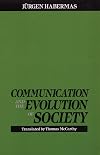
Communication and the Evolution of Society
by Juergen Habermas
On This Page
Description
In this important volume Habermas outlines the views which form the basis of his critical theory of modern societies. The volume comprises five interlocking essays, which together define the contours of his theory of communication and of his substantive account of social change. 'What is Universal Pragmatics?' is the best available statement of Habermas's programme for a theoryof communication based on the analysis of speech acts. In the following two essays Habermas draws on the work of show more Kohlberg and others to develop a distinctive account of moral consciousness and normative structures. 'Toward a Reconstruction of historical Materialsim' takes these issues further, offering a wide-ranging reconstruction of Marx's historical materialsim understood as a theory of social evolution. The final essay focuses on the question of legitimacy and on the legitimation problems faced by modern states. This book is essential reading for anyone concerned with the key questions of social and political theory today. show lessTags
Recommendations

























Member Reviews
A collection of essays which is probably the best introduction to Habermas' work in his own words. The five essays introduce one aspect of his project: his reliance on an interpretation of speech-act theory to provide the normative grounding for his own project (he considers other critical theorists, such as Adorno, to lack normative grounds; that is, he thinks they're more or less forced to be relativists); his use of cognitive developmental theories (which he re-casts in more linguistic terms, as per his first essay) to explain the evolution of societies; two essays deal with his insistence that this is nevertheless a 'materialist' project (thanks to his re-interpretation of historical materialism as explanation of "levels of social show more integration" rather than modes of production); and his discussion of the modern welfare state.
Easily the best essay is the last one on the welfare state; it might even be more timely now, post GFC, than in the late seventies when it was first published. Basically, he argues that the state takes on the role of guardian for both the economy and the population. If the economy fails, the state loses face; if the population feels the bad effects of a growing economy, the state loses face. More or less, it's a lose lose game for the modern state. The stuff on historical materialism is terrible, as you might expect when someone's trying to theoretically describe not only the shift from pre-modern to modern societies (interesting, possibly doable) but also the shift from pre-human to human societies (not going to happen.) The essay on cognitive development is almost as absurd. And the first essay, on speech act theory and Habermas' 'universal pragmatics' shows us why Habermas will go down in history as the single worst theoretician of the twentieth century as far as displaying his own views goes: he takes an easy to understand, interesting theory (speech act theory) and tweaks it in an easy to understand, interesting way (insisting on the importance of illocutionary force outside of institutional bounds)... but takes 70 pages to do so, and makes the whole thing seem like a mess. Too bad. Anyway, read this rather than his massive tomes. The introduction by McCarthy, too, is excellent. show less
Easily the best essay is the last one on the welfare state; it might even be more timely now, post GFC, than in the late seventies when it was first published. Basically, he argues that the state takes on the role of guardian for both the economy and the population. If the economy fails, the state loses face; if the population feels the bad effects of a growing economy, the state loses face. More or less, it's a lose lose game for the modern state. The stuff on historical materialism is terrible, as you might expect when someone's trying to theoretically describe not only the shift from pre-modern to modern societies (interesting, possibly doable) but also the shift from pre-human to human societies (not going to happen.) The essay on cognitive development is almost as absurd. And the first essay, on speech act theory and Habermas' 'universal pragmatics' shows us why Habermas will go down in history as the single worst theoretician of the twentieth century as far as displaying his own views goes: he takes an easy to understand, interesting theory (speech act theory) and tweaks it in an easy to understand, interesting way (insisting on the importance of illocutionary force outside of institutional bounds)... but takes 70 pages to do so, and makes the whole thing seem like a mess. Too bad. Anyway, read this rather than his massive tomes. The introduction by McCarthy, too, is excellent. show less
Ratings
Members
- Recently Added By
Author Information

236+ Works 9,383 Members
Jurgen Habermas is a German sociologist who studied at the universities of Gottingen, Zurich, and Bonn. He taught at Frankfurt am Main, Marburg, and Heidelberg before becoming professor of philosophy at the University of Frankfurt. His works, widely translated, have made him one of the most influential social theorists of our time. Habermas is show more considered by some to be an intellectual heir to Max Weber and what has been called the Frankfurt School. His work has centered mainly on the role of communication and technology in changing patterns of social relations, human activity, and values. An outspoken advocate of the Enlightenment and a champion of reason, he has also cautioned that the technical rationality associated with modern capitalism often functions as ideology and may stand in the way of human progress. (Bowker Author Biography) show less
Classifications
- Genres
- Sociology, Nonfiction, Philosophy, Anthropology, Literature Studies and Criticism
- DDC/MDS
- 301.14 — Society, government, & culture Social sciences, sociology & anthropology Sociology and anthropology Formerly: Social psychology Communication Theory
- LCC
- HM106 .H313 — Social sciences Sociology (General) Sociology These are obsolete numbers no longer used
- BISAC
Statistics
- Members
- 160
- Popularity
- 205,138
- Reviews
- 1
- Rating
- (3.58)
- Languages
- English, German
- Media
- Paper, Ebook
- ISBNs
- 6
- UPCs
- 2
- ASINs
- 3