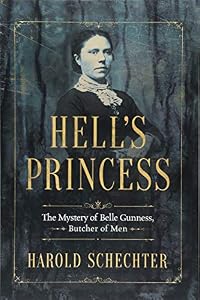
Hell's Princess: The Mystery of Belle Gunness, Butcher of Men
by Harold Schechter
On This Page
Description
"The shocking true story of one of the twentieth century's most prolific female serial killers." -- book jacket. Belle Gunness engaged in wholesale slaughter, partly out of greed but mostly for the sheer joy of it. Between 1902 and 1908 she lured a succession of unsuspecting victims to her La Porte, Indiana 'murder farm.' Some were hired hands. Others were well-to-do bachelors. All of them vanished without a trace. When their bodies were dug up, they hadn't merely been poisoned... they'd show more been butchered. Schechter profiles the killing spree of the woman who came to be known as Lady Bluebeard. show lessTags
Recommendations



























Member Reviews
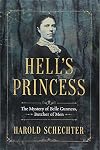
This was just the thing for a couple days spent resentfully nursing a nasty cold: Nyquil, kleenex, flannel PJs, and a juicy true crime book. Living in the Chicago area, I was interested in the "local" angle too. I raised an eyebrow over an author who "specializes in serial killers," but Schechter knows his job. Briskly paced, thoroughly researched and as gory as you could want. He's also a little full of himself, making fun of the breathless writing of the yellow journalism of the time of the story, but doesn't stint on the "diabolical," "ghastly," horrifying," etc. adjectives himself. As others have pointed out, he can set your teeth on edge with his insistence on Belle's homely appearance (the cover photo doesn't make her look so bad, show more really), casual use of racial epithets, etc. And it's not his fault that no one has ever been able to verify what actually happened to Belle in the end. I had not heard of her before, so this was all pretty interesting stuff to me, including the courtroom jousting, which others found boring. A few more photos might have been a good addition - I was Googling on my iPad to see what some of these folks looked like. A pretty decent true crime horror story for someone who isn't normally that into such things, but it killed some sickly hours for me, so I'm happy. show less
The story of Gunness, a Norwegian immigrant who married twice, took in many children, ran a mid-sized farm, and murdered her husbands, children, and lots of lonely men who answered her lonely hearts newspaper ads in the early 1900s.
Believed to have killed around 28 people, she is likely still the record holder as the most prolific female serial killer in America. When it looked like she was about to be found out, her house burned to the ground, along with her children and a conveniently headless female body, leading to decades of speculation as to whether or not she had actually died in the fire (blamed on a disgruntled ex-employee) or set it herself and escaped.
It's strange that her name isn't as known as her fellow male psychopaths. show more Even in her fifties and nearly 300 pounds, with what is described as a "frog face", she possessed a strong seductive quality, noted by surviving paramours, that allowed her to lure men to their deaths. Her letters to lonely Norwegian men from all over the country drew them to cash out their stocks, sell farms, leave their families, and want to marry her even after seeing her. Even the young farm hand who was sentenced for the fire, while insisting that he was innocent, said her had fallen in love with Belle. Bizarre story that has been heavily researched by the author, including the "sightings" of Belle decades later. Very cool graphics and evidence and photos throughout the book. show less
Believed to have killed around 28 people, she is likely still the record holder as the most prolific female serial killer in America. When it looked like she was about to be found out, her house burned to the ground, along with her children and a conveniently headless female body, leading to decades of speculation as to whether or not she had actually died in the fire (blamed on a disgruntled ex-employee) or set it herself and escaped.
It's strange that her name isn't as known as her fellow male psychopaths. show more Even in her fifties and nearly 300 pounds, with what is described as a "frog face", she possessed a strong seductive quality, noted by surviving paramours, that allowed her to lure men to their deaths. Her letters to lonely Norwegian men from all over the country drew them to cash out their stocks, sell farms, leave their families, and want to marry her even after seeing her. Even the young farm hand who was sentenced for the fire, while insisting that he was innocent, said her had fallen in love with Belle. Bizarre story that has been heavily researched by the author, including the "sightings" of Belle decades later. Very cool graphics and evidence and photos throughout the book. show less
A true crime speed read about Belle Gunness, a serial killer of gullible Norwegian immigrants whose money and lives she stole after soliciting their aid in running her farm through ads in Norwegian newspapers, promising marriage and property if they came to her with all their cash and no inconvenient personal encumberments (like inquisitive family members who might miss them if they disappeared). Not overly graphic, but not sparing of details as she dismembered and buried the hapless fellers in rapid succession on her "lovely farm" in Indiana during the first decade of the 20th century. In addition to the prospective husbands, there is also a distinct possibility that Belle murdered several children entrusted to her care. I was show more disappointed that there were no photographs except the one on the cover in the library edition I read, especially after one review particularly mentioned "cool graphics and evidence and photos throughout the book". Most non-fiction needs illustrations, I find. And references to photographs of main actors in the drama should always be accompanied by those photographs,no? Schechter has a reads-easy style, doesn't play sensationalist games with the reader (although the chapter headings are a bit of a tease), and readily admits that even though he had hoped to solve the mystery of Belle's own uncertain demise, the facts are simply not conclusive. show less
I read the Kindle copy while listening to the Audible version. I thought the narrator, Malcolm Hillgartner, was good. He held my attention. My guy, who was listening, thought he did well too.
I followed along on the Kindle because it is a twisted tale. Her crimes were committed over years and there were a number of theories about what happened. I like that the authors gave us what was known and thought then let us decide what we thought happened. The Kindle book has a number of interesting things to look at that I may have missed if I had just listened.
We both found this a fascinating book. This is our second book by these authors. We are definitely planning to read more by them. From the two books we have read, we believe, they do show more extensive research to write well written books that are interesting and thought provoking. We have been having numerous entertaining discussions. Both of us recommend this book to those interested in true crime cases. show less
I followed along on the Kindle because it is a twisted tale. Her crimes were committed over years and there were a number of theories about what happened. I like that the authors gave us what was known and thought then let us decide what we thought happened. The Kindle book has a number of interesting things to look at that I may have missed if I had just listened.
We both found this a fascinating book. This is our second book by these authors. We are definitely planning to read more by them. From the two books we have read, we believe, they do show more extensive research to write well written books that are interesting and thought provoking. We have been having numerous entertaining discussions. Both of us recommend this book to those interested in true crime cases. show less
Disclaimer: I received a free copy in a Goodreads giveaway.
"Meh" sums it up for me. I didn't know anything about Gunness before I started this, and I've never read anything else by this author, so I didn't have any preconceptions going into it. Now that I've finished, I wouldn't say it's been a waste of my time but it wasn't captivating, either. Given the subject matter, it really takes some doing to make your writing not captivating.
When I read the author's bio, I was stunned to learn that he's a literature professor because I didn't find the writing very appealing or well structured. Ironically, there's one point where he says that publishers were trying to cash in on the Gunness case's popularity in the press by pasting together show more newspapers stories into books that were poorly or not at all edited. Just newspaper clippings slapped together with a binding. Yet his own writing has little more narrative than the get-rich-quick publishers he derides.
Structurally, the book starts out with a lot of irrelevant, random info about La Porte, Indiana and other crimes committed there. Why? I can see why establishing the setting is important, but this isn't done well. We don't need to know about so-and-so's complaints about choosing "La Porte" as the town's name decades before anything in the book happened. Likewise, we don't need to know if local resident John Doe robbed the bank or Jane Doe smothered her child in circumstances having nothing to do with Gunness. It doesn't add anything to the narrative.
It doesn't get any better from there, I'm sad to say. For a book about Belle Gunness, the author uses a lot of space writing about absolutely everyone else. The author clearly loves going off on irrelevant tangents. Tangents that contribute to the backstory would be nice, but most of them don't.
As others have pointed out, the author's voice lends an unfortunate misogyny throughout the book. If a woman in the book is not attractive by the author's standards, she's a horrible, ugly thing, and he can't figure out why any other man would be attracted to her. For a literature professor, he seems to have missed the "beauty is in the eye of the beholder" theme so common in Western lit. Also, you know, that whole thing where women are people and not just a sum of men's ratings of their attractiveness.
I did learn a lot about Belle Gunness and her crimes, which were fascinating. As portrayed, she didn't seem to care about making convincing excuses. No one in town seemed to find her behavior problematic even though she had a history of being suspected of arson for insurance money and other crimes. Didn't the poor bank teller think to at least mention to his boss that she cashed out a different man's life savings every other week? It's baffling that she got away with it for so long.
On a final note, the animation in the Kindle version is really distracting. I turned it off immediately. I hope it doesn't become a trend for authors to use this, except maybe in non-fiction science books where it could be useful for illustration purposes. show less
"Meh" sums it up for me. I didn't know anything about Gunness before I started this, and I've never read anything else by this author, so I didn't have any preconceptions going into it. Now that I've finished, I wouldn't say it's been a waste of my time but it wasn't captivating, either. Given the subject matter, it really takes some doing to make your writing not captivating.
When I read the author's bio, I was stunned to learn that he's a literature professor because I didn't find the writing very appealing or well structured. Ironically, there's one point where he says that publishers were trying to cash in on the Gunness case's popularity in the press by pasting together show more newspapers stories into books that were poorly or not at all edited. Just newspaper clippings slapped together with a binding. Yet his own writing has little more narrative than the get-rich-quick publishers he derides.
Structurally, the book starts out with a lot of irrelevant, random info about La Porte, Indiana and other crimes committed there. Why? I can see why establishing the setting is important, but this isn't done well. We don't need to know about so-and-so's complaints about choosing "La Porte" as the town's name decades before anything in the book happened. Likewise, we don't need to know if local resident John Doe robbed the bank or Jane Doe smothered her child in circumstances having nothing to do with Gunness. It doesn't add anything to the narrative.
It doesn't get any better from there, I'm sad to say. For a book about Belle Gunness, the author uses a lot of space writing about absolutely everyone else. The author clearly loves going off on irrelevant tangents. Tangents that contribute to the backstory would be nice, but most of them don't.
As others have pointed out, the author's voice lends an unfortunate misogyny throughout the book. If a woman in the book is not attractive by the author's standards, she's a horrible, ugly thing, and he can't figure out why any other man would be attracted to her. For a literature professor, he seems to have missed the "beauty is in the eye of the beholder" theme so common in Western lit. Also, you know, that whole thing where women are people and not just a sum of men's ratings of their attractiveness.
I did learn a lot about Belle Gunness and her crimes, which were fascinating. As portrayed, she didn't seem to care about making convincing excuses. No one in town seemed to find her behavior problematic even though she had a history of being suspected of arson for insurance money and other crimes. Didn't the poor bank teller think to at least mention to his boss that she cashed out a different man's life savings every other week? It's baffling that she got away with it for so long.
On a final note, the animation in the Kindle version is really distracting. I turned it off immediately. I hope it doesn't become a trend for authors to use this, except maybe in non-fiction science books where it could be useful for illustration purposes. show less
Belle Gunness lived on a farm in La Porte, IN. When she and her young children died in a horrific fire, her fellow townspeople unearthed 28 bodies on her farm that she had dismembered and buried. It came to light that she was advertising for help on her farm (suggesting marriage), asking the men to bring cash or getting insurance policies, and then murdering them for the money. The gruesome and physical way she murdered these men coupled with the sheer number of men (and some of her adopted children) that she murdered, make her one of the most notorious female serial killers.
[[Harold Schechter]] goes through what is known of Belle's life chronologically, using newspaper accounts. He then covers the trial of the man who was convicted of show more setting Belle's house on fire. He also delves into the sensationalism surrounding the story. While many lament the 24 hour news cycle and voyeurism that are part of life today, it certainly was happening 100 years ago as well. Over 10,000 people showed up at the Gunness farm as the bodies were being unearthed to watch!
The story was interesting, but I'd say the book itself is just ok. The writing style got a little tedious for me - I felt the author relied a little too heavily on using newspaper articles and interviews. It was neat in a way to read contemporary accounts, but it tended to interrupt the flow of the narrative. show less
[[Harold Schechter]] goes through what is known of Belle's life chronologically, using newspaper accounts. He then covers the trial of the man who was convicted of show more setting Belle's house on fire. He also delves into the sensationalism surrounding the story. While many lament the 24 hour news cycle and voyeurism that are part of life today, it certainly was happening 100 years ago as well. Over 10,000 people showed up at the Gunness farm as the bodies were being unearthed to watch!
The story was interesting, but I'd say the book itself is just ok. The writing style got a little tedious for me - I felt the author relied a little too heavily on using newspaper articles and interviews. It was neat in a way to read contemporary accounts, but it tended to interrupt the flow of the narrative. show less
There's not too much I can say about this book other than with a name like the Butcher of Men I expected so much more. While Schechter is witty as a writer I can say that I honestly didn't enjoy his writing style. Most of the words he used and how he described things just didn't sit well with me. Is he a bad writer? Absolutely not, he just is not my cup of tea. I was just so disappointed with this book, I am appreciative all the work that Schechter went to when it comes to research and compiling his data as the book is well researched. It just felt like I was reading a long essay and I was bored. So I put the book down and just have not wanted to pick it back up. I refuse to spend my time reading books that I don't enjoy.
Members
- Recently Added By
Published Reviews
Hell’s Princess is an excellent, spellbinding read. Schechter is a master storyteller and a true ethnographer of the old Midwest.... The great revelation in Hell’s Princess is how long-lasting the Gunness case has proven to be. Since Gunness’ corpse contained no head and seemed to have shrunk a great deal, people immediately began suggesting that the infamous killer had faked her own show more death. Schechter concedes that this may very well have happened, although the most tantalizing case of a post-1908 sighting of Gunness has already been disproven. Still, Hell’s Princess ends on a mysterious note, suggesting that the full truth about “Lady Bluebeard” is not known and may never be known. show less
added by Lemeritus
In this depraved story of sex, deception, greed, and murder, a veteran true-crime writer offers the first definitive history of Belle Gunness (circa 1859-1908), the most prolific female serial killer in American history.... A fascinating and dramatic page-turner that will be a new favorite among true-crime fans.
added by Lemeritus
Schechter (Man-Eater) recounts the horrifying murders committed by Belle Gunness, who lured approximately 28 men to their deaths on her Indiana farm in the early 20th century.... True-crime fans will be hooked from the start.
added by Lemeritus
Lists

Best Biographies
216 works; 26 members

Weirdo Nonfiction
138 works; 3 members
Author Information

56+ Works 7,228 Members
Harold Schechter is a professor of American literature and culture at Queens College, the City University of New York.
Common Knowledge
- Canonical title
- Hell's Princess: The Mystery of Belle Gunness, Butcher of Men
- Original publication date
- 2018
- People/Characters
- Brynhild "Belle" Paulsdatter Storset Gunness; William Antiss; Harry Burr Darling; Peter Gunness; Phillip Gunness; Andrew Helgelien (show all 32); Asle Helgelien; Ray Lamphere; Joseph Maxson; Jennie Olson; Elizabeth Smith; Ralph N. Smith; Albert Smutzer; Lucy Sorenson; Mads Ditlev Anton Sorenson; Myrtle Sorenson; Wirt Worden; Angus Ralston; Emanuel Hogenson; Catherine Lapham; Chris Christofferson; George Berry; Christian Hilkven; Emil Greening; John Weidner; Peter Colson; Frank Pitner; John Hulth; William Humphrey; Johann Hoch; Sheriff Smutzer; Daniel Hutson
- Important places
- LaPorte, Indiana, USA; Chicago, Illinois, USA
- Important events
- Great Conflagration (1871)
- Epigraph
- Belle Gunness was a lady fair / In Indiana State. / She weighed about three hundred pounds, / And that is quite some weight. / That she was stronger than a man / Her neighbors all did own; / She butchered hogs right easily, /... (show all) And did it all alone. / But hogs were just a sideline / She indulged in now and then; / Her favorite occupation / Was a-butchering of men. - Anonymous, "The Ballad of Belle Gunness
- Dedication
- For
CHRISTOPH KELLER - First words
- Fairyland, as every child knows, is a terrifying place, populated by all manner of nightmarish beings: the snaggletoothed witch who lusts for the fattened flesh of little children; the bloodthirsty giant ready to roast any tr... (show all)espassing human on a spit; the smooth-talking wolf with a sweet tooth for tasty young girls. -Prologue
Reduced to charred ruins by the Great Conflagration of 1871, Chicago roared back to life in the following years, a phoenix of limestone, granite, and brick reborn from the aches. -Chapter One - Quotations
- Religion is not the same as ethics. Religion in its fanatic state may be a passion devoid of morality that will take any means to an end.
She never seemed to care for a man for his own self, only for the money or luxury he was able to give her. - Last words
- (Click to show. Warning: May contain spoilers.)"The mystery that hangs about the murderous operations of Mrs. Gunness is likely to never be fully dispelled... in conception and brutality of execution, the crimes of Mrs. Gunness are unparalleled. She is entitled to be known to future generations as the arch fiend of the twentieth century."
- Canonical DDC/MDS
- 364.1523092
- Canonical LCC
- HV6517
Classifications
- Genres
- General Nonfiction, Nonfiction, Biography & Memoir, History
- DDC/MDS
- 364.1523092 — Social sciences Social problems and social services Criminology Criminal offenses Offenses against the person Homicide Murder History, geographic treatment, biography Biography
- LCC
- HV6517 — Social sciences Social pathology. Social and public welfare. Criminology Social pathology. Social and public welfare. Criminology Crimes and offenses
- BISAC
Statistics
- Members
- 571
- Popularity
- 51,354
- Reviews
- 18
- Rating
- (3.57)
- Languages
- English
- Media
- Paper, Audiobook, Ebook
- ISBNs
- 5
- ASINs
- 2