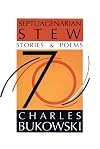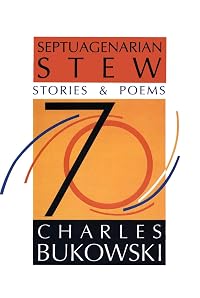
Septuagenarian Stew: Stories and Poems
by Charles Bukowski
On This Page
Description
Septuagenarian Stew is a combination of poetry and stories written by Charles Bukowski that delve into the lives of different people on the backstreets of Los Angeles. He writes of the housewife, the bum, the gambler and the celebrity to evoke a portrait of Los AngelesTags
Recommendations







Member Reviews
Having returned from a beautiful camping trip, we're now back in the city (for another few days, anyway) and what better way to celebrate our urban lifestyle, than to memorize some Charles Bukowski?
too much
Brawley was a good sort
normal as a heating pad
then he
got a few miles on him
started worrying about
aging
popped vitamin pills like
peanuts
when I visited him
his place was filled with
iron
he pumped and pumped iron
and
with each successive visit
I noticed him
turning
more bulky and
blue:
a metallic
lump
his eyes
withdrew
into his
forehead
his smile
bent
like a
rubber
band
he greased his
body
and stood in front
of
mirrors
I no longer knew
who he
was
he just
pumped and
pumped
and
mirrored and
mirrored
he told me,
"you ought to
go for it, I've
been
re-born."
"see you later,"
I show more told
him.
now when people
ask me, "you seen
Brawley
lately?"
"not really," I
tell them
and we move on
to more
interesting subjects
like
Nuclear
Winter.
Like nuclear winter! Blammo! I tell you, the man knew how to end a poem. He's like a fatalistic mule pushing steadily and unassumingly toward a land mine. He thinks nuclear winter is a better topic of conversation than his old acquaintance. What a devastating thing to say about somebody! Hoowee. This was going to be my August memorization poem (yes, I am aware that August is almost over, but better late than never), and I do love its evocation of that particular stage in dealing with an addictive personality, when you realize that you're just weary of the whole shebang, and "no longer know who he is," and by comparison to saying another thing about this person's obsessive and unchanging behavior, talking about impending nuclear winter seems like a companionable and productive way to spend an afternoon.
But then I considered whether I wanted a "telling-off"/"putting-down" poem to enter into my personal repertoire. I already have so many memorized songs to suit that purpose, after all: "Like a Rolling Stone," "It's Alright, Ma," "I Don't Believe You," and even some that are not by Bob Dylan. I thought it might be an overly negative thing to ingest in the way that memorization entails. Then, on balance, I decided that negativity is a part of life and that beautiful expressions of it should be carried around with us along with beautiful expressions of positivity. And just so that I wouldn't forget that again, I decided to memorize the poem that reminded me of it, too:
ruin
William Saroyan said, "I ruined my
life by marrying the same woman
twice."
there will always be something
to ruin our lives,
William,
it all depends upon
what or which
finds us
first,
we are always
ripe and ready
to be
taken.
ruined lives are
normal
both for the wise
and
others.
it is only when
that life
ruined
becomes ours
we realize
then
that the suicides, the
drunkards, the mad, the
jailed, the dopers
and etc. etc.
are just as common
a part of existence
as the gladiola, the
rainbow
the
hurricane
and nothing
left
on the kitchen
shelf.
What a gorgeous poem. I love the cadence of it; despite the prosaic word choice and the conversational tone, I would never mistake this for anything but verse. It strikes a beautiful balance between absolute ease of expression ("there will always be something / to ruin our lives, / William") and chiseled, taut language. I love its progression from the theoretical ("ruined my life") down through the spectrum of experience (gladiolas vs. dopers), and lovingly separates away each layer of experience until it is left with the most concrete, basic fact of our shared humanity: being hungry. We can all come up against "nothing / left / on the the kitchen / shelf," and when we do, we will all be in the same boat. Have compassion for yourself and others, gruff Chinaski seems to say, because you and they are just poor human animals wrapped up in beauty and ugliness, needing to eat and excrete.
In other news, our neighbor spends a lot of energy hating the homeless folks that camp next door. I feel like taping this poem to his expensive sports car, but that would be annoyingly self-righteous. Also, he would totally know who did it. He has seen my library. show less
too much
Brawley was a good sort
normal as a heating pad
then he
got a few miles on him
started worrying about
aging
popped vitamin pills like
peanuts
when I visited him
his place was filled with
iron
he pumped and pumped iron
and
with each successive visit
I noticed him
turning
more bulky and
blue:
a metallic
lump
his eyes
withdrew
into his
forehead
his smile
bent
like a
rubber
band
he greased his
body
and stood in front
of
mirrors
I no longer knew
who he
was
he just
pumped and
pumped
and
mirrored and
mirrored
he told me,
"you ought to
go for it, I've
been
re-born."
"see you later,"
I show more told
him.
now when people
ask me, "you seen
Brawley
lately?"
"not really," I
tell them
and we move on
to more
interesting subjects
like
Nuclear
Winter.
Like nuclear winter! Blammo! I tell you, the man knew how to end a poem. He's like a fatalistic mule pushing steadily and unassumingly toward a land mine. He thinks nuclear winter is a better topic of conversation than his old acquaintance. What a devastating thing to say about somebody! Hoowee. This was going to be my August memorization poem (yes, I am aware that August is almost over, but better late than never), and I do love its evocation of that particular stage in dealing with an addictive personality, when you realize that you're just weary of the whole shebang, and "no longer know who he is," and by comparison to saying another thing about this person's obsessive and unchanging behavior, talking about impending nuclear winter seems like a companionable and productive way to spend an afternoon.
But then I considered whether I wanted a "telling-off"/"putting-down" poem to enter into my personal repertoire. I already have so many memorized songs to suit that purpose, after all: "Like a Rolling Stone," "It's Alright, Ma," "I Don't Believe You," and even some that are not by Bob Dylan. I thought it might be an overly negative thing to ingest in the way that memorization entails. Then, on balance, I decided that negativity is a part of life and that beautiful expressions of it should be carried around with us along with beautiful expressions of positivity. And just so that I wouldn't forget that again, I decided to memorize the poem that reminded me of it, too:
ruin
William Saroyan said, "I ruined my
life by marrying the same woman
twice."
there will always be something
to ruin our lives,
William,
it all depends upon
what or which
finds us
first,
we are always
ripe and ready
to be
taken.
ruined lives are
normal
both for the wise
and
others.
it is only when
that life
ruined
becomes ours
we realize
then
that the suicides, the
drunkards, the mad, the
jailed, the dopers
and etc. etc.
are just as common
a part of existence
as the gladiola, the
rainbow
the
hurricane
and nothing
left
on the kitchen
shelf.
What a gorgeous poem. I love the cadence of it; despite the prosaic word choice and the conversational tone, I would never mistake this for anything but verse. It strikes a beautiful balance between absolute ease of expression ("there will always be something / to ruin our lives, / William") and chiseled, taut language. I love its progression from the theoretical ("ruined my life") down through the spectrum of experience (gladiolas vs. dopers), and lovingly separates away each layer of experience until it is left with the most concrete, basic fact of our shared humanity: being hungry. We can all come up against "nothing / left / on the the kitchen / shelf," and when we do, we will all be in the same boat. Have compassion for yourself and others, gruff Chinaski seems to say, because you and they are just poor human animals wrapped up in beauty and ugliness, needing to eat and excrete.
In other news, our neighbor spends a lot of energy hating the homeless folks that camp next door. I feel like taping this poem to his expensive sports car, but that would be annoyingly self-righteous. Also, he would totally know who did it. He has seen my library. show less
Bukoski is a trashy class act. Trashy because he writes about defecating. Classy cuz he’s honest. Act because he wrote a lot a bullshit for money. This collection, released near the end of his life, contains the usual: drinking, women, shitting, being a fucking bum. We expect this kind of material. However, in this collection, there are a lot of poems about writing (being discovered), old age, work, fame (being recognized), and horse-races. This is new stuff. While I don’t give a shit about horse races, I do care about the existential concerns of a life-long drunk and compulsive writer, who somehow, drunk or otherwise, pulled out a good line or two. He conjures some stuff. On feeling inexplicably content: “good rare feelings come show more at the oddest times, like now as I tell you all of this,” he writes in poem for lost dogs. In tired in the afterdusk, he writes on reflection: “this is the space between spaces, this is when the ever-war relents for just a moment, this is when you consider the inconsiderate years...”
It’s all very nostalgia coated, but still funny. And like most writers/drunks, Bukoski is a mostly honest narrator; he writes about anything regardless of taboo. He does not care what you think, which continually draws us in because we know there are “golden nuggets” to be found. These qualities make up for his “ugly,” utilitarian writing that sometimes seems like “typewriting” (which he talks about often) instead of meaningful, god-inspired prose. show less
It’s all very nostalgia coated, but still funny. And like most writers/drunks, Bukoski is a mostly honest narrator; he writes about anything regardless of taboo. He does not care what you think, which continually draws us in because we know there are “golden nuggets” to be found. These qualities make up for his “ugly,” utilitarian writing that sometimes seems like “typewriting” (which he talks about often) instead of meaningful, god-inspired prose. show less
I loved it, more than "Fuck machine" and other books from old Chinasky. Imagination, whisky, talent, beer, literary madurity and beer made an awesome book.
One of Bukowski's worse books, featuring a high number of poems that fall flat and stories that refuse to compel. But seemingly nothing by Bukowski is utterly terrible, unlike with Ginsberg.
A decent collection of Hank's works, but it's definitely not Hank at the top of his powers.
It's Bukowski. No more needs to be said.
oh you dirty old man, we love you!
Members
- Recently Added By
Lists

Books featuring alcoholics
103 works; 18 members
Author Information

546+ Works 53,005 Members
Charles Bukowski was born in Andernach, Germany, on August 16, 1920. He came to the United States with his parents when he was three years old and spent his early years in poverty. As a young man he was a transient, doing odd jobs. He lived most of his live in boarding houses in the Los Angeles area. He attended Los Angeles City College briefly. show more He worked for the United States Postal Service for about ten years. Bukowski was at home with street people and his work contains a brutal realism and graphic imagery. He began publishing short stories in the mid-1940s. Starting with Flower, Fist and Bestial Wail in 1959, he produced poetry collections almost once a year. His following had grown by the time his collection of poetry about down-and-outers titled It Catches My Heart in Its Hands appeared in 1963. His short story collections include Dirty Old Man and Ejaculations, Exhibitions and General Tales of Ordinary Madness. His novels, with an autobiographical character called Henry Chinaski, include Post Office and Factotum. Bukowski wrote the screenplay for the 1987 motion picture Barfly. He later wrote about the filming of Barfly in his novel, Hollywood. Bukowski died in San Pedro, California, on March 9, 1994. (Bowker Author Biography) show less
Common Knowledge
- Dedication
- For Neeli Cherkovski
- Original language
- English US
Classifications
Statistics
- Members
- 496
- Popularity
- 61,159
- Reviews
- 7
- Rating
- (3.80)
- Languages
- Dutch, English, French, Italian
- Media
- Paper, Ebook
- ISBNs
- 14
- ASINs
- 4