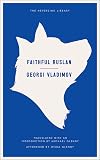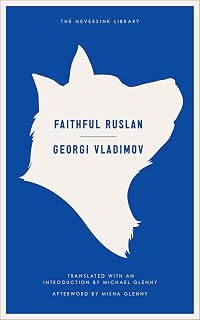
Faithful Ruslan
by Georgi Vladimov
On This Page
Description
Set in a remote Siberian depot immediately following the demolition of one of the gulag's notorious camps and the emancipation of its prisoners, Faithful Ruslan is an embittered cri de coeur from a writer whose circumstances obliged him to resist the violence of arbitrary power. A starving stray, Ruslan and his cadre of fellow guard dogs dutifully wait for the arrival of new prisoners - but the unexpected arrival of a work party provokes a climactic bloodletting. Fashioned from the show more perceptions of an animal, Vladimov's indictment of the gulag exposes all man's cruelty. show lessTags
Recommendations

























Member Reviews
Really, shouldn't I, by this stage in my life, know better than to read books about dogs? Because once you get past the 101 Dalmations stage, there are no happy endings. There are no "and then he sniffed her butt, and she sniffed his, and they walked off into the sunset..." No. The dog dies. The dog always dies.
I'm sure that's why, or at least part of why, though the description of Faithful Ruslan was intriguing, I did not pick it when making my big order from Melville House's Neversink collection. But then, because all the books I had ordered weren't actually going to be published for months, the lovely folks at Melville sent Ruslan for free, as a teaser of sorts.
Okay, we should probably get one thing straight. It may sound like I was show more bitter because this was a bad book. That is not the case at all. I am bitter (a little bit), because this was a wonderful, amazing book, that almost caused me to have a complete bawling breakdown in the middle of the Grand Rapids Children's Museum, before I very wisely closed the book and decided to finish reading it in the car.
I wasn't sure, when I started reading the book, that I would get pulled all the way in. I am not a dog person. And the book is written from the point of view of the dog, Ruslan, which made me wary. Writing a book from the point of view of an animal is a pretty big conceit. It would have to be wonderful, or the author risks falling on his (or her) face. Luckily, this book is wonderful. It feels authentic, is very engaging, and while there is a feeling of doom hanging over the entire book, it never crosses the line into darkness for darkness's sake. Rather, it feels as if it is bearing witness to a story that needed to be told. Indeed, after I finished reading, I discovered (re-discovered) that the book was based on a real-life incident.
A difficult read, but very worthwhile. Recommended to animal lovers and those interested in Soviet history. show less
I'm sure that's why, or at least part of why, though the description of Faithful Ruslan was intriguing, I did not pick it when making my big order from Melville House's Neversink collection. But then, because all the books I had ordered weren't actually going to be published for months, the lovely folks at Melville sent Ruslan for free, as a teaser of sorts.
Okay, we should probably get one thing straight. It may sound like I was show more bitter because this was a bad book. That is not the case at all. I am bitter (a little bit), because this was a wonderful, amazing book, that almost caused me to have a complete bawling breakdown in the middle of the Grand Rapids Children's Museum, before I very wisely closed the book and decided to finish reading it in the car.
I wasn't sure, when I started reading the book, that I would get pulled all the way in. I am not a dog person. And the book is written from the point of view of the dog, Ruslan, which made me wary. Writing a book from the point of view of an animal is a pretty big conceit. It would have to be wonderful, or the author risks falling on his (or her) face. Luckily, this book is wonderful. It feels authentic, is very engaging, and while there is a feeling of doom hanging over the entire book, it never crosses the line into darkness for darkness's sake. Rather, it feels as if it is bearing witness to a story that needed to be told. Indeed, after I finished reading, I discovered (re-discovered) that the book was based on a real-life incident.
A difficult read, but very worthwhile. Recommended to animal lovers and those interested in Soviet history. show less
This is both heartwarming and heartbreaking.
First the heartwarming. This story is told from the worldview of a dog. A very special dog. Ruslan is a guard dog in a Siberian prison camp. We learn about his special relationship with his Master. His Master treats Ruslan well. Ruslan has learned well his role. He is there to assist his Master in any way his Master wants. Ruslan excels and is to some degree "top dog". The world is his oyster.
And then the heartbreaking begins. The prison camp is closing and Ruslan's master sets him "free". Ruslan, however, is programed, very programed, and not in tune with his new situation. He is programed to expect that food from anyone but his Master may be poisoned so he rejects anything offered to him and show more searches for food in the nearby forest. He believes all the people in the village are escaped prisoners so he decides to guard one until his Master returns. He finds his Master in the village and the Master tries some tough love on him feeding him a "sandwich" laced with a heavy dose of mustard. The Master forces Ruslan to swallow the sandwich knowing full well that Ruslan was trained to avoid anything with mustard and is sickened by what he was forced to swallow. The break with the Master is now complete but the rest of the programming is still there. Guard dogs are programmed to meet trains with new prisoners and to "escort" the prisoners to the camp dealing with any that might try to stray from the column. They often had to wait to meet the trains. So the dogs now often go to the station awaiting the next train. But no new prisoners arrive and the reception crew begins to dwindle as the days wear on.
Then one day a train arrives with the workers for the factory that has been built where the old camp had been. Strangely the camp's replacement has no guard towers, and is built right up the forest without a no man's land where escapees could be gunned down, no questions asked. And for some reason the new workers are singing and walking in an orderly column from the train to the "camp". All the dogs' programming kicks in and they form a line escorting the new arrivals. That's when everything falls apart. In their new found enthusiasm for the return of their rightful role one of the dogs decides to teach a new arrival who's boss by grabbing an arm. Naturally others try to free the person from the attacking dog and naturally the other dogs see this as an escape attempt and come to aid of their comrade. It gets ugly, the dogs are outnumbered, and Ruslan is kicked senseless and left for dead. He eventually gains enough strength to move himself to where he has recovered before. Alas there is no recovery. All he ever wanted to do was to be of service to the Service. show less
First the heartwarming. This story is told from the worldview of a dog. A very special dog. Ruslan is a guard dog in a Siberian prison camp. We learn about his special relationship with his Master. His Master treats Ruslan well. Ruslan has learned well his role. He is there to assist his Master in any way his Master wants. Ruslan excels and is to some degree "top dog". The world is his oyster.
And then the heartbreaking begins. The prison camp is closing and Ruslan's master sets him "free". Ruslan, however, is programed, very programed, and not in tune with his new situation. He is programed to expect that food from anyone but his Master may be poisoned so he rejects anything offered to him and show more searches for food in the nearby forest. He believes all the people in the village are escaped prisoners so he decides to guard one until his Master returns. He finds his Master in the village and the Master tries some tough love on him feeding him a "sandwich" laced with a heavy dose of mustard. The Master forces Ruslan to swallow the sandwich knowing full well that Ruslan was trained to avoid anything with mustard and is sickened by what he was forced to swallow. The break with the Master is now complete but the rest of the programming is still there. Guard dogs are programmed to meet trains with new prisoners and to "escort" the prisoners to the camp dealing with any that might try to stray from the column. They often had to wait to meet the trains. So the dogs now often go to the station awaiting the next train. But no new prisoners arrive and the reception crew begins to dwindle as the days wear on.
Then one day a train arrives with the workers for the factory that has been built where the old camp had been. Strangely the camp's replacement has no guard towers, and is built right up the forest without a no man's land where escapees could be gunned down, no questions asked. And for some reason the new workers are singing and walking in an orderly column from the train to the "camp". All the dogs' programming kicks in and they form a line escorting the new arrivals. That's when everything falls apart. In their new found enthusiasm for the return of their rightful role one of the dogs decides to teach a new arrival who's boss by grabbing an arm. Naturally others try to free the person from the attacking dog and naturally the other dogs see this as an escape attempt and come to aid of their comrade. It gets ugly, the dogs are outnumbered, and Ruslan is kicked senseless and left for dead. He eventually gains enough strength to move himself to where he has recovered before. Alas there is no recovery. All he ever wanted to do was to be of service to the Service. show less
Vladimov offers a moving allegory of conditioned devotion to the state in post-Stalinist Russia. The hero here isn’t Ivan Denisovich, but Ruslan, one of the Gulag prison camp’s guard dogs. Ruslan, like the released prisoners who have no place to go, is forced to endure a life that has lost all sense of purpose.
Beautiful, complex, layered, devastating. Wept as I finished. More when I have pulled myself together.
Ruslán es un perro guardián en un campo de trabajo del Gulag soviético. De la noche a la mañana, él y sus compañeros ven cómo los campos se vacían de prisioneros y cómo sus amos, los guardias, a los que aman incondicionalmente, los abandonan a su suerte. Durante las semanas posteriores, Ruslán deberá adaptarse a su nueva situación.
Jan 5, 2023Spanish
Ratings
Members
- Recently Added By
Author Information
15+ Works 233 Members
Some Editions
Series
Belongs to Publisher Series
Work Relationships
Is contained in
Common Knowledge
- Canonical title
- Faithful Ruslan
- Original title
- Верный Руслан; Vernyi Ruslan
- Original publication date
- 1978 (Russian) (Russian); 1979 (English translation) (English translation); 2011-08 (Melville House printing) (Melville House printing)
- Important places
- Siberia (Russian Federation)
- Epigraph*
- Что вы сделали, господа!
М. Горький, "Варвары" - First words*
- Всю ночь выло, качало со скрежетом фонари, звякало наружной шеколдой, а к утру улеглось, успокоилось - и пришел хозяин.
- Last words*
- (Click to show. Warning: May contain spoilers.)- Фас, Руслан!.. Фас!
- Original language
- Russian
*Some information comes from Common Knowledge in other languages. Click "Edit" for more information.
Classifications
- Genres
- Fiction and Literature, General Fiction, Historical Fiction
- DDC/MDS
- 891.7 — Literature & rhetoric Literatures of other languages East Indo-European and Celtic literatures Russian and East Slavic languages
- LCC
- PG3489.3 .L29 .V413 — Language and Literature Slavic languages and literatures. Baltic languages. Albanian language Slavic. Baltic. Albanian Russian literature Individual authors and works 1961-2000
- BISAC
Statistics
- Members
- 187
- Popularity
- 174,197
- Reviews
- 5
- Rating
- (3.98)
- Languages
- 12 — Danish, Dutch, English, French, Hungarian, Norwegian (Bokmål), Norwegian, Polish, Russian, Spanish, Swedish, Turkish
- Media
- Paper, Ebook
- ISBNs
- 18
- ASINs
- 5