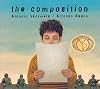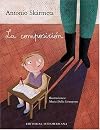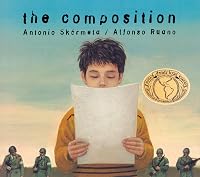
The Composition
by Antonio Skármeta
On This Page
Description
When a government official comes into a third grade classroom and tells the students to write a composition entitled "What My Family Does at Night," Pedro must decide how he feels about the military dictatorship that is running his country.Tags
Recommendations


Member Recommendations
Member Reviews
People Pedro knows are being taken away by the government. It’s a scary time. Then a general comes to Pedro’s school and announces a contest for the best composition. The theme? What My Family Does at Night.
This little picture book shines. It could have easily been a diatribe against dictatorships
but the author makes his point without lecturing. And, in the process, he shares little moments in the lives of families during this scary time.
Here’s a little bit from the story, with Pedro talking to his friend about the essay.
“What are you going to write?” he (Pedro) asked.
“Anything,” said Juan. “How about you?”
“I don’t know,” said Pedro.
“What did your parents do yesterday?” asked Juan.
“Same as usual. They came show more home, they are, they listened to the radio, they went to bed.”
“Just like my mother.”
My mother started crying,” said Pedro.
“Mothers are always crying,” said Juan.
“I hardly ever cry,” said Pedro. “I haven’t cried for a year.”
“What about if I hit you and you get a black eye. Would you cry then?” asked Juan.
“Why would you do that when you’re my friend?” said Pedro.
“That’s true. I wouldn’t,” answered Juan. show less
This little picture book shines. It could have easily been a diatribe against dictatorships
but the author makes his point without lecturing. And, in the process, he shares little moments in the lives of families during this scary time.
Here’s a little bit from the story, with Pedro talking to his friend about the essay.
“What are you going to write?” he (Pedro) asked.
“Anything,” said Juan. “How about you?”
“I don’t know,” said Pedro.
“What did your parents do yesterday?” asked Juan.
“Same as usual. They came show more home, they are, they listened to the radio, they went to bed.”
“Just like my mother.”
My mother started crying,” said Pedro.
“Mothers are always crying,” said Juan.
“I hardly ever cry,” said Pedro. “I haven’t cried for a year.”
“What about if I hit you and you get a black eye. Would you cry then?” asked Juan.
“Why would you do that when you’re my friend?” said Pedro.
“That’s true. I wouldn’t,” answered Juan. show less
Pedro is a somewhat small 9 year old (or that's what the neighborhood boys say, at least) who loves soccer and loves spending time with his family. But when neighborhood folks start to be taken away by the military, Pedro begins to have a nagging feeling something bad is happening. Pedro uses wit and communication skills to learn more about the political environment and support his family and friends.
A beautifully written and illustrated tale that drew me in from the start to finish, with unexpected depth and a profound theme of standing up to abuses of power at any age.
A beautifully written and illustrated tale that drew me in from the start to finish, with unexpected depth and a profound theme of standing up to abuses of power at any age.
Media: Watercolor
Genre: Realistic Fiction
Critique: This book is a realistic fiction and paints a vivid picture of what is taking place in many countries around the world which are currently ruled by dictatorships. This book is also a good example of plot. The conflict of the dictatorship arises when people start getting arrested. The tension rises as the officers forces students to write papers about what their family does, and the climax is when we fear Pedro has given away his family in his paper.
Genre: Realistic Fiction
Critique: This book is a realistic fiction and paints a vivid picture of what is taking place in many countries around the world which are currently ruled by dictatorships. This book is also a good example of plot. The conflict of the dictatorship arises when people start getting arrested. The tension rises as the officers forces students to write papers about what their family does, and the climax is when we fear Pedro has given away his family in his paper.
Una familia en el contexto de la dictadura en Chile, conmocionada por la visita de un militar al colegio y la propuesta de escribir una composición sobre lo que hace la familia
Sep 8, 2016Spanish
La composición es un ejemplo de las injusticias del gobierno en un lugar se llama Perú. Es una historia de dos niños se encuentran disposición porque un padre estaba en un situación mal. Creo que este libro se demostrada un situación real en una manera sensitiva. Pero, también el libro es triste porque hay muchas situaciones reales como este en muchas países con los gobiernos como este.
Dec 7, 2007Spanish
Pedro está de cumpleñaos y recibe de regalo una pelota de plástico. La historia trascurre en pleno gobierno militar, tiempo en el cual los padres de Pedro escuchan la radio, para así poder informarse de las noticias nacionales.
Oct 30, 2006Spanish
Pedro está de cumpleñaos y recibe un regalo, una pelota de plástico. La historia trascurre en pleno gobierno militar, tiempo en el cual los padres de Pedro escuchan la radio, para así poder informarse de las noticias nacionales.
Sep 24, 2006Spanish
Members
- Recently Added By
Lists

1001 Children's Books You Must Read Before You Grow Up
774 works; 101 members

Picture Books About Civil Rights
51 works; 4 members

Childhood: Books for or about children in different cultures around the wor
345 works; 18 members
Author Information

58+ Works 2,642 Members
Author Antonio Skármeta was born in Antofagasta, Chile on November 7, 1940. He studied literature and philosophy in Chile and at Columbia University. He taught literature at the University of Chile from 1967 to 1973. He left his country in 1973 because he was profoundly affected by his country's political travail. After the collapse of Pinochet's show more military dictatorship, Skármeta returned to Chile and hosted a television program on literature and the arts. He served as the Chilean ambassador in Germany from 2000 to 2003. He has written several novels including Ardiente Paciencia, which inspired the 1994 Academy Award-winning movie Il Postino (The Postman); The Insurrection, about the Nicaraguan Revolution just before Somoza's fall; and Chileno!, a young adult book drawing on Skármeta 's own experience of exile. (Bowker Author Biography) show less
Awards and Honors
Awards
Common Knowledge
- Original title
- La composición
- Original publication date
- 1990
- Important places
- Chile
- Original language
- Spanish
Classifications
Statistics
- Members
- 316
- Popularity
- 101,229
- Reviews
- 7
- Rating
- (4.42)
- Languages
- 7 — Danish, English, French, German, Italian, Portuguese, Spanish
- Media
- Paper, Audiobook
- ISBNs
- 18
- ASINs
- 1