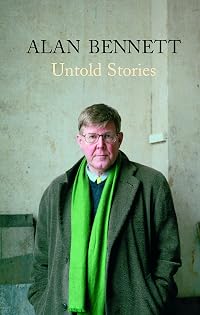
Untold Stories
by Alan Bennett
On This Page
Description
Untold Stories brings together some of the finest and funniest writing by Alan Bennett, one of England's best-known literary figures."[Bennett] does what only the best writers can do--make us look at ourselves in a way we've never done before." --Michael PalinAlan Bennett's first major collection since Writing Home contains previously unpublished work--including the title piece, a poignant memoir of his family and of growing up in Leeds--along with his much celebrated diary for the years show more 1996 to 2004, and numerous other exceptional essays, reviews, and comic pieces. In this highly anticipated compendium, the Today Book Club author of The Clothes They Stood Up In reveals a great many untold secrets and stories with his inimitable humor and wry honesty--his family's unspoken history, his memories of Peter Cook and Dudley Moore, and his response to the success of his most recent play, The History Boys.Since the success of Beyond the Fringe in the 1960s, Bennett has delighted audiences worldwide with writing that is, in his words, "no less serious because it is funny." The History Boys opened to great acclaim at the Royal National Theatre in 2004, winning numerous awards, and is scheduled to open in New York City in April 2006. show lessTags
Recommendations













Member Recommendations

Member Reviews
Alan Bennett does seem to have a knack for giving nondescript, interchangeable titles to his various collections of miscellaneous writings: it actually wouldn't be such a bad thing if he followed up his own suggestion and just called this The 2005 Alan Bennett Annual.
As always, there's a lot of good stuff here: excerpts from the diaries, introductions to books and plays, lectures, obituaries, autobiographical essays, etc. It's put together in a fairly random and intersecting way, so it doesn't make much sense to read it through from cover to cover - if you do, you keep coming across good bits that he has recycled from elsewhere. I watched the film of The History Boys when I was about halfway through, and spotted quite a few bits that show more appear in this book in other contexts. But that's all part of the fun, and it helps to create the illusion that we are watching his creative process at work. It is an illusion, of course: reading these pieces we are reminded how much of a performer Bennett is. Tellingly, Bennett quotes Philip Larkin as objecting to giving public readings because he didn't like pretending to be himself. Bennett has no such inhibitions: he obviously loves pretending to be Alan Bennett. (And he doesn't mind getting other people to pretend to be Alan Bennett either: witness the two Alan Bennetts in the stage version of The lady in the van.) It is striking, though, that the AB we meet on the printed page is rather more assertive and intellectual than the AB we know and love from the telly.
The diaries, which are probably the closest thing we get to raw material here, are the liveliest: the longer pieces, where he writes about the old age and mental illness of his relatives and his own treatment for cancer, are necessarily a bit depressing, but not without the occasional touch of dry Yorkshire wit. The least interesting parts of the book are the texts of lectures he gave at the National Gallery and Leeds Art Gallery: slide shows don't really work without the slides.
Compared to the earlier collections, he's a lot more open here about his personal life, which turns out to be disappointingly unsensational (if this account is to be believed). It was rather more entertaining for the reader when no-one officially knew whether he was straight or gay, but it must be easier for Bennett not to have to keep obfuscating his pronouns any more.
(Aside: whilst writing this, I noticed the various covers of different editions of this book lined up in the margin. It's worth a look - they are all based on the same photograph, but Bennett's scarf is a slightly different colour in each one, and he moves about the frame like a bouncing ball, right, left and centre. Strange.) show less
As always, there's a lot of good stuff here: excerpts from the diaries, introductions to books and plays, lectures, obituaries, autobiographical essays, etc. It's put together in a fairly random and intersecting way, so it doesn't make much sense to read it through from cover to cover - if you do, you keep coming across good bits that he has recycled from elsewhere. I watched the film of The History Boys when I was about halfway through, and spotted quite a few bits that show more appear in this book in other contexts. But that's all part of the fun, and it helps to create the illusion that we are watching his creative process at work. It is an illusion, of course: reading these pieces we are reminded how much of a performer Bennett is. Tellingly, Bennett quotes Philip Larkin as objecting to giving public readings because he didn't like pretending to be himself. Bennett has no such inhibitions: he obviously loves pretending to be Alan Bennett. (And he doesn't mind getting other people to pretend to be Alan Bennett either: witness the two Alan Bennetts in the stage version of The lady in the van.) It is striking, though, that the AB we meet on the printed page is rather more assertive and intellectual than the AB we know and love from the telly.
The diaries, which are probably the closest thing we get to raw material here, are the liveliest: the longer pieces, where he writes about the old age and mental illness of his relatives and his own treatment for cancer, are necessarily a bit depressing, but not without the occasional touch of dry Yorkshire wit. The least interesting parts of the book are the texts of lectures he gave at the National Gallery and Leeds Art Gallery: slide shows don't really work without the slides.
Compared to the earlier collections, he's a lot more open here about his personal life, which turns out to be disappointingly unsensational (if this account is to be believed). It was rather more entertaining for the reader when no-one officially knew whether he was straight or gay, but it must be easier for Bennett not to have to keep obfuscating his pronouns any more.
(Aside: whilst writing this, I noticed the various covers of different editions of this book lined up in the margin. It's worth a look - they are all based on the same photograph, but Bennett's scarf is a slightly different colour in each one, and he moves about the frame like a bouncing ball, right, left and centre. Strange.) show less
I bought this back in 2016, but left after reading Writing Home until I read Killing Time in almost one sitting and decided that I wanted more of the author’s easy style and humour. I wasn’t disappointed, as this varied collection of essays, articles and diary entries were wonderful, usually with an underlying moral truth or seriousness.
The first (auto)biographical essays illuminate time past that is largely unrecorded (or if recorded, largely unpublished) and provided some echoes of what life might have been like for my parents and grandparents. It is hard for me to really remember what my parents and grandparents were like, rather than photograph like impressions of particular events, but these essays help recall my past memories, show more however different.
The diaries are from years that I lived through and it’s amusing to note references to exhibitions that I recall, as well as comments on the politics and culture.
Going to the Pictures, a lecture given by Bennett as a trustee of the National Gallery, is my favourite essay from this collection, with such humour regarding one’s reactions to paintings, as well as the connection between going to the pictures (films) in the 1940’s and 1950’s , and contemporaries viewing paintings in the fifteenth and sixteenth century, with references to saints and, later, classical mythology. show less
The first (auto)biographical essays illuminate time past that is largely unrecorded (or if recorded, largely unpublished) and provided some echoes of what life might have been like for my parents and grandparents. It is hard for me to really remember what my parents and grandparents were like, rather than photograph like impressions of particular events, but these essays help recall my past memories, show more however different.
The diaries are from years that I lived through and it’s amusing to note references to exhibitions that I recall, as well as comments on the politics and culture.
Going to the Pictures, a lecture given by Bennett as a trustee of the National Gallery, is my favourite essay from this collection, with such humour regarding one’s reactions to paintings, as well as the connection between going to the pictures (films) in the 1940’s and 1950’s , and contemporaries viewing paintings in the fifteenth and sixteenth century, with references to saints and, later, classical mythology. show less
This is a lovely book that kept me entertained on my commuter journeys for going on a month. It is a sprawling unweildly collection of Bennett's musings on life, Leeds, family, philosophy, art, history, homosexuality and mortality - some pieces date from the time that he was seriously ill with cancer (now in remission).
I know there are some who find Bennett irritating - and for sure he is repetitious. But I know of no-one who combines his intelligence and articulacy with so much clearly genuine modesty.
He writes so well in his fictions of the lost souls of life because he too has always been a little bit lost and uncomfortable despite his fame and success.
He seems never to have quite slotted in to either the lower middle class of his show more upbringing, the intellectual class of Oxford, or the self-regarding coterie of theatre and show-biz.. But he manages to write sympathetially about people from all walks of life. Like us all, he has his prejudices, but is about as open-minded as we have any right to expect. show less
I know there are some who find Bennett irritating - and for sure he is repetitious. But I know of no-one who combines his intelligence and articulacy with so much clearly genuine modesty.
He writes so well in his fictions of the lost souls of life because he too has always been a little bit lost and uncomfortable despite his fame and success.
He seems never to have quite slotted in to either the lower middle class of his show more upbringing, the intellectual class of Oxford, or the self-regarding coterie of theatre and show-biz.. But he manages to write sympathetially about people from all walks of life. Like us all, he has his prejudices, but is about as open-minded as we have any right to expect. show less
Second volume of semi-autobiography, augmented with excerpts of diaries from the last 10 years and background to varoius plays and TV programmes. Lots about his mother's depression and his puberty - the intimacy of revelations perhaps reflecting that he had cancer when he wrote it and maybe thought he wouldn't live to see it published. Also, he's not afraid to show himself in a bad light - eg when he was sometimes unsympathetic to the plight of his parents and other family members. Some desperately poignant observations, which make you want to keep reading. However, in the historical (non-diary) sections, the frequency with which he repeats himself (often within a page or two) and swaps, seemingly arbitrarily, between present and past show more tense is infuriating and distracting. show less
Bennett is undeniably one of my favourite writers. Without any trace of melodrama, he is able to convey the intricate emotions of what may seem an ordinary life. A combination of family, personal and literary memoir, this is a book for keeping, dipping into now and then.
More than any writer publishing today, Alan Bennett’s work is recognised as a facet of the man himself. Spying my copy of 'Untold Stories' a colleague comments ‘Oh, you’re reading Alan Bennett’. This is representative of many things – his penchant for understated titles, the strength of his voice and written persona, but most probably, his heavy use of personal experience.
'Untold Stories' is a blend of autobiography, family memoir and writerly scrapbook, and it is in this book that Bennett explicitly references some of the murmurs and unknowns that have never really been consciously excluded from previous work, but have also never been aired publicly. In his comment about why he has never accepted an honour he admits, “I show more wish I could dispose of the question” and “I then generally edge [it] round to a discussion of honours in general.” Here he doesn’t. He faces the questions of his sexuality, family history and stance on the gay movement, all with a clarity, humour and humility that is facilitated by his belief that “none of it was likely to be published in my lifetime, so where was the problem?”
This frankness adds touching beauty to his accounts of the illnesses and deaths in his family, his teenage angst and his encounter with cancer. As this is Alan Bennett, of course, it’s all treated with a beguiling awkwardness and a Northen normality that is partly, one thinks, as much of a character as the A. Bennetts one and two in 'The Lady in the Van'.
The fragmented nature of the book means it seems almost to be intended to be read out of sync, but reading it front to back, one is irritated by the repetition of four or five Big Ideas that Bennett uses in memoir, diary, lecture and play. Although these are often funny and insightful on first reading, they really jar by the end of the book and could easily have been avoided by some more careful editing or selection. Similarly, to a regular reader of the 'London Review of Books', the large section of Bennett’s diary extracts may not be altogether fresh either, but are highly recommended if it’s the first time you’ve seen them.
I don’t think there’s any harm in skipping whole sections of this book if you’re so inclined. Not interested in the lectures, fine. Read the diaries already, fine. But the sections that are really, strongly recommended are the opening and closing memoirs ‘Untold Stories’ and ‘Ups and Downs’. For anyone fairly new to Bennett, or for any dyed in the wool Alan fans, read it front to back, and savour every minute of it. show less
'Untold Stories' is a blend of autobiography, family memoir and writerly scrapbook, and it is in this book that Bennett explicitly references some of the murmurs and unknowns that have never really been consciously excluded from previous work, but have also never been aired publicly. In his comment about why he has never accepted an honour he admits, “I show more wish I could dispose of the question” and “I then generally edge [it] round to a discussion of honours in general.” Here he doesn’t. He faces the questions of his sexuality, family history and stance on the gay movement, all with a clarity, humour and humility that is facilitated by his belief that “none of it was likely to be published in my lifetime, so where was the problem?”
This frankness adds touching beauty to his accounts of the illnesses and deaths in his family, his teenage angst and his encounter with cancer. As this is Alan Bennett, of course, it’s all treated with a beguiling awkwardness and a Northen normality that is partly, one thinks, as much of a character as the A. Bennetts one and two in 'The Lady in the Van'.
The fragmented nature of the book means it seems almost to be intended to be read out of sync, but reading it front to back, one is irritated by the repetition of four or five Big Ideas that Bennett uses in memoir, diary, lecture and play. Although these are often funny and insightful on first reading, they really jar by the end of the book and could easily have been avoided by some more careful editing or selection. Similarly, to a regular reader of the 'London Review of Books', the large section of Bennett’s diary extracts may not be altogether fresh either, but are highly recommended if it’s the first time you’ve seen them.
I don’t think there’s any harm in skipping whole sections of this book if you’re so inclined. Not interested in the lectures, fine. Read the diaries already, fine. But the sections that are really, strongly recommended are the opening and closing memoirs ‘Untold Stories’ and ‘Ups and Downs’. For anyone fairly new to Bennett, or for any dyed in the wool Alan fans, read it front to back, and savour every minute of it. show less
I have a real soft spot for Alan Bennet, must be the wry Yorkshire humour. This book didn't disappoint, it was a fantastic collection of autobiographical work, diaries and random musings. I particularly enjoyed his account of his childhood in the Leeds area and coming to terms with his mother's mental illness. He tells the tale in his typical dry style, which adds lightness to what would otherwise be a pretty grim tale.
Members
- Recently Added By
Lists

...read all, pay nowt (Books set in Yorkshire)
86 works; 14 members

Art of Reading
188 works; 5 members

John Carey's Sunday Best
82 works; 3 members
Author Information

154+ Works 17,228 Members
Bennett was born in Armley in Leeds, West Yorkshire. He decided to apply for a scholarship at Oxford University. He was accepted by Exeter College, Oxford from which he graduated with a first-class degree in history. He was born on May 9, 1934; he is an English author, actor, humorist and playwright. Bennett was made an Honorary Fellow of Exeter show more College, Oxford in 1987. He was also awarded a D.Litt by the University of Leeds in 1990 and an Hon. PhD from Kingston in 1996. In October 2008 Bennett announced that he was donating his entire archive of working papers, unpublished manuscripts, diaries and books to the Bodleian Library free of charge, as a gesture of thanks and repaying a debt he felt he owed to the UK's social welfare system that had given him educational opportunities which his humble family background would otherwise never have afforded. In 2015 his title, Six Poets: Hardy to Larkin: An Anthology by Alan Bennett, made The New Zealand Best Seller List. He also made the list in 2016 with his title The Lady in the Van. (Bowker Author Biography) show less
Awards and Honors
Work Relationships
Is contained in
Common Knowledge
- Original publication date
- 2005
- Important places
- Yorkshire, England, UK
- First words
- At Christmas when I was a boy and hung my pillowcase at the end of the bed one of the presents I could generally count on was an annual.
- Quotations
- Success (like death) brings letters.
Myra lives in a succession of briefly rented rooms.... These comfortless accommodations ... exude a particular sort of hopelessness ... Aunty Myra had too many sharp corners to be one of her characters, but they are the setti... (show all)ng for many of the novels of Barbara Pym, and one of the reasons I find her books quite lowering to read.
It was only with "The Less Deceived" that Larkin achieved his characteristic voice, that wry, lugubrious, thoroghly unheroic tone which can turn so unexpectedly tender and lyrical and which made him, apart from Betjeman perha... (show all)ps, the best loved of contemporary English poets....
Fond of compound adjectives - air-sharpened, rain-ceased, bone-riddled - [Larkin] shares this with Hardy, with whom
he invites comparison though his sentiments are less gawky, what they have most in common a deep, unshift... (show all)able despair.
To read Larkin aloud is to become aware of his skill as a craftsman.
[Larkin's poem "The Trees"] makes a pair, a pendant as they say in art history, with Hardy's "Proud Songsters" - the trees, as it were, and the birds in the trees, both poems coming as close to optimism as either poet allows ... (show all)himself. - Last words
- (Click to show. Warning: May contain spoilers.)Take heart.
- Blurbers
- Carey, John; Brown, Craig; Stevenson, Jane; McCrystal, Cal
Classifications
Statistics
- Members
- 1,300
- Popularity
- 18,655
- Reviews
- 21
- Rating
- (4.01)
- Languages
- English
- Media
- Paper, Audiobook, Ebook
- ISBNs
- 15
- ASINs
- 8