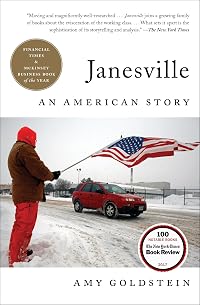
Janesville: An American Story
by Amy Goldstein
On This Page
Description
"A Washington Post reporter's intimate account of the fallout from the closing of a General Motors' assembly plant in Janesville, Wisconsin--Paul Ryan's hometown--and a larger story of the hollowing of the American middle class. This is the story of what happens to an industrial town in the American heartland when its factory stills--but it's not the familiar tale. Most observers record the immediate shock of vanished jobs, but few stay around long enough to notice what happens next, when a show more community with a can-do spirit tries to pick itself up. Pulitzer Prize winner Amy Goldstein has spent years immersed in Janesville, Wisconsin where the nation's oldest operating General Motors plant shut down in the midst of the Great Recession, two days before Christmas of 2008. Now, with intelligence, sympathy, and insight into what connects and divides people in an era of economic upheaval, she makes one of America's biggest political issues human. Her reporting takes the reader deep into the lives of autoworkers, educators, bankers, politicians, and job re-trainers to show why it's so hard in the twenty-first century to recreate a healthy, prosperous working class. For this is not just a Janesville story or a Midwestern story. It's an American story"-- show lessTags
Recommendations






























Member Reviews
This is a well researched and extremely readable book about life in Janesville, Wisconsin, from 2008 through 2013, in the years following the closure of what had been the longest-running GM plant in the country. Literally generations of Janesville residents had made their livings from the plant and the many manufacturing companies that existed to supply parts to the cars built there. Interestingly, Janesville is also the hometown of Paul Ryan, Republican champion of governmental austerity and former Speaker of the House, a somewhat ironic fact given how solidly Democratic and pro-union the town has always been.
In the wake of the plant closing, the town's economy and lifestyle were devastated. Amy Goldstein skillfully and compassionately show more details the rising and pervasive unemployment, the lowering of standards of living of previously solidly middle-class families, to near the poverty line. School systems begin struggling, with students often going hungry and short on basic supplies, parents working two jobs just to try to get half of the income their union jobs had paid or driving four hours each way--generally staying away from home from Monday through Friday--to take jobs in still running plants. Goldstein also chronicles the efforts of local agencies to provide help in the form of job training and pro-active economic boosterism that tried to bring new corporations to town. In the midst of this came the election of Scott Walker-an avowed enemy of unions and government subsidies alike--as the state's governor. Soon the teachers' union was under attack from above, as well.
Goldstein's reporting method was, in addition to providing a comprehensive overview of events, to tell the town's story through the eyes of several families, people she clearly got to know well. In so doing, Goldstein was able to paint detailed portraits of the day to day lives and struggles of the people of Janesville during these extremely difficult years. She also chronicles, although not in great detail, the ways in which these events gradually created "two Janesvilles," as the interests of the still thriving upper class and the increasingly desperate middle and lower classes began to diverge more and more dramatically.
At one point, soon after Walker's election, he visits town and attends a banquet where a leader of the town's business community asks him in a one-on-one conversation, "Any chance we'll ever get to be a completely red state and work on these unions and become right-to-work? What can we do to help you?"
Walker's response is, "Oh, yeah. Well, we're going to start in a couple weeks with our budget adjustment bill. The first step is, we're going to deal with collective bargaining for all public employee unions, because you use divide and conquer."
The business leader's response: "You're right on target."
A sad aspect into all of this is Goldstein's reporting, and documenting, that job retraining, as hard as people worked at making it available and as hard as people worked to receive it, in the end did little to improve the lives and incomes of most of the people who took such training.
This book does a lot to bring all of these issues--for those of us not living in areas like Janesville--into sharp, human-dimensioned focus. I suppose one of the drawbacks is that the viewpoint of many of her sources is somewhat self-selectiong. By that I mean that the blue collar families that moved into conservatism and eventually, perhaps, into Maga territory, were probably nowhere near as likely to agree to spend quality time with a reporter.
I feel strongly, however, that this book is an extremely valuable resource for understanding the economic and cultural issues besetting so much of American society today. show less
In the wake of the plant closing, the town's economy and lifestyle were devastated. Amy Goldstein skillfully and compassionately show more details the rising and pervasive unemployment, the lowering of standards of living of previously solidly middle-class families, to near the poverty line. School systems begin struggling, with students often going hungry and short on basic supplies, parents working two jobs just to try to get half of the income their union jobs had paid or driving four hours each way--generally staying away from home from Monday through Friday--to take jobs in still running plants. Goldstein also chronicles the efforts of local agencies to provide help in the form of job training and pro-active economic boosterism that tried to bring new corporations to town. In the midst of this came the election of Scott Walker-an avowed enemy of unions and government subsidies alike--as the state's governor. Soon the teachers' union was under attack from above, as well.
Goldstein's reporting method was, in addition to providing a comprehensive overview of events, to tell the town's story through the eyes of several families, people she clearly got to know well. In so doing, Goldstein was able to paint detailed portraits of the day to day lives and struggles of the people of Janesville during these extremely difficult years. She also chronicles, although not in great detail, the ways in which these events gradually created "two Janesvilles," as the interests of the still thriving upper class and the increasingly desperate middle and lower classes began to diverge more and more dramatically.
At one point, soon after Walker's election, he visits town and attends a banquet where a leader of the town's business community asks him in a one-on-one conversation, "Any chance we'll ever get to be a completely red state and work on these unions and become right-to-work? What can we do to help you?"
Walker's response is, "Oh, yeah. Well, we're going to start in a couple weeks with our budget adjustment bill. The first step is, we're going to deal with collective bargaining for all public employee unions, because you use divide and conquer."
The business leader's response: "You're right on target."
A sad aspect into all of this is Goldstein's reporting, and documenting, that job retraining, as hard as people worked at making it available and as hard as people worked to receive it, in the end did little to improve the lives and incomes of most of the people who took such training.
This book does a lot to bring all of these issues--for those of us not living in areas like Janesville--into sharp, human-dimensioned focus. I suppose one of the drawbacks is that the viewpoint of many of her sources is somewhat self-selectiong. By that I mean that the blue collar families that moved into conservatism and eventually, perhaps, into Maga territory, were probably nowhere near as likely to agree to spend quality time with a reporter.
I feel strongly, however, that this book is an extremely valuable resource for understanding the economic and cultural issues besetting so much of American society today. show less
In 2008, General Motors closed its production plant in Janesville, Wisconsin, laying off thousands of people. Goldstein chronicles the direct impact, and less dramatic reverberations, this has on the community - from laid-off workers trying to pay the bills to teachers trying to help students suddenly dealing with uncertainty and stress at home.
The strength of this chronicle is the manageable but diverse group that Goldstein chooses to follow over the next five years. There is the bank president/community booster, the school social worker, several laid-off GMers who take different paths to forge a new life, the head of the local job resource center, and a few others. The group provides Goldstein a large canvas to trace various effects, show more but never becomes unwieldy. She also includes a few more meta themes in the book, particularly the widening political divide, and the election and recall effort of Governor Scott Walker is included, as are the fortunes of Janesville's native son, now-former Rep. Paul Ryan. But she always returns to the "regular" people and tells their stories with genuine care and empathy.
Janesville reminded me in some ways of The Unwinding by George Packer, particulary in the emphasis on the decline of the middle class and widening political and economic divisions in America. Both are worth reading, but Janesville is probably more accessible. It's an important read, and certainly a worthwhile one. show less
The strength of this chronicle is the manageable but diverse group that Goldstein chooses to follow over the next five years. There is the bank president/community booster, the school social worker, several laid-off GMers who take different paths to forge a new life, the head of the local job resource center, and a few others. The group provides Goldstein a large canvas to trace various effects, show more but never becomes unwieldy. She also includes a few more meta themes in the book, particularly the widening political divide, and the election and recall effort of Governor Scott Walker is included, as are the fortunes of Janesville's native son, now-former Rep. Paul Ryan. But she always returns to the "regular" people and tells their stories with genuine care and empathy.
Janesville reminded me in some ways of The Unwinding by George Packer, particulary in the emphasis on the decline of the middle class and widening political and economic divisions in America. Both are worth reading, but Janesville is probably more accessible. It's an important read, and certainly a worthwhile one. show less
What happened to Janesville is what has happened to America and is why America is not what it once was.
I was especially drawn to Janesville: An American Story by Amy Goldstein because I grew up in Rockford, Illinois, about forty-five minutes or so south. Throughout my time attending the University of Wisconsin-Madison from 2002-2005 I would drive through Janesville; I would occasionally stop for food or such like on Milton Avenue on the north side of town.
Otherwise, however, I would rarely venture up there, and even though I lived within an hour, I clearly did not know much about it. Before reading this book I was not aware of the major GM factory there, or that it was the home of Parker Pen.
And when I lived there, and drove through show more there, the GM factory was still going. This book chronicles what would happen to Janesville beginning in 2008, with the announcement of the closure of the GM plant and its hastened demise, until 2013, chronicling how the town and its citizens would respond to their changed environment.
The book follows a few families and town professionals and their stories throughout this period. Overall, it’s devastating. Those who retired from GM and could enjoy their pension were fine; so were those who were already well-ensconced in higher level white-collar work, like running the local bank.
But everyone else suffered all kinds of levels of diminished life quality. The best off financially were the “gypsies” who transferred to work at other GM plants but whose families remained in Janesville: they were able to maintain about the same standard of economic living, but the breadwinner would be gone for most of the week, and the families would acutely feel the lack of their presence.
Many others refused to do that to their families; they would thus suffer economically. Many bought into the general premise of retraining and finding new careers; most who did so found themselves in new jobs paying half or so what they made previously. Such retraining led one woman into a very dark place with a terrible end. Most of those who did not go the retraining route ironically ended up doing economically better than those who did, but still encountered a lot more job insecurity and wages were still far less than before. Teenagers end up working two or three jobs and their incomes help support their families, and it still really isn’t enough. All of the forms of charity are overwhelmed: they all experience greater need and have all lost significant sources of revenue and manpower.
By 2013, according to the numbers, it might seem like things had recovered: the unemployment rate was lower than it had been. People had jobs; but the quality of jobs were nothing like what existed before. There had been a stable middle class in Janesville, and all that attended to it; most of that was hollowed out.
And it wasn’t that Janesville workers were lazy or not motivated to work; they all wanted to work, and many were working multiple jobs.
What is most distressing about this story is how “normal” it was. It all took place after I had left the area and was living in northern Ohio and then in Los Angeles. But the story of what happened in Janesville from 2008 to the present is the same story as which took place in Rockford beginning a few years earlier than that. It was the story of the town in which I lived in northern Ohio, and really the whole area, highly dependent on the automotive industry. It’s probably the story of way too many areas in the Upper Midwest and around the country in general.
This book does not present itself as having a specific agenda save to chronicle and detail the fallout of the loss of a major employer in a small town. It does its job in a well and devastating way. If you want to know why America is as it is today, this is a good place to start. show less
I was especially drawn to Janesville: An American Story by Amy Goldstein because I grew up in Rockford, Illinois, about forty-five minutes or so south. Throughout my time attending the University of Wisconsin-Madison from 2002-2005 I would drive through Janesville; I would occasionally stop for food or such like on Milton Avenue on the north side of town.
Otherwise, however, I would rarely venture up there, and even though I lived within an hour, I clearly did not know much about it. Before reading this book I was not aware of the major GM factory there, or that it was the home of Parker Pen.
And when I lived there, and drove through show more there, the GM factory was still going. This book chronicles what would happen to Janesville beginning in 2008, with the announcement of the closure of the GM plant and its hastened demise, until 2013, chronicling how the town and its citizens would respond to their changed environment.
The book follows a few families and town professionals and their stories throughout this period. Overall, it’s devastating. Those who retired from GM and could enjoy their pension were fine; so were those who were already well-ensconced in higher level white-collar work, like running the local bank.
But everyone else suffered all kinds of levels of diminished life quality. The best off financially were the “gypsies” who transferred to work at other GM plants but whose families remained in Janesville: they were able to maintain about the same standard of economic living, but the breadwinner would be gone for most of the week, and the families would acutely feel the lack of their presence.
Many others refused to do that to their families; they would thus suffer economically. Many bought into the general premise of retraining and finding new careers; most who did so found themselves in new jobs paying half or so what they made previously. Such retraining led one woman into a very dark place with a terrible end. Most of those who did not go the retraining route ironically ended up doing economically better than those who did, but still encountered a lot more job insecurity and wages were still far less than before. Teenagers end up working two or three jobs and their incomes help support their families, and it still really isn’t enough. All of the forms of charity are overwhelmed: they all experience greater need and have all lost significant sources of revenue and manpower.
By 2013, according to the numbers, it might seem like things had recovered: the unemployment rate was lower than it had been. People had jobs; but the quality of jobs were nothing like what existed before. There had been a stable middle class in Janesville, and all that attended to it; most of that was hollowed out.
And it wasn’t that Janesville workers were lazy or not motivated to work; they all wanted to work, and many were working multiple jobs.
What is most distressing about this story is how “normal” it was. It all took place after I had left the area and was living in northern Ohio and then in Los Angeles. But the story of what happened in Janesville from 2008 to the present is the same story as which took place in Rockford beginning a few years earlier than that. It was the story of the town in which I lived in northern Ohio, and really the whole area, highly dependent on the automotive industry. It’s probably the story of way too many areas in the Upper Midwest and around the country in general.
This book does not present itself as having a specific agenda save to chronicle and detail the fallout of the loss of a major employer in a small town. It does its job in a well and devastating way. If you want to know why America is as it is today, this is a good place to start. show less
A fascinating, detailed, wise accounting about what Janesville did when the GM plant and suppliers closed, a disaster for the economy and livelihoods of most residents. But I just couldn't keep reading when Paul Ryan came up -- the current Ryan vs (the appearance of) the former Ryan was just too disgusting. I can't help but think of the Ryan who MISREAD an article about a waitress saying her extra $1.50 (purportedly because of tax cut) would help her "cover her Costco annual fee." She was actually pointing out how ironic -- criminal? -- it was that corporations got the lion's share -- which they are investing in buying back their shares, not in increased wages or "bonuses" (i.e. crumbs). So yea -- a great book, but I'm just too show more disgusted to take "former Ryan" seriously as a public servant. show less
Sometimes, at the library, I’ll pick up a book at random based solely on the cover or the title and start reading it, ignoring the dust jacket and blurbs on the back. That’s what I did with Janesville—and I’m so glad I did. Were I asked, “Want to read a book about a town in Wisconsin that suffered after a GM plant closed?” I would have passed, not out of coldheartedness but because there are only so many hours in the day to read what grabs us.
This book is a great achievement for several reasons. The structure and interweaving narratives are handled skillfully—and by focusing on this array of people. Goldstein offer a mosaic of life after the plant’s closing. It’s also, in its style, an example of the clarity that show more Strunk and White urged on all of us.
What I found most remarkable, however, was the nearly-apolitical stance from which the tale is told. So much writing about economics and the nation’s current challenges is marked by finger-pointing. I never got a sense of that from this book. She doesn't point fingers; she gestures towards a display of people. I was surprised to read the blurbs on the back, which (I think falsely) characterize Janesville as a political anti-Trump screed. It's not, so if you're hoping to read something you can use as ammo against your cousin who's a Trump supporter, you'll be disappointed. The book is so much better than that. show less
This book is a great achievement for several reasons. The structure and interweaving narratives are handled skillfully—and by focusing on this array of people. Goldstein offer a mosaic of life after the plant’s closing. It’s also, in its style, an example of the clarity that show more Strunk and White urged on all of us.
What I found most remarkable, however, was the nearly-apolitical stance from which the tale is told. So much writing about economics and the nation’s current challenges is marked by finger-pointing. I never got a sense of that from this book. She doesn't point fingers; she gestures towards a display of people. I was surprised to read the blurbs on the back, which (I think falsely) characterize Janesville as a political anti-Trump screed. It's not, so if you're hoping to read something you can use as ammo against your cousin who's a Trump supporter, you'll be disappointed. The book is so much better than that. show less
Janesville is about the loss of GM car manufacturing jobs in this Wisconsin town and all the long term effects. Goldstein really does a good job of showing how General Motors let these people down and at the same time shows the rise of Scott Walker and super, labor busting conservatives. It was quite pleasant to have just finished it before Walker finally went down.
This is the story of a town where for many years the major employer was General Motors. Following GM’s bankruptcy in 2009 the plant was one of a number that closed down, and this is the story of what happened afterwards. It makes tough reading in places but is sympathetically written and has some good outcomes. The author gives pretty short shrift to trickle down economics and pull yourself up by your own bootstraps advice from Republican politicians. House Speaker Paul Ryan, a Janesville native son and Republican Vice Presidential candidate comes in for particular criticism. This was a worthy recommendation by Obama.
Members
- Recently Added By
Published Reviews
Goldstein gives the reader a gripping account of the GM layoff, the real loss it caused and the victims’ heroic resilience in adapting to that loss. By the end of this moving book, I wanted her to write a sequel on what might have been done to prevent the damage in the first place. For it turns out that while we’re often primed to take management’s word for what a company needs to do, show more this is a question well worth asking... In the end, Goldstein says, “ it became evident that no one outside — not the Democrats nor the Republicans, not the bureaucrats in Madison or in Washington, not the fading unions nor the struggling corporations — had the key to create the middle class anew.” Maybe so. But does such a disproportionate burden have to rest on the weary shoulders of the Jerad Whiteakers of the nation? How welcome it would be if the higher-ups at GM and elsewhere demonstrated the same generosity and ingenuity that Jerad and his co-workers have displayed. show less
added by Lemeritus
“Janesville” joins a growing family of books about the evisceration of the working class in the United States. What sets it apart is the sophistication of its storytelling and analysis... perhaps the most powerful aspect of “Janesville” is its simple chronological structure, which allows Goldstein to show the chain reaction that something so calamitous as a plant closing can effect. show more Each falling domino becomes a headstone, signifying the death of the next thing... “Janesville” is eye-opening, important, a diligent work of reportage. I am sure Paul Ryan will read it. I wonder what he will say. show less
added by Lemeritus
While it highlights many moments of resilience and acts of compassion, Amy Goldstein's "Janesville: An American Story" also has a tragic feel. It depicts the noble striving of men and women against overpowering forces — in this case, economic ones... Goldstein is a reporter, not a pundit. She is fair-minded and empathetic in presenting her viewpoint characters. Also fairly, as Ryan becomes a show more leading figure in American politics, she notes the dissonance between the gospel of local self-reliance that Ryan preaches and what is available to people struggling in his hometown. show less
added by Lemeritus
Lists

Top Five Books of 2017
757 works; 231 members

Books recommended by Barack Obama
295 works; 28 members

Books Read in 2023
5,547 works; 145 members

Club Read's Recommended Nonfiction Written by Women
618 works; 30 members
Barack Obama's Favorite Books of 2017
12 works; 1 member
Author Information

13 Works 563 Members
Amy Goldstein has been a staff writer for thirty years at The Washington Post, where much of her work has focused on social policy. Among her awards, she shared the 2002 Pulitzer Prize for national reporting. She has been a fellow at Harvard University at the Nieman Foundation for Journalism and at the Radcliffe Institute for Advanced Study. She show more lives in Washington, DC. show less
Awards and Honors
Awards
Distinctions
Common Knowledge
- Original publication date
- 2017
- People/Characters
- Kristi Beyer; Mike Vaughn; Barb Vaughn; Dave Vaughn; Jerad Whiteaker; Tammy Whiteaker (show all 20); Marv Wopat; Matt Wopat; Darcy Wopat; Linda Korban; Sue Olmsted; Tim Cullen; Paul Ryan; Ann Forbeck; Sharon Kennedy; Deri Wahlert; Diane Hendricks; Mary Willmer; Bob Borremans; Stan Milam
- Important places
- Janesville, Wisconsin, USA
- Important events
- GM plant closing 2008, Recession 2008
- Dedication
- For Cynthia ad Robert Goldstein, who taught me to love - and look up - words and have never stopped trying to improve their community
- First words
- At 7:07 a.m., the last Tahoe reaches the end of the assembly line.
- Quotations
- Keeping up appearances, trying to hide the ways that pain is seeping in, is one thing that happens when good jobs go away and middle-class people tumble out of the middle class.
Over a few years, it became evident that no one outside—not the Democrats nor the Republicans, not the bureaucrats in Madison or in Washington, not the fading unions nor the struggling corporations—had the key to create t... (show all)he middle class anew.
Wisconsin sends off to the company its final economic incentive package to try to land the new small car for Janesville’s assembly plant. The package adds up to $195 million: $115 million in state tax credits and energy-eff... (show all)iciency grants, the $20 million that Marv Wopat pushed through the county board, $15 million from the strapped Janesville city government, and $2 million from Beloit, plus private industry incentives, including from the businesses willing to buy out the tavern in the assembly plant’s parking lot. And that isn’t counting concessions worth $213 million that UAW Local 95 is willing to sacrifice in exchange for retrieving jobs. The biggest incentive package in Wisconsin history... Michigan offered nearly five times as much.
to offer General Motors the amazing sum of $779 million worth of tax breaks over the next twenty years and $135 million in job-training funds, plus water and sewer credits from Orion Township and money from a fund to help com... (show all)panies find good workers. In all, more than $1 billion in public money.
When General Motors decided last year to build a Chevy compact, the Cruze, at its assembly plant in Lordstown, Ohio, that state gave GM $220 million in incentives. After the Ford Motor Company decided last year to spend $75 m... (show all)illion to renovate a truck plant in Wayne, Michigan, in order to manufacture a compact model, the Ford Focus, the state of Michigan agreed to give Ford $387 million in tax credits and rebates. And when Volkswagen last year decided to build a plant in Chattanooga, Tennessee, to manufacture a sedan, the Passat, that company received $554 million in state and local tax breaks. All were more than Wisconsin offered General Motors to try to get the lights back on at Janesville. Even in this high-stakes, high-priced environment, Michigan’s play in the bidding war
at 6 a.m. on August 1, 2011, when production of the Sonic began, 40 percent of the workers were paid $14 an hour. Many parts were shipped from South Korea. The engines came from Mexico. And in another innovation, some parts s... (show all)uppliers began working right inside the Orion plant. Their average wage: $10 an hour. This was the price of victory.
The evidence is thin that job training in the United States is an effective way to lead laid-off workers back into solid employment.
These are kids whose parents used to scrape by on jobs at Burger King or Target or the Gas Mart. Now their parents are competing with the unemployed autoworkers who used to look down on these jobs but now are grasping at any ... (show all)job they can find. So, as middle-class families have been tumbling downhill, working-class families have been tumbling into poverty. And as this down-into-poverty domino effect happens, some parents are turning to drinking or drugs. Some are leaving their kids behind while they go looking for work out of town. Some are just unable to keep up the rent. So with a parent or on their own, a growing crop of teenagers is surfing the couches at friends’ and relatives’ places—or spending nights in out-of-the-way spots in cars or on the street.
There is a hub, too, for food, which is plentiful and has, for days, included free deliveries of Ian’s Pizza, which is just a block up State Street from the capitol. Ian’s has been deluged with phone calls and online orde... (show all)rs from protest sympathizers from all fifty states and two dozen nations, who, in acts of long-distance solidarity, are paying for the pizzas to be delivered to the capitol so that the demonstrators do not go hungry.
Counterintuitive as it may seem, the out-of-a-job workers who went to Blackhawk are working less than the others. Nearly two thousand laid-off people in and around Janesville have studied at Blackhawk. Only about one in three... (show all) has a steady job—getting at least some pay every season of the year—compared with about half the laid-off people who did not go back to school.
Besides, the people who went to Blackhawk are not earning as much money. Before the recession, their wages had been about the same as for other local workers. By this summer, the people who have found a new job without retrai... (show all)ning are being paid, on average, about 8 percent less than they were paid before. But those who went to Blackhawk are being paid, on average, one third less than before. Most startling, the group whose pay has fallen the most are people like Mike, who stuck it out at Blackhawk until they graduated. These successful students tended to have had higher wages before the recession. For that reason, the decrease in their pay is especially steep, dropping by nearly half. - Last words
- (Click to show. Warning: May contain spoilers.)He has eight and a half years until he will be eligible to retire with a GM pension.
- Blurbers
- Kidder, Tracy; McWhorter, Diane; Putnam, Robert D.; Danziger, Sheldon; Dionne, E.J.; Woodward, Bob
- Canonical DDC/MDS
- 330.977587
- Canonical LCC
- HC108.J36
Classifications
- Genres
- Sociology, Economics, General Nonfiction, Nonfiction, History
- DDC/MDS
- 330.977587 — Society, government, & culture Economics Jobs & Careers Economic geography and history North America Midwestern U.S. Wisconsin
- LCC
- HC108 .J36 — Social sciences Economic history and conditions Economic history and conditions By region or country
- BISAC
Statistics
- Members
- 542
- Popularity
- 54,929
- Reviews
- 24
- Rating
- (4.08)
- Languages
- English
- Media
- Paper, Audiobook, Ebook
- ISBNs
- 10
- ASINs
- 3