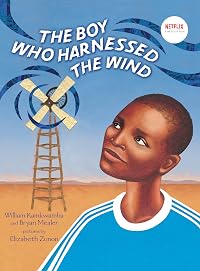
The Boy Who Harnessed the Wind: Picture Book Edition
by William Kamkwamba  , Bryan Mealer
On This Page
Description
"When 14-year-old William Kamkwamba's Malawi village was hit by a drought in 2001, everyone's crops began to fail. His family didn't have enough money for food, let alone school, so William spent his days in the library. He came across a book on windmills and figured out how to build a windmill that could bring electricity to his village. Everyone thought he was crazy but William persevered and managed to create a functioning windmill out of junkyard scraps. Several years later he figured show more out how to use the windmill for irrigation purposes"-- show lessTags
Recommendations
Member Reviews
Necessity is the mother of invention, and nowhere is that old adage more evident than in the true story of William Kamkwamba, a young Malawian boy who built a windmill on his father's land, in order to bring electricity to his family home for the first time. Facing possible starvation due to a drought-related famine, and unable to attend school, William began to investigate the machinery he found so fascinating at a nearby library set up by Americans. Here he discovered the idea of the windmill, and set out to build one of his own. Although some in his village laughed at him, he persisted, and soon achieved what had hitherto been only a dream: electric power...
Although I have been familiar with the story of William Kamkwamba for a show more number of years, since the publication of his memoir in 2009, I have never happened to pick up any of the versions of his story, be it the original edition intended for adult readers, the young reader's adaptation done in 2015, or this picture-book retelling created for younger children in 2012. I'm glad that I have finally rectified that oversight, as Kamkwamba's story is certainly inspirational. This picture-book telling is engaging, and is paired with the vibrantly colorful oil paint and cut paper illustrations of Elizabeth Zunon, whose work I know from such titles as One Plastic Bag: Isatou Ceesay and the Recycling Women of the Gambia, as well as her own Grandpa Cacao: A Tale of Chocolate, from Farm to Family. Recommended to young dreamers and inventors, and to picture-book readers looking for stories about overcoming great challenges with creativity and perseverance. show less
Although I have been familiar with the story of William Kamkwamba for a show more number of years, since the publication of his memoir in 2009, I have never happened to pick up any of the versions of his story, be it the original edition intended for adult readers, the young reader's adaptation done in 2015, or this picture-book retelling created for younger children in 2012. I'm glad that I have finally rectified that oversight, as Kamkwamba's story is certainly inspirational. This picture-book telling is engaging, and is paired with the vibrantly colorful oil paint and cut paper illustrations of Elizabeth Zunon, whose work I know from such titles as One Plastic Bag: Isatou Ceesay and the Recycling Women of the Gambia, as well as her own Grandpa Cacao: A Tale of Chocolate, from Farm to Family. Recommended to young dreamers and inventors, and to picture-book readers looking for stories about overcoming great challenges with creativity and perseverance. show less
Rating: 4.5* of five
The Book Report: The book description says:
When fourteen-year-old William Kamkwamba's Malawi village was hit by a drought, everyone's crops began to fail. Without enough money for food, let alone school, William spent his days in the library . . . and figured out how to bring electricity to his village. Persevering against the odds, William built a functioning windmill out of junkyard scraps, and thus became the local hero who harnessed the wind.
Lyrically told and gloriously illustrated, this story will inspire many as it shows how - even in the worst of times - a great idea and a lot of hard work can still rock the world.
My Review: Four stars for the delightful story of a young man who does NOT allow cuts in show more education funding caused by economic crisis to interfere with his learning, for the clear benefit clearly ascribed to the public library donated by the US Government, for the tale of a vision pursued and a piece of the world changed because of it, and for a man telling his story so that no one can feel it can't be done.
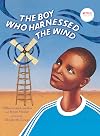
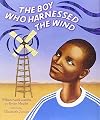
The half star is all down to the lovely mixed-media illos by Elizabeth Zunon. The young man's face and his family's presence in soft pastels contrasted with the three-dimensionality of the maize, the sun, etc...how nice a counterpoint it made.
Friend Joe Welch praised this book, so I'm happy to credit him with the shove to read it. My mood improved markedly after reading the book and absorbing its implication that a person can indeed change his world by simply refusing to allow negativity to stall him. Mr. Kamkwamba, thank you for making an old man's day brighter. show less
The Book Report: The book description says:
When fourteen-year-old William Kamkwamba's Malawi village was hit by a drought, everyone's crops began to fail. Without enough money for food, let alone school, William spent his days in the library . . . and figured out how to bring electricity to his village. Persevering against the odds, William built a functioning windmill out of junkyard scraps, and thus became the local hero who harnessed the wind.
Lyrically told and gloriously illustrated, this story will inspire many as it shows how - even in the worst of times - a great idea and a lot of hard work can still rock the world.
My Review: Four stars for the delightful story of a young man who does NOT allow cuts in show more education funding caused by economic crisis to interfere with his learning, for the clear benefit clearly ascribed to the public library donated by the US Government, for the tale of a vision pursued and a piece of the world changed because of it, and for a man telling his story so that no one can feel it can't be done.
The half star is all down to the lovely mixed-media illos by Elizabeth Zunon. The young man's face and his family's presence in soft pastels contrasted with the three-dimensionality of the maize, the sun, etc...how nice a counterpoint it made.
Friend Joe Welch praised this book, so I'm happy to credit him with the shove to read it. My mood improved markedly after reading the book and absorbing its implication that a person can indeed change his world by simply refusing to allow negativity to stall him. Mr. Kamkwamba, thank you for making an old man's day brighter. show less
The Boy who Harnessed The Wind is the powerful and very colorful story of William Kamkwamba. Most of the spectacle for me comes from the almost paper mache art style. In a way it almost reminds me of something psychedelic. The story is very inspiring but doesn't match the spectacle of the art leaving the story feeling unbalanced.
"The Boy Who Harnessed the Wind" tells the story of William Kamkwamba, a boy who built a windmill in order to produce electricity. Kamwamba grew up in Malawi with farmers for parents. A severe drought killed off his family's crops, as well as many others', and left much of Malawi starving. William's family could no longer afford to send him to school, so instead he spent his days at the library learning about science and engineering. He learned that he could produce electricity by creating a windmill and that this might eventually help him to pump water to his father's fields.
"The Boy Who Harnessed the Wind" is an inspiring story about William's dedication to learning and helping his family, despite extreme hardships. There is an show more interesting section at the back of the book that gives a more detailed explanation of William's story. Elizabeth Zunon's illustrations are a unique blend of painting and collage. I would recommend this book to first through fourth grade teachers. show less
"The Boy Who Harnessed the Wind" is an inspiring story about William's dedication to learning and helping his family, despite extreme hardships. There is an show more interesting section at the back of the book that gives a more detailed explanation of William's story. Elizabeth Zunon's illustrations are a unique blend of painting and collage. I would recommend this book to first through fourth grade teachers. show less
Slow read til end. Too detailed, but amazing achievement. KIRKUS REVIEWThe author and his collaborator have condensed the original memoir of the same name, a story of an innovative and compassionate boy coming of age during an era of extreme hardship in Malawi.This newest incarnation of Kamkwamba?s tale is as absorbing as its predecessor and still delivers with equanimity facts both disturbing and inspiring. Kamkwamba describes his early life in Masitala, a tiny rural village where, typically, large families of subsistence farmers lived in huts without electricity or running water. Until December 2000, Kamkwamba?s life reads like an African parallel to the idyllic, early-20th-century scenes in Sterling North?s Rascal: soccer with balls show more made from plastic bags; juicy mangoes and crunchy grasshoppers; storytelling by the light of a kerosene lamp; experiments with old radio parts; loyal friends and faithful pet. A perfect storm of deforestation, governmental changes, flooding and drought creates a sudden famine. The text does not spare readers the effects of starvation and grinding poverty on humans and animals. However, there are also many descriptions of how and why power-generating inventions work, and the passages about creating tools from almost nothing are reminiscent of Laura Ingalls Wilder?s Little House series. Against astounding odds, Kamkwamba?s eventual creation of a windmill to bring lighting to his family?s home is nothing short of amazing. Compelling and informative for a broad readership and a good addition to STEM collections. (map, prologue, photographs, epilogue, acknowledgments) (Memoir. 11-16) show less
This informational text is about the true story of William Kamkwamba and how he harnessed the wind for electricity. This book uses illustrations to bring the story to life. I would have this book in any elementary classroom. It is a great story of perseverance and the importance of education - even in less than ideal situations. It would be fun to introduce a science lesson about wind with this book.
The Boy Who Harnessed the Wind is the story of William Kamkwamba. Born in Malawi, he is interested in how things work. When his family faces drought and famine, he decides to helb by building a wind turbine out of trash he finds.
This is an inspiring story that touches on real issues. We feel for William and his family, he faces real trials in the form of hunger and poverty. He helps his family through hard work and determination. Even as the book ends with his success, it reminds the readers of all of the work he has ahead of him.
This is an inspiring story that touches on real issues. We feel for William and his family, he faces real trials in the form of hunger and poverty. He helps his family through hard work and determination. Even as the book ends with his success, it reminds the readers of all of the work he has ahead of him.
Members
- Recently Added By
Lists

One Picture Book Per Country
206 works; 1 member
Author Information

5 Works 6,039 Members
William Kamkwamba graduated from Dartmouth College. His memoir The Boy Who Harnessed the Wind was also adapted for young readers. (Bowker Author Biography)
William Kamkwamba is a LibraryThing Author, an author who lists their personal library on LibraryThing.

6+ Works 6,221 Members
All Editions
Awards and Honors
Awards
Notable Lists
Work Relationships
Is an adaptation of
Common Knowledge
- Canonical title
- The Boy Who Harnessed the Wind: Picture Book Edition
- People/Characters
- William Kamkwamba
- Important places
- Malawi
- Disambiguation notice
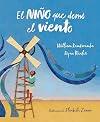
- This is the Picture Book Edition of this title. Please do not combine with the Young Reader's Edition or the original, as they are separate works.
Classifications
Statistics
- Members
- 662
- Popularity
- 43,631
- Reviews
- 36
- Rating
- (4.16)
- Languages
- English, Spanish
- Media
- Paper, Ebook
- ISBNs
- 5
- ASINs
- 3