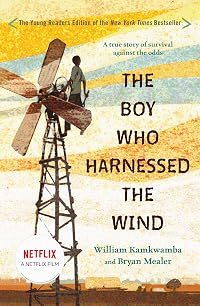
The Boy Who Harnessed the Wind [Young Readers Edition]
by William Kamkwamba  , Bryan Mealer (Author)
On This Page
Description
Now a Netflix film starring and directed by Chiwetel Ejiofor, this is a gripping memoir of survival and perseverance about the heroic young inventor who brought electricity to his Malawian village.When a terrible drought struck William Kamkwamba's tiny village in Malawi, his family lost all of the season's crops, leaving them with nothing to eat and nothing to sell. William began to explore science books in his village library, looking for a solution. There, he came up with the idea that show more would change his family's life forever: he could build a windmill. Made out of scrap metal and old bicycle parts, William's windmill brought electricity to his home and helped his family pump the water they needed to farm the land.
Retold for a younger audience, this exciting memoir shows how, even in a desperate situation, one boy's brilliant idea can light up the world. Complete with photographs, illustrations, and an epilogue that will bring readers up to date on William's story, this is the perfect edition to read and share with the whole family. show less
Tags
Recommendations











Member Reviews
Generally speaking, as an American, it’s pretty commonplace to cheer on a feel-good, up-from- poverty-to-overcome-the-odds story, especially when the story comes with its own subset of dramatic qualifiers – first a famine, then the floods, and, great heresy!, forbidden thinking, as in going against the grain in one’s own culture. That’s as quintessentially American as you can get. All the better when the story rises from another part of the world, as in the developing or “third” world, where the challenges are seemingly so insurmountable, one cannot help but root for the protagonist no matter the impossibility of the obstacles.
In The Boy Who Harnessed the Wind, William Kamkwamba tells a personal tale, as the cliché goes, show more so tall, only a team of Hollywood’s finest tear-jerker specialists might concoct such a story. Happily for us, it’s all true. But as many of us who stay attuned to micro-histories in our midst, the truly heroic gestures in the long history of humankind are often accomplished by an “everyperson” on a rather regular basis.
Kamkwamba’s mini-epic is that of an uber-geek hero – not the sort of uniform-clad demi-deity whose persona is adjusted for just this side of social justice, and set to “cool” for onscreen worship. William’s domain is the field of physics, specifically how to generate electricity from the junk and scrap yards near his small village in Malawi. First, he wants to do something practical, necessity being the mother of invention. But Kamwamba’s dreams were already big before he embarked on his quest to conquer darkness and bring light to his family, his village, and his country.
To read of a child devastated by the thought that s/he might not be able to attend school is refreshing and inspiring. Even the most jaded educator or stuck-in-the-mud cynic who knows well how apathetic the state of education is in the United States should come away feeling at least a glimmer of hope.
Kamkwamba’s persistence, once he is turned away from school for lack of funds to pay his fees, sets him on a path that he rarely leaves, save for when he must help in the harvest, a family enterprise which he writes about with great joy. The spirit-crushing stamina needed to stay alive living life as a starving child during a famine would be excuse enough to abandon any hopes of being hopeful –for what? If nature, upon which his family and village so fully depend, had forsaken them, what was left to hope for?
And yet, Kamkwamba maintains, buoyed by occasional thoughts of returning to his studies, strengthened by his friendships with a few close friends – Charity, Geoffrey, and Gilbert – grounded in his bonds with his family, and surviving the daily horror of watching the life die out of his dog, only to set him free in the blue-gum forest with the help of a friend who convinces Kamkwamba that it is more humane to allow him to pass on to the next world than endure another day of suffering. As loyal to the dog as the dog was to him, Kamkwamba is torn, but ultimately realizes that following his friend’s advice is best.
Yet, it is that same deep sense of compassion and selflessness – IN A CHILD – that steadies him as he weathers the criticism and heckling from family and community members alike regarding his curiosity to find treasure in trash. He is a master recycler – a poster child for the movement – and a determined DIY daredevil.
By the time Kamkwamba constructs, then climbs, his fabulously clumsy-looking contraption, you get a sense that he would just as easily be at home working in a special effects shop or stunt team as he makes science seem death-defyingly dangerous on a practical level. There were enough close calls during the latter half of the book to make you realize one person’s sense of derring-do could lead to a family’s demise, but done with the best of intentions.
This is a must read for everyone who loves the spunk of rebel spirit that drives our most driven inventors and creative-types. This is STEM on steroids to the nth degree. Kamkwamba is not merely an African/Malawian Benjamin Franklin or Thomas Edison; he joins the long line of inventors of color who, once enabled with knowledge and a sense of know-how, decided to apply their talents and sense of ingenuity to solve practical dilemmas.
As Kamkwamba now benefits from the benefactors who will not let a rising star’s ascendance fade anytime soon, who knows what else he will contribute to the world of creation? Let’s hope we are lucky enough to live in the midst of such brilliance, sustained by a drive to succeed despite the haters and hardheads who insist on saying “NO!” when all one needs is a chance to try and defy with a “YES!”. show less
In The Boy Who Harnessed the Wind, William Kamkwamba tells a personal tale, as the cliché goes, show more so tall, only a team of Hollywood’s finest tear-jerker specialists might concoct such a story. Happily for us, it’s all true. But as many of us who stay attuned to micro-histories in our midst, the truly heroic gestures in the long history of humankind are often accomplished by an “everyperson” on a rather regular basis.
Kamkwamba’s mini-epic is that of an uber-geek hero – not the sort of uniform-clad demi-deity whose persona is adjusted for just this side of social justice, and set to “cool” for onscreen worship. William’s domain is the field of physics, specifically how to generate electricity from the junk and scrap yards near his small village in Malawi. First, he wants to do something practical, necessity being the mother of invention. But Kamwamba’s dreams were already big before he embarked on his quest to conquer darkness and bring light to his family, his village, and his country.
To read of a child devastated by the thought that s/he might not be able to attend school is refreshing and inspiring. Even the most jaded educator or stuck-in-the-mud cynic who knows well how apathetic the state of education is in the United States should come away feeling at least a glimmer of hope.
Kamkwamba’s persistence, once he is turned away from school for lack of funds to pay his fees, sets him on a path that he rarely leaves, save for when he must help in the harvest, a family enterprise which he writes about with great joy. The spirit-crushing stamina needed to stay alive living life as a starving child during a famine would be excuse enough to abandon any hopes of being hopeful –for what? If nature, upon which his family and village so fully depend, had forsaken them, what was left to hope for?
And yet, Kamkwamba maintains, buoyed by occasional thoughts of returning to his studies, strengthened by his friendships with a few close friends – Charity, Geoffrey, and Gilbert – grounded in his bonds with his family, and surviving the daily horror of watching the life die out of his dog, only to set him free in the blue-gum forest with the help of a friend who convinces Kamkwamba that it is more humane to allow him to pass on to the next world than endure another day of suffering. As loyal to the dog as the dog was to him, Kamkwamba is torn, but ultimately realizes that following his friend’s advice is best.
Yet, it is that same deep sense of compassion and selflessness – IN A CHILD – that steadies him as he weathers the criticism and heckling from family and community members alike regarding his curiosity to find treasure in trash. He is a master recycler – a poster child for the movement – and a determined DIY daredevil.
By the time Kamkwamba constructs, then climbs, his fabulously clumsy-looking contraption, you get a sense that he would just as easily be at home working in a special effects shop or stunt team as he makes science seem death-defyingly dangerous on a practical level. There were enough close calls during the latter half of the book to make you realize one person’s sense of derring-do could lead to a family’s demise, but done with the best of intentions.
This is a must read for everyone who loves the spunk of rebel spirit that drives our most driven inventors and creative-types. This is STEM on steroids to the nth degree. Kamkwamba is not merely an African/Malawian Benjamin Franklin or Thomas Edison; he joins the long line of inventors of color who, once enabled with knowledge and a sense of know-how, decided to apply their talents and sense of ingenuity to solve practical dilemmas.
As Kamkwamba now benefits from the benefactors who will not let a rising star’s ascendance fade anytime soon, who knows what else he will contribute to the world of creation? Let’s hope we are lucky enough to live in the midst of such brilliance, sustained by a drive to succeed despite the haters and hardheads who insist on saying “NO!” when all one needs is a chance to try and defy with a “YES!”. show less
I enjoyed this book a lot, and stayed up waaaaaaay past my bedtime last night to finish it. An inspiring true story about a boy growing up in a farming village in Malawi. When drought and wide-spread famine come to Malawi, William has to drop out of school. Crushed, William finds solace in his primary school library, reading everything they have, and repeatedly checking out books about physics. A maker and tinkerer at heart, William reads and puzzles and then hunts scrap materials and fashions a crude windmill made entirely out of recycled parts. Villagers regard him and his creation with suspicion, but it works, and generates electricity for his family's farm. William's success leads to a radio report, an influential blog, and then a show more guest appearance at a TED event in Tanzania with other inspiring and innovative Africans. William's reaction the first time he is introduced to Google is priceless, and his story from high school dropout to Dartmouth graduate determined to improve the lives of rural Africans is so moving.
My husband has the original book. After some debate I decided to read the Young Readers Edition (not the picture book) from my library so I could recommend it to students. If there's a young tinkerer or dreamer you know, this would be a good choice. show less
My husband has the original book. After some debate I decided to read the Young Readers Edition (not the picture book) from my library so I could recommend it to students. If there's a young tinkerer or dreamer you know, this would be a good choice. show less
The Boy Who Harnessed the Wind could have easily been a disaster of a book, especially when you consider books for similar audience like "I Will Always Write Back." The highlighting of the problem of African poverty could have been just another contribution of the single story of Africa to be digested by Americans, but Kamkwamba's writing actually provides a rich picture of African life. Is it honest about his community's problems? Yes. Is it reductive? No.
What I loved most about this book is that it is a far cry from the white savior narrative. What I most like to see in books about "diverse" characters is AGENCY. Despite the odds against him, Kamkwamba takes full control of his fate AND the fate of his community. His persistence and show more innovation in creating his windmill, from teaching himself about engineering to making his own tools, shows readers the power an individual can have.
I would love to share this book with my faculty as it fits well with our project-based learning approach to curriculum. As we walk our students through The Design Cycle (Ask, Research, Imagine, Plan, Create, Evaluate, Improve) as a way to understand the cognitive process, I couldn't help but notice how Kamkwamba almost perfectly illustrates the cycle of creation. This book would be a great way to show students how well the scientific process can really work when approached with the right mindset. show less
What I loved most about this book is that it is a far cry from the white savior narrative. What I most like to see in books about "diverse" characters is AGENCY. Despite the odds against him, Kamkwamba takes full control of his fate AND the fate of his community. His persistence and show more innovation in creating his windmill, from teaching himself about engineering to making his own tools, shows readers the power an individual can have.
I would love to share this book with my faculty as it fits well with our project-based learning approach to curriculum. As we walk our students through The Design Cycle (Ask, Research, Imagine, Plan, Create, Evaluate, Improve) as a way to understand the cognitive process, I couldn't help but notice how Kamkwamba almost perfectly illustrates the cycle of creation. This book would be a great way to show students how well the scientific process can really work when approached with the right mindset. show less
I feel as if I'm not being critical enough, but I've loved the books we read this semester and this is no exception
In fact, I found this book the most inspiring and illuminating of all the books we read. The passages on the 2000 famine in Malawi made me so conscious of every bite I ate that day. I remembered the constant refrain of starving children in Africa that became almost a parody of itself i n my childhood and realized that Kamkwamba was living through his famine even as I laughed at my mother.
It might be a strange comparison, but reading this book reminded me of the first time I read Dune and became aware of every drink of water or drop lost in the shower. My overhead lighting, gas fireplaces, hot showers and broken down show more laptop all began to dazzle me.
My favorite books in life are the ones that heighten my awareness and make me step into another perspective of the world. Kamkwamba did more than make me realize what I daily take for granted. He made me contemplate all that can be accomplished without these conveniences. He made me think about the nature of community and what's lost or gained in a modernized world. He made me think about the opportunities that I've had from birth and how much an education I've always considered second rate has truly given me.
It's not that I've never thought about these things. That's not the point. Its that the feeling of their truths is so easily forgotten. With his easy first person style, Kamkwamba creates a relatable vision of a world otherwise alien to students in the western world. show less
In fact, I found this book the most inspiring and illuminating of all the books we read. The passages on the 2000 famine in Malawi made me so conscious of every bite I ate that day. I remembered the constant refrain of starving children in Africa that became almost a parody of itself i n my childhood and realized that Kamkwamba was living through his famine even as I laughed at my mother.
It might be a strange comparison, but reading this book reminded me of the first time I read Dune and became aware of every drink of water or drop lost in the shower. My overhead lighting, gas fireplaces, hot showers and broken down show more laptop all began to dazzle me.
My favorite books in life are the ones that heighten my awareness and make me step into another perspective of the world. Kamkwamba did more than make me realize what I daily take for granted. He made me contemplate all that can be accomplished without these conveniences. He made me think about the nature of community and what's lost or gained in a modernized world. He made me think about the opportunities that I've had from birth and how much an education I've always considered second rate has truly given me.
It's not that I've never thought about these things. That's not the point. Its that the feeling of their truths is so easily forgotten. With his easy first person style, Kamkwamba creates a relatable vision of a world otherwise alien to students in the western world. show less
Goodreads Review:
William Kamkwamba was born in Malawi, a country where magic ruled and modern science was mystery. It was also a land withered by drought and hunger, and a place where hope and opportunity were hard to find. But William had read about windmills in a book called Using Energy, and he dreamed of building one that would bring electricity and water to his village and change his life and the lives of those around him. His neighbors may have mocked him and called him misala—crazy—but William was determined to show them what a little grit and ingenuity could do.
Enchanted by the workings of electricity as a boy, William had a goal to study science in Malawi's top boarding schools. But in 2002, his country was stricken with a show more famine that left his family's farm devastated and his parents destitute. Unable to pay the eighty-dollar-a-year tuition for his education, William was forced to drop out and help his family forage for food as thousands across the country starved and died.
Yet William refused to let go of his dreams. With nothing more than a fistful of cornmeal in his stomach, a small pile of once-forgotten science textbooks, and an armory of curiosity and determination, he embarked on a daring plan to bring his family a set of luxuries that only two percent of Malawians could afford and what the West considers a necessity—electricity and running water. Using scrap metal, tractor parts, and bicycle halves, William forged a crude yet operable windmill, an unlikely contraption and small miracle that eventually powered four lights, complete with homemade switches and a circuit breaker made from nails and wire. A second machine turned a water pump that could battle the drought and famine that loomed with every season.
Soon, news of William's magetsi a mphepo—his "electric wind"—spread beyond the borders of his home, and the boy who was once called crazy became an inspiration to those around the world.
Here is the remarkable story about human inventiveness and its power to overcome crippling adversity. The Boy Who Harnessed the Wind will inspire anyone who doubts the power of one individual's ability to change his community and better the lives of those around him. show less
William Kamkwamba was born in Malawi, a country where magic ruled and modern science was mystery. It was also a land withered by drought and hunger, and a place where hope and opportunity were hard to find. But William had read about windmills in a book called Using Energy, and he dreamed of building one that would bring electricity and water to his village and change his life and the lives of those around him. His neighbors may have mocked him and called him misala—crazy—but William was determined to show them what a little grit and ingenuity could do.
Enchanted by the workings of electricity as a boy, William had a goal to study science in Malawi's top boarding schools. But in 2002, his country was stricken with a show more famine that left his family's farm devastated and his parents destitute. Unable to pay the eighty-dollar-a-year tuition for his education, William was forced to drop out and help his family forage for food as thousands across the country starved and died.
Yet William refused to let go of his dreams. With nothing more than a fistful of cornmeal in his stomach, a small pile of once-forgotten science textbooks, and an armory of curiosity and determination, he embarked on a daring plan to bring his family a set of luxuries that only two percent of Malawians could afford and what the West considers a necessity—electricity and running water. Using scrap metal, tractor parts, and bicycle halves, William forged a crude yet operable windmill, an unlikely contraption and small miracle that eventually powered four lights, complete with homemade switches and a circuit breaker made from nails and wire. A second machine turned a water pump that could battle the drought and famine that loomed with every season.
Soon, news of William's magetsi a mphepo—his "electric wind"—spread beyond the borders of his home, and the boy who was once called crazy became an inspiration to those around the world.
Here is the remarkable story about human inventiveness and its power to overcome crippling adversity. The Boy Who Harnessed the Wind will inspire anyone who doubts the power of one individual's ability to change his community and better the lives of those around him. show less
Keep the tissues nearby when reading this story. Between the heartbreaking descriptions of narrowly surviving a famine to the astounding and, at times, unimaginable perseverance of an adolescent boy, this story kept the tears welling in my eyes. William Kamkwamba was a young boy living in Malawi, Africa when an devastating famine took hold of his community. During a drought with no end in sight, William and his family found themselves without much food, without much money, and, eventually for William, without an education.
As he watched those around him slowly wear away to skin and bones, including his loving canine companion, William knew that something must be done to keep those he loved alive. Although his family was unable to afford show more his secondary school fees, William still managed to continue learning by visiting the local library and reading everything he could get his hands on, especially science-related matter. Without divulging too much of the plot, William uses scraps of metal and electronics to build a windmill. The sheer determination of his project and the numerous positive effects that unfold because of it can't help but make you smile. To read of a young man seeing the internet, an elevator, and a subway card for the first time, almost like seeing through the eyes of a child on Christmas morning, just pulls on your heartstrings.
This story would be amazing to read about from the perspective of any young person with a dream, but the fact that this all happened in a destitute part of Africa makes it much more astounding. From a young boy who truly knew what it was like to be hungry, what it was like to be poverty-stricken, and what it was like to want an education, but not have the capability to receive it, this unimaginable, yet uplifting story portrays how greatness can be achieved in any culture, by any race, and by someone in any economical situation. Beautifully told story that should be read by all! show less
As he watched those around him slowly wear away to skin and bones, including his loving canine companion, William knew that something must be done to keep those he loved alive. Although his family was unable to afford show more his secondary school fees, William still managed to continue learning by visiting the local library and reading everything he could get his hands on, especially science-related matter. Without divulging too much of the plot, William uses scraps of metal and electronics to build a windmill. The sheer determination of his project and the numerous positive effects that unfold because of it can't help but make you smile. To read of a young man seeing the internet, an elevator, and a subway card for the first time, almost like seeing through the eyes of a child on Christmas morning, just pulls on your heartstrings.
This story would be amazing to read about from the perspective of any young person with a dream, but the fact that this all happened in a destitute part of Africa makes it much more astounding. From a young boy who truly knew what it was like to be hungry, what it was like to be poverty-stricken, and what it was like to want an education, but not have the capability to receive it, this unimaginable, yet uplifting story portrays how greatness can be achieved in any culture, by any race, and by someone in any economical situation. Beautifully told story that should be read by all! show less
The Boy Who Harnessed the Wind has the curious power to both shame and inspire. Reading William Kamkwamba's account of how he brought electricity and water to his Malawian village will make any emotionally healthy reader check her privilege. As I got to know Kamkwamba—his optimism in the face of suffering and his seemingly boundless ingenuity—I felt uncomfortably aware of the imbalance between my expectations of the world and my contributions to the world. But far stronger than that was a reanimated sense of possibility and potential.
Warm, funny, heartbreaking, and charmingly written—Kamkwamba collaborates with Bryan Mealer—the book is never maudlin or heavy-handed; even during the weightiest moments, the power of the story show more comes from the simplicity of the telling. Readers may find hard to get through the chapters describing the terrible famine that gripped Malawi in 2001, but the tale that follows is incredibly uplifting. It's impossible not to stand in awe of Kamkwamba as he teaches himself key principles of science through visits to his understocked local library, or cobbles together a working windmill from random items he finds in a scrapyard—tractor fan, bike frame and generator, old PVC pipes, and other forgotten "junk."
Through it all, Kamkwamba's distinctive voice—good-natured, self-aware, affectionate, and naturally curious—comes through on every page. The Boy Who Harnessed the Wind is the rare work that can be used in several classrooms at once: English, social studies, and science teachers could plan a wonderful interdisciplinary unit around this extraordinary book. show less
Warm, funny, heartbreaking, and charmingly written—Kamkwamba collaborates with Bryan Mealer—the book is never maudlin or heavy-handed; even during the weightiest moments, the power of the story show more comes from the simplicity of the telling. Readers may find hard to get through the chapters describing the terrible famine that gripped Malawi in 2001, but the tale that follows is incredibly uplifting. It's impossible not to stand in awe of Kamkwamba as he teaches himself key principles of science through visits to his understocked local library, or cobbles together a working windmill from random items he finds in a scrapyard—tractor fan, bike frame and generator, old PVC pipes, and other forgotten "junk."
Through it all, Kamkwamba's distinctive voice—good-natured, self-aware, affectionate, and naturally curious—comes through on every page. The Boy Who Harnessed the Wind is the rare work that can be used in several classrooms at once: English, social studies, and science teachers could plan a wonderful interdisciplinary unit around this extraordinary book. show less
Members
- Recently Added By
Lists

Beautiful Feet Books
304 works; 7 members
Author Information

5 Works 6,020 Members
William Kamkwamba graduated from Dartmouth College. His memoir The Boy Who Harnessed the Wind was also adapted for young readers. (Bowker Author Biography)
William Kamkwamba is a LibraryThing Author, an author who lists their personal library on LibraryThing.

Some Editions
Awards and Honors
Work Relationships
Is an adaptation of
Common Knowledge
- Canonical title
- The Boy Who Harnessed the Wind [Young Readers Edition]
- Original publication date
- 2015
- People/Characters
- William Kamkwamba
- Important places
- Malawi
- Dedication
- To my family
-- W.K. - First words
- The machine was ready. (Prologue)
My name is William Kamkwamba, and to understand the story that I am about to tell, you must first understand the country that raised me. - Last words
- (Click to show. Warning: May contain spoilers.)Think of your dreams and ideas as tiny miracle machines inside you that no-one can touch. The more faith you put into them, the bigger they get, until one day they'll rise up and take you with them.
- Publisher's editor
- Hornik, Lauri
- Blurbers
- Gore, Al; Isaacson, Walter
- Original language
- English
- Disambiguation notice
- This is the Young Reader's Edition of this title. Please do not combine with the original, which has the subtitle : Creating Currents of Electricity and Hope, or the Picture Book Edition, as they are separate works.
Classifications
Statistics
- Members
- 2,169
- Popularity
- 9,381
- Reviews
- 81
- Rating
- (4.41)
- Languages
- Chinese, English, Korean
- Media
- Paper, Audiobook, Ebook
- ISBNs
- 22
- ASINs
- 4