On This Page
Description
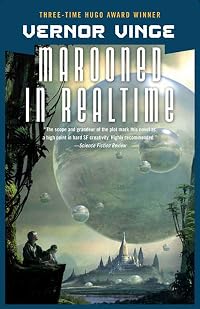
"In this thriller, nobody knows why there are only three hundred humans left alive on the Earth fifty million years from now. Opinion is fiercely divided on whether to settle in and plant the seed of mankind anew, or to continue using high-energy stasis fields, or "bobbles," in venturing into the future. When somebody is murdered, it's obvious that someone has a secret and is willing to kill to preserve it. The murder intensifies the rift between the two factions, threatening the survival of show more the human race. It's up to twenty-first-century detective Wil Brierson, the only cop left in the world, to find the culprit, a diabolical fiend whose lust for power could cause the utter extinction of man."--BOOK JACKET. show lessTags
Recommendations






Member Reviews
3.5/5
A sequel to Vinge's The Peace War, but set millions of years in the distant future as the last three hundred humans struggle for their survival. These humans were bobbled at various point since the events of the first book, and all found themselves back in realtime when the human race has been erased, whether through war, alien invasion, or technological singularity no one is sure. A high-tech couple that bobbled forward has plans to restart the human race, and to do so they gather all the stragglers they can find, even roping in an isolated cell of Peacers and NM government officials. Everything is thrown into jeopardy when Marta, the primary architect of this plan, is left outside of the bobble as the community travels farther show more into the future for a more ideal setting. Her partner hires a detective from the old world to solve her murder, and it is through his eyes we experience this murder mystery in the future.
I will say that it's refreshing to have a sequel set far after the events of the first novel. Sure, a few of the same characters pop up, and lots of the exposition depends on your knowledge from The Peace War, but I appreciate Vinge's confidence to tell a completely different type of story.
The highlights of this sequel are by far the diary of Marta, as she experiences life, and survival, for the first time without the support of technology. Vinge does a great job of capturing the tragedy of her story, and it's the first time I felt strong emotion for a character across both of these novels. Outside of her story, most of the characters are wooden enough as to be forgettable. The other strong point is the world, the history of the world that it's set. I love Vinge's extrapolation of what the bobbling tech, cybernetics, and virtual immorality might lead to in terms of politics, warfare, crime, technology, exploration, ecology, and human nature itself. We see a people that are so utterly dependent on that high tech that they sometimes collapse into a coma-like state without it. Yet underneath that dependence is a irrepressible toughness of the human spirit, something we see firsthand in Marta during her struggle in realtime. Vinge's humanity, while weakened by the technology they love so much, are still optimistically portrayed both as individuals and as a community.
The conclusion to the mystery is, unfortunately, extremely suspect, and falls back onto tropes pretty badly. Yes, Marooned in Realtime doesn't hide that it loves all of those tropes, but it's eye-rolling painful when the detective at the end suggests that he essentially knew whodunit all along. The conclusion is rushed, both in the moment and in the setup, and the ending to me feels like the most important part of mystery like this. Otherwise why am I reading it? The author has made me buy into the tension, the drama of the mystery, and if the reveal is lackluster it will taint the rest of the book. Vinge is also dependent on long winded exposition blocks that rip you right out of the present moment of the story. I get that there's a lot to explain, but Vinge hardly tries to make those things come up naturally within the context of the narrative.
This is a diptych much more focused on ideas than on people, narrative, prose, or a strong thematic viewpoint. Yet I still enjoyed reading them. In terms of mid-tier SF that's focused on the ideas, it's actually pretty good. If this is your type of thing, I would recommend it for a good bit of fun, spending time 50 megayears from now. show less
A sequel to Vinge's The Peace War, but set millions of years in the distant future as the last three hundred humans struggle for their survival. These humans were bobbled at various point since the events of the first book, and all found themselves back in realtime when the human race has been erased, whether through war, alien invasion, or technological singularity no one is sure. A high-tech couple that bobbled forward has plans to restart the human race, and to do so they gather all the stragglers they can find, even roping in an isolated cell of Peacers and NM government officials. Everything is thrown into jeopardy when Marta, the primary architect of this plan, is left outside of the bobble as the community travels farther show more into the future for a more ideal setting. Her partner hires a detective from the old world to solve her murder, and it is through his eyes we experience this murder mystery in the future.
I will say that it's refreshing to have a sequel set far after the events of the first novel. Sure, a few of the same characters pop up, and lots of the exposition depends on your knowledge from The Peace War, but I appreciate Vinge's confidence to tell a completely different type of story.
The highlights of this sequel are by far the diary of Marta, as she experiences life, and survival, for the first time without the support of technology. Vinge does a great job of capturing the tragedy of her story, and it's the first time I felt strong emotion for a character across both of these novels. Outside of her story, most of the characters are wooden enough as to be forgettable. The other strong point is the world, the history of the world that it's set. I love Vinge's extrapolation of what the bobbling tech, cybernetics, and virtual immorality might lead to in terms of politics, warfare, crime, technology, exploration, ecology, and human nature itself. We see a people that are so utterly dependent on that high tech that they sometimes collapse into a coma-like state without it. Yet underneath that dependence is a irrepressible toughness of the human spirit, something we see firsthand in Marta during her struggle in realtime. Vinge's humanity, while weakened by the technology they love so much, are still optimistically portrayed both as individuals and as a community.
The conclusion to the mystery is, unfortunately, extremely suspect, and falls back onto tropes pretty badly. Yes, Marooned in Realtime doesn't hide that it loves all of those tropes, but it's eye-rolling painful when the detective at the end suggests that he essentially knew whodunit all along. The conclusion is rushed, both in the moment and in the setup, and the ending to me feels like the most important part of mystery like this. Otherwise why am I reading it? The author has made me buy into the tension, the drama of the mystery, and if the reveal is lackluster it will taint the rest of the book. Vinge is also dependent on long winded exposition blocks that rip you right out of the present moment of the story. I get that there's a lot to explain, but Vinge hardly tries to make those things come up naturally within the context of the narrative.
This is a diptych much more focused on ideas than on people, narrative, prose, or a strong thematic viewpoint. Yet I still enjoyed reading them. In terms of mid-tier SF that's focused on the ideas, it's actually pretty good. If this is your type of thing, I would recommend it for a good bit of fun, spending time 50 megayears from now. show less
An enjoyable scifi mystery, although I was more engaged by its unusual premise and structure than by the actual sleuthing part, which felt a bit underbaked.
I should also note that I read the entire thing without realizing it was #2 in a series. So it works just fine as a standalone novel, for anyone who wants to just drop in for the detective story.
I should also note that I read the entire thing without realizing it was #2 in a series. So it works just fine as a standalone novel, for anyone who wants to just drop in for the detective story.
I really enjoyed Vinge's A Fire Upon the Deep and A Deepness in the Sky, so I was eager to pick up some of his earlier work. I found this book to be a little bit of a disappointment. Marooned in Realtime certainly starts with a a great concept: a group of people pop out of stasis fields to discover that humanity has vanished from the earth pretty much without a trace. This leaves them in a bit of a predicament. They continue to use these stasis bubbles to make discreet jumps forward in time, but a clever killer manages to trap Marta, one of their leaders, outside the bubble, leaving her to live and ultimately die in solitude while every other surviving human lives on into the future inside the stasis field. The next time the group pops show more out into "realtime," they discover what has happened and set Brierson, a surviving lawman, to figure out what happened. I'd describe the book as a mystery that is more effective as science fiction than as a mystery.
The only character I developed much empathy for was Marta, who had forty years of solitude to figure out who had killed her, and to leave clues for those who would come later to investigate, knowing that the killer would be there to try to prevent any message from getting through. Marooned in Realtime is entertaining and suspenseful, but the ultimate resolution (especially the message from Brierson's long dead wife) left me only partially satisfied. show less
The only character I developed much empathy for was Marta, who had forty years of solitude to figure out who had killed her, and to leave clues for those who would come later to investigate, knowing that the killer would be there to try to prevent any message from getting through. Marooned in Realtime is entertaining and suspenseful, but the ultimate resolution (especially the message from Brierson's long dead wife) left me only partially satisfied. show less
Vernor Vinge writes pretty imaginative and (to me) unusual SciFi books, and this one was no exception. It's the second part of the series, but it's all much later than the first book, by thousands (millions?) of years. Something (humans? We never know for sure) all but destroyed the human race, and now they're close to finalizing that act. But mixed with that is a simple murder mystery to occupy our interest until the end.
I found it to be thoughtful and interesting, like most of his books. In this story, he expands the concept of the bobbles introduced in the last book, and they are used in ways you might never expect.
I found it to be thoughtful and interesting, like most of his books. In this story, he expands the concept of the bobbles introduced in the last book, and they are used in ways you might never expect.
A fun read, and like Deepness in the Sky, very much a book of ideas.
Rousseau says: "Give civilized man time to gather all his machines about him, and he will no doubt easily beat the savage; but if you would see a still more unequal contest, set them together naked and unarmed, and you will soon see the advantage of having all our forces constantly at our disposal, of being always prepared for every event, and of carrying one's self, as it were, perpetually whole and entire about one." Vinge says -- "unless it's a civilized man who has prepared for an endurance game..."
Rousseau says: "Give civilized man time to gather all his machines about him, and he will no doubt easily beat the savage; but if you would see a still more unequal contest, set them together naked and unarmed, and you will soon see the advantage of having all our forces constantly at our disposal, of being always prepared for every event, and of carrying one's self, as it were, perpetually whole and entire about one." Vinge says -- "unless it's a civilized man who has prepared for an endurance game..."
This book surprised me. It started out pretty slow and slightly confusing ... it's a sequel to the previous novel, but I didn't really recognize any characters, just the technology they talk about. Rather suddenly, a little more than halfway through the book, all the exposition was done and the story entered fast-paced intense mode. I finished the last half in two days. Quite a good story!
Vernor introduces, at least to me, a new concept in his "bobbles" as a way of traveling in time. It strikes me as a lonely journey if you undertake it by your self. The people in the book have access to life prolonging technologies and other advancements, but the warring nature of our species continues to plague our existence.
Members
- Recently Added By
Published Reviews
Dit boek is het vervolg op 'de vredesoorlog', maar onafhankelijk te lezen. Het verhaal speelt miljoenen jaren na nu, de beschaving en de mensheid zijn onder onduidelijke omstandigheden verdwenen. Slechts een klein aantal personen heeft de ondergang overleefd. Een ieder probeert er het beste van te maken, want ziekte en dood zijn geen realiteit meer. Twee vrouwen proberen de mensheid te show more restaureren. Niet iedereen is even enthousiast, er wordt een moord gepleegd. Hier neemt het verhaal een wending en wordt van sociologische-sf een sf-detective compleet met excentrieke personen en hoogstaande technologie. Dit alles is spannend geschreven en compleet met mega-schurk. show less
added by karnoefel
Lists

Libertarian Books
102 works; 18 members

Singularity
12 works; 1 member

Schisms in transhumanity - SF
34 works; 1 member

Unshelved Book Clubs
579 works; 5 members

Forced Exposure
83 works; 1 member

Books Read in 2021
5,361 works; 113 members

Books Read in 2026
1,919 works; 66 members
Author Information

58+ Works 23,204 Members
Some Editions
Awards and Honors
Awards
Series

Belongs to Publisher Series
Work Relationships
Common Knowledge
- Original title
- Marooned in Realtime
- Original publication date
- 1986
- People/Characters
- Wil Brierson; Della Lu; Marta Korolev; Yelén Korolev; Steve Fraley; Kim Tioulang
- Dedication
- To all those Marooned without hope of rescue
- First words
- On the day of the big rescue, Wil Brierson took a walk on the beach.
- Last words
- (Click to show. Warning: May contain spoilers.)The one who still lives, the one who has not said goodbye.
- Publisher's editor
- Frenkel, James
Classifications
Statistics
- Members
- 1,340
- Popularity
- 17,877
- Reviews
- 18
- Rating
- (3.95)
- Languages
- 7 — Dutch, English, Finnish, French, German, Italian, Spanish
- Media
- Paper, Ebook
- ISBNs
- 13
- ASINs
- 9