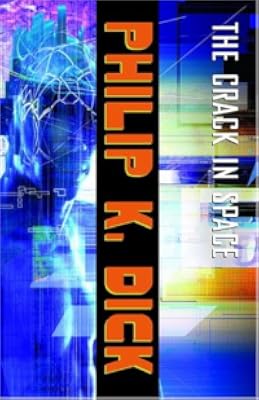
The Crack in Space
by Philip K. Dick
On This Page
Description
A repairman discovers that a hole in a faulty Jifi-scuttler leads to a parallel world. Jim Briskin, campaigning to be the first black president of the United States, thinks alter-Earth is the solution to the chronic overpopulation that has seventy million people cryogenically frozen; Tito Cravelli, a shadowy private detective, wants to know why Dr Lurton Sands is hiding his mistress on the planet; billionaire mutant George Walt wants to make the empty world all his own. But when the other show more earth turns out to be inhabited, everything changes. show lessTags
Recommendations
















Member Reviews
In an overpopulated world, millions of people have elected to become bibs (cryogenically frozen until the job market opens up), abortion centers are prospering, and prostitution has been made legal on orbiting satellites (to ease "frustrations", while preventing pregnancy). It's a huge problem faced by the presidential candidates, who must present solutions to this problem if they are to be elected.
Jim Briskin announces in a public speech a possible solution. A company has stumbled upon a portal to a parallel world, apparently uninhabited, to which people can emigrate. This announcement opens a whole can of worms and new problems, especially when they find out the alternate world was not as unpopulated as they all thought.
Mixed in show more with all the population stuff are constant commentaries about race relations, most notably because Briskin, a Col, could be the first black president of the United States. I couldn't help but read this and think about the fact that President Obama is currently in the white house. The race question gets confounded even further once the people on alt-earth are discovered.
It's a fairly short read, and it goes very quick. But a lot gets packed into it, and there's a lot of jumping from character to character. Dick doesn't seem to be as interested in achieving an emotional connection with the reader as an intellectual one. You're not meant to feel for the characters or get to know them, you're meant to get a taste for their point of view. Every one's got an opinion, and the author presents many of them, so many that it's not entirely clear where he stands on anything. This is a thinking book, certainly fun, but one that I would like to sit with a book group and chat about. A reader could come at it from many angles -- each would be correct. show less
Jim Briskin announces in a public speech a possible solution. A company has stumbled upon a portal to a parallel world, apparently uninhabited, to which people can emigrate. This announcement opens a whole can of worms and new problems, especially when they find out the alternate world was not as unpopulated as they all thought.
Mixed in show more with all the population stuff are constant commentaries about race relations, most notably because Briskin, a Col, could be the first black president of the United States. I couldn't help but read this and think about the fact that President Obama is currently in the white house. The race question gets confounded even further once the people on alt-earth are discovered.
It's a fairly short read, and it goes very quick. But a lot gets packed into it, and there's a lot of jumping from character to character. Dick doesn't seem to be as interested in achieving an emotional connection with the reader as an intellectual one. You're not meant to feel for the characters or get to know them, you're meant to get a taste for their point of view. Every one's got an opinion, and the author presents many of them, so many that it's not entirely clear where he stands on anything. This is a thinking book, certainly fun, but one that I would like to sit with a book group and chat about. A reader could come at it from many angles -- each would be correct. show less
'60s Dick Reading Challenge, Book 1
So, I set a goal for myself, to read all of the books written by my favorite SFF author, Philip K. Dick, in the 1960s. This is a somewhat arbitrary goal, but I've been jonesing to get back into some good SFF, and specifically PKD, so that's what I did. I eventually want to read all the novels, as I am obsessive about completion. I just wish I hadn't picked this one to start with. It is bad.
I'll give PKD some props; I think his heart was in the right place. Probably beating too fast, thanks to the amphetamines he frequently wrote with.
[b:The Crack in Space|22586|The Crack in Space|Philip K. Dick|https://i.gr-assets.com/images/S/compressed.photo.goodreads.com/books/1320394432l/22586._SY75_.jpg|23604] show more serves as a good example of why I've always disliked religious propaganda disguised as mainstream media. When I was growing up, there was a push to like "Christian rock," but it stood out to me as disingenuous, motivated by the religion and not the art, and therefore missing most of the stuff that appealed to those who just wanted some good music. Like stirring baby aspirin in applesauce. Here, Dick has a message, and it's about as subtle as Stryper was in the 80s.
[b:The Crack in Space|22586|The Crack in Space|Philip K. Dick|https://i.gr-assets.com/images/S/compressed.photo.goodreads.com/books/1320394432l/22586._SY75_.jpg|23604] focuses on an in-progress presidential campaign, and like much of Dick's writing, the future setting of the story is one that is noticeably different than our current (or his 60s-era current) times. A black man is running for president in this future, and putting aside the fact that it seems quaint given the post-Obama world I read it in, it just manages to feel forced and a little cringe-y. Some of this can be attributed to the outdated language used when talking about race. No, it doesn't go there, but it gets uncomfortable.
Not surprisingly, the ideas in Dick's novels are sometimes better than the execution, and when dealing with the realities of race (putting aside the very obviously treated as pure, fantastical speculation that the presidential run must have seemed to him) and the economy, systemic inequalities, and over-population. The fact that there are millions who are in suspended animation due to a severe lack of jobs, that those suspended are mostly "cols" (see? yikes) who see long-term hibernation for a possible future as being more hopeful than living in a world that, even in the mind of this writer, still can't come to terms with systemic racism and economic oppression, really says a lot.
The problem with this novel is that this commentary on race, as much as it is present at all, seems to have happened by accident, and is a theme that is never fully explored. Add to that a soap opera-esque inclination to have characters speak much of the exposition, and to craft that dialog as if intending to represent the Transatlantic accent in written form, well, it gets to be a bit much, with little to tempt a reader who hasn't challenged himself to read all the novels written in the 60s by a particular author. show less
So, I set a goal for myself, to read all of the books written by my favorite SFF author, Philip K. Dick, in the 1960s. This is a somewhat arbitrary goal, but I've been jonesing to get back into some good SFF, and specifically PKD, so that's what I did. I eventually want to read all the novels, as I am obsessive about completion. I just wish I hadn't picked this one to start with. It is bad.
I'll give PKD some props; I think his heart was in the right place. Probably beating too fast, thanks to the amphetamines he frequently wrote with.
[b:The Crack in Space|22586|The Crack in Space|Philip K. Dick|https://i.gr-assets.com/images/S/compressed.photo.goodreads.com/books/1320394432l/22586._SY75_.jpg|23604] show more serves as a good example of why I've always disliked religious propaganda disguised as mainstream media. When I was growing up, there was a push to like "Christian rock," but it stood out to me as disingenuous, motivated by the religion and not the art, and therefore missing most of the stuff that appealed to those who just wanted some good music. Like stirring baby aspirin in applesauce. Here, Dick has a message, and it's about as subtle as Stryper was in the 80s.
[b:The Crack in Space|22586|The Crack in Space|Philip K. Dick|https://i.gr-assets.com/images/S/compressed.photo.goodreads.com/books/1320394432l/22586._SY75_.jpg|23604] focuses on an in-progress presidential campaign, and like much of Dick's writing, the future setting of the story is one that is noticeably different than our current (or his 60s-era current) times. A black man is running for president in this future, and putting aside the fact that it seems quaint given the post-Obama world I read it in, it just manages to feel forced and a little cringe-y. Some of this can be attributed to the outdated language used when talking about race. No, it doesn't go there, but it gets uncomfortable.
Not surprisingly, the ideas in Dick's novels are sometimes better than the execution, and when dealing with the realities of race (putting aside the very obviously treated as pure, fantastical speculation that the presidential run must have seemed to him) and the economy, systemic inequalities, and over-population. The fact that there are millions who are in suspended animation due to a severe lack of jobs, that those suspended are mostly "cols" (see? yikes) who see long-term hibernation for a possible future as being more hopeful than living in a world that, even in the mind of this writer, still can't come to terms with systemic racism and economic oppression, really says a lot.
The problem with this novel is that this commentary on race, as much as it is present at all, seems to have happened by accident, and is a theme that is never fully explored. Add to that a soap opera-esque inclination to have characters speak much of the exposition, and to craft that dialog as if intending to represent the Transatlantic accent in written form, well, it gets to be a bit much, with little to tempt a reader who hasn't challenged himself to read all the novels written in the 60s by a particular author. show less
This was one of the books I picked up during my last visit to my library. It caught my eye as I walked past the Fantasy & Sci-fi section, a section that I rarely venture into. I have a strange relationship with Sci-fi, I love watching it but the bug hasn't translated to my reading for some reason. The few Sci-fi titles that I have read have all been entertaining but I still haven't found the book that makes me really sit up and say 'wow'.
I was a little worried when I started this book that it would be a sequel and I would miss out on not having the back story. From what I can make out having finished the book is that some of the characters do feature in other books but I didn't really feel like I should have read the others first. There show more were a lot of characters in the opening chapters and I did find myself flicking back in the initial stages checking who certain people were. This was short lived though and by a quarter of the way through the book I had settled with the characters and the world in which the inhabit. One thing that I did have difficultly visualizing though was the Jifi-scuttler.
A huge theme in the book is race and it is introduced very early. Initially I was put off but the term 'cols' used to describe anyone who wasn't white in the American future. I always try to accept that certain language was acceptable when a given book was written (1966 in this case). It became apparent very quickly though that this term is used to demonstrate that prejudice still existed in this world and that it was wrong. Another thing that struck me is that as the time this book was written a black presidential candidate would have been unthinkable. Of course, today we have Obama as the president of America but it is still a very powerful aspect of the book.
The writing is very easy on the mind, the pace just about right and the story is a great one. The fact that Dick manages to get so many social issues into one story is a testament to the talent he clearly had. There are so many issues that it would have been easy for them to all feel crow-barred into the story but they don't. They fit naturally and are presented really well.
This was a very entertaining read, I look forward to reading more Philip K. Dick. show less
I was a little worried when I started this book that it would be a sequel and I would miss out on not having the back story. From what I can make out having finished the book is that some of the characters do feature in other books but I didn't really feel like I should have read the others first. There show more were a lot of characters in the opening chapters and I did find myself flicking back in the initial stages checking who certain people were. This was short lived though and by a quarter of the way through the book I had settled with the characters and the world in which the inhabit. One thing that I did have difficultly visualizing though was the Jifi-scuttler.
A huge theme in the book is race and it is introduced very early. Initially I was put off but the term 'cols' used to describe anyone who wasn't white in the American future. I always try to accept that certain language was acceptable when a given book was written (1966 in this case). It became apparent very quickly though that this term is used to demonstrate that prejudice still existed in this world and that it was wrong. Another thing that struck me is that as the time this book was written a black presidential candidate would have been unthinkable. Of course, today we have Obama as the president of America but it is still a very powerful aspect of the book.
The writing is very easy on the mind, the pace just about right and the story is a great one. The fact that Dick manages to get so many social issues into one story is a testament to the talent he clearly had. There are so many issues that it would have been easy for them to all feel crow-barred into the story but they don't. They fit naturally and are presented really well.
This was a very entertaining read, I look forward to reading more Philip K. Dick. show less
http://www.infinityplus.co.uk/nonfiction/cantata140.htm
This is not one of Philip K. Dick's typical novels. The plot is linear and coherent, and at no point are any of the major characters confronted with the awful possibility that the universe as they experience it may be only apparently real. Unfortunately this also means that as Dick novels go, this is not a particularly good one.
Originally published as The Crack in Space in 1966, but written a couple of years earlier during the author's most prolific period, this book is essentially an unsuccessful attempt to grapple with the issues of overpopulation and racism. The year is 2080. Jim Briskin, the Liberal-Republican candidate for the presidency of the United States, hopes to unseat show more the incumbent Bill Schwartz, of the States Rights Conservative Democrats. Briskin is a former TV "newsclown" (presumably at least in part a reference to comedy actor Ronald Reagan) who hopes to become the first Negro (sic) president. It's a nice coincidence that as I type, Arnold Schwarzenegger, who starred in the film version of Dick's "We Can Remember It For You, Wholesale", is campaigning to succeed Reagan as governor of California.
The overpopulation problem in Cantata 140 appears to be something that affects the United States alone, perhaps due to the development of anti-aging treatments that allow people to continue working well past their hundredth birthday. The government's attempts to deal with it by legalised prostitution, semi-compulsory abortion and putting large numbers of the lower classes into suspended animation seem about as realistic as Isaac Asimov's proposal, in one of his non-fiction books, to stop the population explosion by encouraging masturbation and homosexuality. (Not that there's anything wrong with either masturbation or homosexuality, but please let's be realistic about the benefits!)
The treatment of racism is muted. All non-white groups are generally referred to as "Cols", presumably short for "coloureds", and it's implied that the government has sinister plans to minimise their numbers and influence, to the point of the Vice-President's links with an extremist organisation that attempts to assassinate Briskin (with a weapon whose nature is not satisfactorily explained). But we learn nothing about Briskin's own social or family background, and little about social conditions for the various ethnic groups. The setting appears to be 1960's California with a few extra gadgets; the world outside the USA is barely mentioned (not counting parallel universes).
The gadgets are a nice touch. They include taxis that can take you straight to orbit, and the "Jiffi-scuttler" which is an instantaneous transport system whose details are not otherwise made clear. The core of the plot concerns one such machine which develops a leak to a parallel world which Briskin seizes on as his solution to the overpopulation problem - wake up the sleepers in suspended animation ("Wachet auf!" is Bach's Cantata 140, hence the title) and let them go through the leak and colonise it! The consequent political tussles are diverting but not convincing. In any case the classic "my house has unexpectedly developed a doorway into another dimension" story, pioneered by Lewis Carroll, was done much better around this time by Clifford Simak in "The Big Front Yard" and has not been equalled since (certainly not by Robert Sawyer's dismal Hominids, which benefited from this year's Worldcon location to win the Hugo).
A few standard Dick themes are present. The sinister government conspiracy mentioned above is one; the idea of emigration from earth to a better place is another. The parallel universe is a nod in the direction of alternate perceptions of reality though a tame one by Dick's usual standards. The character George Walt, conjoined twins with one head but two brains and two bodies, is clearly an echo of Dick's obsession with his own twin brother who died at birth. The plot gets a little confused and frantic towards the end, but I felt more because of carelessness than authorial grand design.
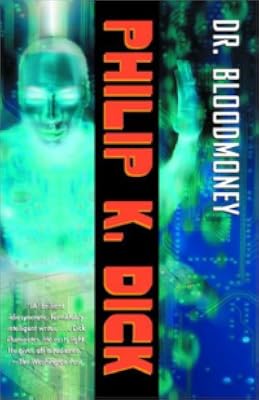
The presentation of the book is somewhat disappointing. The title as originally published is nowhere mentioned, and there are some silly misprints ("deeps-ace" for "deep-space", "prose" for "pro's", "facet" for "fact") which would surely have been caught by any proof-reader who was actually awake. The attractive cover by Chris Moore has little obvious relationship with the story. Unless you are a Dick completist, you can probably give this one a miss. show less
This is not one of Philip K. Dick's typical novels. The plot is linear and coherent, and at no point are any of the major characters confronted with the awful possibility that the universe as they experience it may be only apparently real. Unfortunately this also means that as Dick novels go, this is not a particularly good one.
Originally published as The Crack in Space in 1966, but written a couple of years earlier during the author's most prolific period, this book is essentially an unsuccessful attempt to grapple with the issues of overpopulation and racism. The year is 2080. Jim Briskin, the Liberal-Republican candidate for the presidency of the United States, hopes to unseat show more the incumbent Bill Schwartz, of the States Rights Conservative Democrats. Briskin is a former TV "newsclown" (presumably at least in part a reference to comedy actor Ronald Reagan) who hopes to become the first Negro (sic) president. It's a nice coincidence that as I type, Arnold Schwarzenegger, who starred in the film version of Dick's "We Can Remember It For You, Wholesale", is campaigning to succeed Reagan as governor of California.
The overpopulation problem in Cantata 140 appears to be something that affects the United States alone, perhaps due to the development of anti-aging treatments that allow people to continue working well past their hundredth birthday. The government's attempts to deal with it by legalised prostitution, semi-compulsory abortion and putting large numbers of the lower classes into suspended animation seem about as realistic as Isaac Asimov's proposal, in one of his non-fiction books, to stop the population explosion by encouraging masturbation and homosexuality. (Not that there's anything wrong with either masturbation or homosexuality, but please let's be realistic about the benefits!)
The treatment of racism is muted. All non-white groups are generally referred to as "Cols", presumably short for "coloureds", and it's implied that the government has sinister plans to minimise their numbers and influence, to the point of the Vice-President's links with an extremist organisation that attempts to assassinate Briskin (with a weapon whose nature is not satisfactorily explained). But we learn nothing about Briskin's own social or family background, and little about social conditions for the various ethnic groups. The setting appears to be 1960's California with a few extra gadgets; the world outside the USA is barely mentioned (not counting parallel universes).
The gadgets are a nice touch. They include taxis that can take you straight to orbit, and the "Jiffi-scuttler" which is an instantaneous transport system whose details are not otherwise made clear. The core of the plot concerns one such machine which develops a leak to a parallel world which Briskin seizes on as his solution to the overpopulation problem - wake up the sleepers in suspended animation ("Wachet auf!" is Bach's Cantata 140, hence the title) and let them go through the leak and colonise it! The consequent political tussles are diverting but not convincing. In any case the classic "my house has unexpectedly developed a doorway into another dimension" story, pioneered by Lewis Carroll, was done much better around this time by Clifford Simak in "The Big Front Yard" and has not been equalled since (certainly not by Robert Sawyer's dismal Hominids, which benefited from this year's Worldcon location to win the Hugo).
A few standard Dick themes are present. The sinister government conspiracy mentioned above is one; the idea of emigration from earth to a better place is another. The parallel universe is a nod in the direction of alternate perceptions of reality though a tame one by Dick's usual standards. The character George Walt, conjoined twins with one head but two brains and two bodies, is clearly an echo of Dick's obsession with his own twin brother who died at birth. The plot gets a little confused and frantic towards the end, but I felt more because of carelessness than authorial grand design.
The presentation of the book is somewhat disappointing. The title as originally published is nowhere mentioned, and there are some silly misprints ("deeps-ace" for "deep-space", "prose" for "pro's", "facet" for "fact") which would surely have been caught by any proof-reader who was actually awake. The attractive cover by Chris Moore has little obvious relationship with the story. Unless you are a Dick completist, you can probably give this one a miss. show less
ORIGINALLY POSTED AT Fantasy Literature.
In Philip K. Dickƒ??s The Crack in Space (1966), American technology and civilization has advanced so far that citizens can easily take a spaceship to make daily visits to an orbiting satellite whorehouse, personal Jifi-scuttlers are used to warp space/time so that people can quickly travel from home to work in a distant city, and overpopulation is such a public concern that millions of dispossessed Americans have chosen to be put in cryogenic storage until a habitable planet is discovered.
Yet, America has not advanced so far in other respects. It�?s 2080, racism is still rampant, and Jim Briskin is hoping to be elected as the first African-American President. He needs to convince both the show more �?Caucs� and the �?Cols� (oh, what horrible nicknames!) that he�?s the best man for the job. This isn�?t always easy to do for a principled man who isn�?t willing to abandon his conservative ideals just to get the endorsement of the powerful mutant who controls the satellite broadcasts. It gets even harder when his white campaign manager defects to the other side and Briskin is now the target of assassination attempts.
But when a repairman discovers an alternate universe in his clientÂ??s broken Jifi-Scuttler, Jim Briskin sees a way that he can win the election Â?? by promising to send all the frozen people to inhabit the alternate Earth. Sure enough, in pure PKD style, the Americans quickly and unthinkingly embrace BriskinÂ??s crazy idea and off they go, heading for disaster!
The Crack in Space is related to one of my favorite PKD short stories: Â??Prominent Author,Â? in which weÂ??re introduced to the Jifi-scuttler. DickÂ??s stories are always bizarrely entertaining. TheyÂ??re usually fast-paced and full of weird people with weird ideas doing weird things. In The Crack in Space, which contains a more straight-forward plot than many of his novels, we have a famous organ transplant doctor whoÂ??s divorcing his wife (an Â??abort-consultantÂ?Â) while hiding his mistress in a parallel universe. Where is Dr. Sands getting all the organs for his transplants? Then thereÂ??s George Walt, the man with two bodies (but only one head) who runs the orbiting whorehouse and wants to get rid of Jim Briskin because Briskin wants to shut him down. As usual, all the characters talk on vid phones, drink synthetic coffee, avoid the automatic reporters, get divorced, and worry about overpopulation.
The Crack in Space is fun, but not up to par with the best PKD offers. I donÂ??t know if Dick really imagined that in 2080 American race relations wouldnÂ??t have progressed beyond 1960s levels, but this really makes the novel feel more dated than his other works do. Also, the way that Americans dealt with the parallel universe was so simplistic and na??ve that this was hard to swallow, but yet itÂ??s so typical of PKD. Fans, who are used to his frenzied plots and other little writing quirks, are likely to just chuckle and let it go. In the end, though, thereÂ??s a beautiful ironic message. As Americans are dealing with race warfare, PKD shows us that, really, weÂ??re all human after all.
Brilliance Audio, who is gradually producing all of Philip K. DickÂ??s novels in audio format, did another wonderful job with this one. Eric Dawe performs it superbly. show less
In Philip K. Dickƒ??s The Crack in Space (1966), American technology and civilization has advanced so far that citizens can easily take a spaceship to make daily visits to an orbiting satellite whorehouse, personal Jifi-scuttlers are used to warp space/time so that people can quickly travel from home to work in a distant city, and overpopulation is such a public concern that millions of dispossessed Americans have chosen to be put in cryogenic storage until a habitable planet is discovered.
Yet, America has not advanced so far in other respects. It�?s 2080, racism is still rampant, and Jim Briskin is hoping to be elected as the first African-American President. He needs to convince both the show more �?Caucs� and the �?Cols� (oh, what horrible nicknames!) that he�?s the best man for the job. This isn�?t always easy to do for a principled man who isn�?t willing to abandon his conservative ideals just to get the endorsement of the powerful mutant who controls the satellite broadcasts. It gets even harder when his white campaign manager defects to the other side and Briskin is now the target of assassination attempts.
But when a repairman discovers an alternate universe in his clientÂ??s broken Jifi-Scuttler, Jim Briskin sees a way that he can win the election Â?? by promising to send all the frozen people to inhabit the alternate Earth. Sure enough, in pure PKD style, the Americans quickly and unthinkingly embrace BriskinÂ??s crazy idea and off they go, heading for disaster!
The Crack in Space is related to one of my favorite PKD short stories: Â??Prominent Author,Â? in which weÂ??re introduced to the Jifi-scuttler. DickÂ??s stories are always bizarrely entertaining. TheyÂ??re usually fast-paced and full of weird people with weird ideas doing weird things. In The Crack in Space, which contains a more straight-forward plot than many of his novels, we have a famous organ transplant doctor whoÂ??s divorcing his wife (an Â??abort-consultantÂ?Â) while hiding his mistress in a parallel universe. Where is Dr. Sands getting all the organs for his transplants? Then thereÂ??s George Walt, the man with two bodies (but only one head) who runs the orbiting whorehouse and wants to get rid of Jim Briskin because Briskin wants to shut him down. As usual, all the characters talk on vid phones, drink synthetic coffee, avoid the automatic reporters, get divorced, and worry about overpopulation.
The Crack in Space is fun, but not up to par with the best PKD offers. I donÂ??t know if Dick really imagined that in 2080 American race relations wouldnÂ??t have progressed beyond 1960s levels, but this really makes the novel feel more dated than his other works do. Also, the way that Americans dealt with the parallel universe was so simplistic and na??ve that this was hard to swallow, but yet itÂ??s so typical of PKD. Fans, who are used to his frenzied plots and other little writing quirks, are likely to just chuckle and let it go. In the end, though, thereÂ??s a beautiful ironic message. As Americans are dealing with race warfare, PKD shows us that, really, weÂ??re all human after all.
Brilliance Audio, who is gradually producing all of Philip K. DickÂ??s novels in audio format, did another wonderful job with this one. Eric Dawe performs it superbly. show less
A sloppy,goofy and occasionally tedious effort. Dick jumps from character to character as in "The Man in the High Castle", but doesn't really seem to be interested enough in any of them. Awkward, clunky dialogue. The "big racial message" of the book is written with crayon in giant block letters. The story focuses and picks up pace at the end ever so slightly, but never manages to make me care about what happens one way or another. In short, it's a dud, as awkward a work as his first novel "The Solar Lottery" (actually, that's a little better). Maybe it's based on an outline he had lying around from then. I wont advise anyone not to read it, but go into the reading of it expecting less.
Although for PK Dick standards it feels "conventional", this is still a good and enjoyable science-fiction book.
In a future with new technologies but the same old problems about population and racism we find an idealistic politician, a mean business man (or two) and some sci-fi surprises. Don't want to reveal more!
Again, good plain science fiction to have a good reading time.
In a future with new technologies but the same old problems about population and racism we find an idealistic politician, a mean business man (or two) and some sci-fi surprises. Don't want to reveal more!
Again, good plain science fiction to have a good reading time.
Members
- Recently Added By
Lists

Books Read in 2023
5,638 works; 147 members
Author Information

678+ Works 147,176 Members
Phillip Kindred Dick was an American science fiction writer best known for his psychological portrayals of characters trapped in illusory environments. Born in Chicago, Illinois, on December 16, 1928, Dick worked in radio and studied briefly at the University of California at Berkeley before embarking on his writing career. His first novel, Solar show more Lottery, was published in 1955. In 1963, Dick won the Hugo Award for his novel, The Man in the High Castle. He also wrote a series of futuristic tales about artificial creatures on the loose; notable of these was Do Androids Dream of Electric Sheep?, which was later adapted into film as Blade Runner. Dick also published several collections of short stories. He died of a stroke in Santa Ana, California, in 1982. (Bowker Author Biography) show less
Some Editions
Series
Belongs to Publisher Series
Work Relationships
Common Knowledge
- Canonical title
- The Crack in Space
- Original title
- The Crack In Space
- Alternate titles
- Cantata-140
- People/Characters
- Jim Briskin; Tito Cravelli; Dr. Lurton Sands; George Walt; Frank Woodbine
- Important places
- Golden Door Moments of Bliss; Earth; Alter-Earth
- First words
- The young couple, black-baked, dark-skinned, probably Mexican or Puerto Rican, stood nervously at Herb Lackmore's counter and the boy, the husband, said in a low voice, 'Sir, we want to be put to sleep. We want to become b... (show all)ibs.'
- Last words*
- (Click to show. Warning: May contain spoilers.)Wie sich erweisen sollte, war dies eine durchaus zutreffende Prognose.
- Publisher's editor*
- Alpers, Hans Joachim
- Original language
- English
*Some information comes from Common Knowledge in other languages. Click "Edit" for more information.
Classifications
Statistics
- Members
- 1,027
- Popularity
- 25,322
- Reviews
- 12
- Rating
- (3.23)
- Languages
- 9 — English, French, German, Hungarian, Italian, Japanese, Polish, Portuguese, Turkish
- Media
- Paper, Audiobook, Ebook
- ISBNs
- 35
- ASINs
- 23