Jealousy
by Alain Robbe-Grillet
There is 1 current discussion about this work.
On This Page
Description
In his most famous and perhaps most typical work, Robbe-Grillet explores his principal preoccupation: the meaning of reality. The novel is set on a tropical banana plantation, and the action is seen through the eyes of a narrator who never appears in person, never speaks and never acts. He is a point of observation, his personality only to be guessed at, watching every movement of the other characters' actions as they flash like moving pictures across the distorting screen of a jealous show more mind.The result is one of the most important and influential books of our time, a completely integrated masterpiece that has already become a classic. show lessTags
Recommendations
















Member Reviews
Obra prima sem tamanho, compulsivamente o li em poucas horas, pois a capacidade do Robbe-Grillet repetir as mesmas cenas destrinchando a linguagem de formas diferentes é particularmente brilhante, especialmente porque reflete no tipo de pensamento obsessivo causado pelo ciúme, mesmo que se isente de qualquer tipo de análise psicológica no sentido clássico da acepção e sim aniquilando o tempo. Não é uma leitura difícil ou chata como vemos muitos dizendo por aí, mas sim melhor degustada por aqueles aptos a assumirem seu amor pela grandiosidade e diversidade da linguagem.
Un libro-terremoto, una lettura che fa guardare la letteratura in modo diverso. So poco del "nouveau roman" e dello stesso Robbe Grillet (ma ho visto Marienbad di Resnais), ma questo racconto del 1958 stravolge la struttura del romanzo "introspettivo", mostrando che ci può essere tutto anche solo sulla superficie. E poi c'è la struttura temporale, mobile, sfuggente, imprevedibile. È un romanzo cubista e come nota Lucentini (che qui traduce in modo eccellente e cura pre e post-fazione) è un poliziesco nella misura in cui la struttura indiziaria della scrittura conferisce al lettore un ruolo attivo di interpretazione. È infatti un libro che va letto con attenzione e partecipazione, e anche in questo si discosta da tanta letteratura show more di intrattenimento cui siamo andati abituandoci. Si potrebbe criticare a Robbe Grillet la freddezza del tutto, la mancanza di empatia e la riduzione del libro a un esercizio di stile. Ma chi se ne frega: da un esercizio di stile così, chiunque sia interessato alla scrittura può apprendere tantissimo.
PS: se le recensioni di Goodreads sono un buon barometro, in Italia non sembra leggerlo nessuno... se hai intercettato queste mie righe, corri subito a comprare questo libro, fidati. show less
PS: se le recensioni di Goodreads sono un buon barometro, in Italia non sembra leggerlo nessuno... se hai intercettato queste mie righe, corri subito a comprare questo libro, fidati. show less
“The world is neither meaningful, nor absurd. it quite simply is, and that, in any case, is what is so remarkable about it.”
― Alain Robbe-Grillet
For anyone interested in exploring the fiction of the Nouveu Roman (New Novel), Alain Robbe-Grillet’s 100-page novella, “Jealousy,” would make for a great start, a prime example of the author’s unique style, a style highlighting precise, mathematical and frequently repetitive descriptions of objects rather than the novel’s more traditional emphasis on inner psychology or stream-of-consciousness. Reading this short novel set on a banana plantation within the tropics made for one unique literary experience; more specifically, here are six themes most piquant:
Novel As Film
English show more “Jealousy” is a translation of the French “Jalousie,” and in French there is a second meaning of this word -- ‘shutters’, that is, window shutters. Actually, I don’t know if any other reviewer or literary critic noted a third possible meaning: camera shutter, as in camera shutter speed working in concert with the aperture settings of a film camera. It’s this third meaning I particularly enjoy since one possible interpretation of the novel is ‘novel-as-film,’ that is, the two main character, a man and a women, could be leading actors in a film with the objective 3rd person narrator as film director, Incidentally, Robbe-Grillet was one of the top French film directors of his day.
Detail, Detail, Detail
On the first two pages we are given a blueprint of the house, courtyard and surrounding banana trees along with a legend labeling ten different parts of the house. And throughout the novel the detail continues, expressed in a kind of mechanical drawing length-and-width language, descriptions overwhelmingly visual, as if outlining specifics for a film crew to construct a set and do a filming. Mechanical engineering-like detail also applies to the surrounding banana trees, for example, here is a snippet from a full two pages description: “Without bothering with the order in which the actually visible banana trees and the cut banana trees occur, the sixth row gives the following number: twenty-two, twenty-one, twenty, nineteen – which represent respectively the rectangle, the true trapezoid, the trapezoid with a curved edge, and the same after subtracting the holes cut in the harvest.”
Alienation From Nature
The way the author writes about man-made objects and nature, one has the distinct impression the two main characters, Franck and A . . . (yes, we are only given the lady’s first initial and three dots) are in a running battle with such as engines continually breaking down as well as tropical heat, the deafening racket of crickets, the dark of the night and particularly one species of insect, sometimes wriggling, sometimes squished, described in minute detail: the centipede. Recall how Albert Camus wrote frequently about man’s estrangement and alienation from the world; also recall how Jean-Paul Sartre philosophized extensively about the alienation of human experience (being-for-itself) from objects and nature (being-in-itself). Alan Robbe-Grillet was much influenced by both Camus and Sartre.
Alienation From One’s Own Body
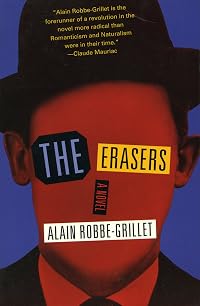
“Franck’s face as well as his whole body are virtually petrified.” A . . . is “Petrified by her own gaze.” Also, reference is made to the stiff movements of both A . . . and Franck, movements in sharp contrast to one of the Negros described as having a loose, quick gait. Sidebar: In Robbe-Grillet’s novel “The Erasers,” the main character, Wallas, is the one with the loose, quick gait and the people in the novel’s city are the ones that are stiff or flabby.
Novel Within a Novel
Both main characters are reading, reflecting and sharing their thoughts on an African novel that has many parallels with their own lives in the tropics. For me, this was a most fascinating part of this novella. At one point we read about Franck’s (and also the narrator’s) reaction to A . . . ‘s discussing various other possibilities the plot of this African novel could have taken: “Then Franck sweeps away in a single gesture all the suppositions they had just constructed together. It’s no use making up contrary possibilities, since things are the way they are, reality stays the same.” How about that; on the topic of things, the narrator (or possibly Franck) echoes Robbe-Grillet’s own disinclination to use simile and metaphor. And, by the way, not only are there nearly zero similes or metaphors in this novella, the sentences tend to be short and staccato.
Metafiction, anyone?
“The sentences become shorter and limit themselves for the most part, to repeating fragments of those spoken during their last two days, or even before.” Does this quote refer to the spoken sentences of the main characters or to the written sentences of the novella, or both? One more fascinating aspect we encounter – is the narrator really all that objective or is the narrator an integral part of the life of either or both of the main characters? The more I contemplate the possibilities at every turn in this little new novel, the more admiration I have for its author.
*Special thanks to Goodreads friend Ian for suggesting we both read and write separate reviews for this Robbe-Grillet novella. show less
An early edition of La jalousie, 7e mille, printed on December 10th 1959. I read the novel some time in the early 1970s and found its detailed descriptions seen through the eyes of the narrator as very abstract and analytical. This time round I found it strange for other reasons. I had been listening to Proust’s Remembrance of things past on multiple CDs in the car. Jealousy is examined so clearly there through the relationships of Swann and Odette and the narrator and Albertine. Hundreds of pages are devoted to the experience of jealousy through actions and dialogue. The theme of jealousy in La jalousie (and the use of the word 'jalousie' meaning a slatted window to stop intrusive peeping) is seen through the eyes of another narrator show more who never speaks but just observes the objects of his jealousy. To make matters more interesting I realise that I am reading the book through the eyes of a previous reader. One Lilian Rowlinson has written her name in ink in the top right hand corner of the front free endpaper and has dated it 1961. Not only that, Lilian through her pencilled annotations within the text has helped me understand some of the difficult words, for instance:
mediane, page 9
strie, page 11
de plain-pied, page12
en quinconce, page 13
casier, page 14
cloison, page 15
sous-main, page 15
cruche, page 21
amovible, page 21
anse, page 22
maculant, page 24
carnassier, page 27
vrombissement, page 27
scarabee, page 27
I can picture Lilian in 1961 sitting at a desk thumbing through a French-English dictionary. I wonder why she stopped annotating the text on page 27 only to pick it up again with the word ‘enduit’ on page 129. Did she run out of patience with the novel, struggling as I did, with the nouveau roman style? Did she skip to the summary in the back cover where she checked out the meaning of ‘aimant’ and ‘limaille’? Was she asked by someone, a teacher perhaps, to concentrate on pages 129-133 and 151-162, the only other pages subject to pencilled translations? show less
mediane, page 9
strie, page 11
de plain-pied, page12
en quinconce, page 13
casier, page 14
cloison, page 15
sous-main, page 15
cruche, page 21
amovible, page 21
anse, page 22
maculant, page 24
carnassier, page 27
vrombissement, page 27
scarabee, page 27
I can picture Lilian in 1961 sitting at a desk thumbing through a French-English dictionary. I wonder why she stopped annotating the text on page 27 only to pick it up again with the word ‘enduit’ on page 129. Did she run out of patience with the novel, struggling as I did, with the nouveau roman style? Did she skip to the summary in the back cover where she checked out the meaning of ‘aimant’ and ‘limaille’? Was she asked by someone, a teacher perhaps, to concentrate on pages 129-133 and 151-162, the only other pages subject to pencilled translations? show less
“The world is neither meaningful, nor absurd. it quite simply is, and that, in any case, is what is so remarkable about it.”
― Alain Robbe-Grillet
For anyone interested in exploring the fiction of the Nouveu Roman (New Novel), Alain Robbe-Grillet’s 100-page novella, “Jealousy,” would make for a great start, a prime example of the author’s unique style, a style highlighting precise, mathematical and frequently repetitive descriptions of objects rather than the novel’s more traditional emphasis on inner psychology or stream-of-consciousness. Reading this short novel set on a banana plantation within the tropics made for one unique literary experience; more specifically, here are six themes most piquant:
Novel As Film
English show more “Jealousy” is a translation of the French “Jalousie,” and in French there is a second meaning of this word -- ‘shutters’, that is, window shutters. Actually, I don’t know if any other reviewer or literary critic noted a third possible meaning: camera shutter, as in camera shutter speed working in concert with the aperture settings of a film camera. It’s this third meaning I particularly enjoy since one possible interpretation of the novel is ‘novel-as-film,’ that is, the two main character, a man and a women, could be leading actors in a film with the objective 3rd person narrator as film director, Incidentally, Robbe-Grillet was one of the top French film directors of his day.
Detail, Detail, Detail
On the first two pages we are given a blueprint of the house, courtyard and surrounding banana trees along with a legend labeling ten different parts of the house. And throughout the novel the detail continues, expressed in a kind of mechanical drawing length-and-width language, descriptions overwhelmingly visual, as if outlining specifics for a film crew to construct a set and do a filming. Mechanical engineering-like detail also applies to the surrounding banana trees, for example, here is a snippet from a full two pages description: “Without bothering with the order in which the actually visible banana trees and the cut banana trees occur, the sixth row gives the following number: twenty-two, twenty-one, twenty, nineteen – which represent respectively the rectangle, the true trapezoid, the trapezoid with a curved edge, and the same after subtracting the holes cut in the harvest.”
Alienation From Nature
The way the author writes about man-made objects and nature, one has the distinct impression the two main characters, Franck and A . . . (yes, we are only given the lady’s first initial and three dots) are in a running battle with such as engines continually breaking down as well as tropical heat, the deafening racket of crickets, the dark of the night and particularly one species of insect, sometimes wriggling, sometimes squished, described in minute detail: the centipede. Recall how Albert Camus wrote frequently about man’s estrangement and alienation from the world; also recall how Jean-Paul Sartre philosophized extensively about the alienation of human experience (being-for-itself) from objects and nature (being-in-itself). Alan Robbe-Grillet was much influenced by both Camus and Sartre.
Alienation From One’s Own Body
“Franck’s face as well as his whole body are virtually petrified.” A . . . is “Petrified by her own gaze.” Also, reference is made to the stiff movements of both A . . . and Franck, movements in sharp contrast to one of the Negros described as having a loose, quick gait. Sidebar: In Robbe-Grillet’s novel “The Erasers,” the main character, Wallas, is the one with the loose, quick gait and the people in the novel’s city are the ones that are stiff or flabby.
Novel Within a Novel
Both main characters are reading, reflecting and sharing their thoughts on an African novel that has many parallels with their own lives in the tropics. For me, this was a most fascinating part of this novella. At one point we read about Franck’s (and also the narrator’s) reaction to A . . . ‘s discussing various other possibilities the plot of this African novel could have taken: “Then Franck sweeps away in a single gesture all the suppositions they had just constructed together. It’s no use making up contrary possibilities, since things are the way they are, reality stays the same.” How about that; on the topic of things, the narrator (or possibly Franck) echoes Robbe-Grillet’s own disinclination to use simile and metaphor. And, by the way, not only are there nearly zero similes or metaphors in this novella, the sentences tend to be short and staccato.
Metafiction, anyone?
“The sentences become shorter and limit themselves for the most part, to repeating fragments of those spoken during their last two days, or even before.” Does this quote refer to the spoken sentences of the main characters or to the written sentences of the novella, or both? One more fascinating aspect we encounter – is the narrator really all that objective or is the narrator an integral part of the life of either or both of the main characters? The more I contemplate the possibilities at every turn in this little new novel, the more admiration I have for its author.
*Special thanks to Goodreads friend Ian for suggesting we both read and write separate reviews for this Robbe-Grillet novella. show less
A man suspects his wife is having an affair with his neighbor. He searches for proof, for clues, playing the same sequence of events over and over in his mind looking for signs. When did it begin? Do they suspect he knows? How far will the affair go?
Alain Robbe-Grillet's short novel, Jealousy, covers familiar territory-- a married woman's indiscretion with her married neighbor. But Mr. Robbe-Grillet breaks new ground, or I should say broke new ground when he wrote Jealousy in 1957. Where have the French been hiding him since?
Jealousy is a third-person first-person narrative. All but one of the scenes feature the husband and wife entertaining the neighbor who spends time at their house while his own wife stays home sick. But the husband show more is almost invisible. The third person narrator never mentions him. Instead, the narrator obsessively reviews what look like unimportant events in a stream of consciousness style that perplexes as much as it enlightens.
Try as he might, the narrator cannot find proof of the wife's infidelity. Glances over dinner, pauses in the conversation, even a night spent together in a hotel do not prove anything. There seems to be no grounds for jealousy. But suspiscion lingers. The reader understands that the wife and the neighbor must be up to something. Why keep going over the same set of events if they're not? Soon the reader becomes aware that the third person narrator is the husband--that the third person is really a first person narration. Obsessed with his wife's infidelity, the husband has written himself out of the novel as he jealously examines and re-examines how his wife and his neighbor behave.
One night, the neighbor kills a centipede as it crawls up the wall during an uneventful dinner. This event is observed in such detail and so many times from so many angles that the reader soon believes it must mean something. But what? The neighbor and the wife drive into town, a drive of several hours from the banana plantations where they live, and fail to return until the next day claiming bad road conditions prevented night travel. This also must mean something, but again what are we to make of it?
By the end, the experience of reading Jealously becomes the experience of jealousy itself. There is no resolution, no linear plot, not much in the way of character either. Instead, the novel takes the reader into the emotion. Jealousy is the novel's main character in the end. It serves no purpose, it is not resolved, it has no single cause nor anything to support its existence except itself. Jealousy gives birth to itself and feeds itself as it grows.
Jealousy knocked my socks off. It's the best books I've read in a very long time. I'm thrilled to find something so fresh, even if it is 50 years old. I know it's only January, but this one is sure to make my best reads of 2011 list. Alain Robbe-Grillet, where have you been all my life? show less
Alain Robbe-Grillet's short novel, Jealousy, covers familiar territory-- a married woman's indiscretion with her married neighbor. But Mr. Robbe-Grillet breaks new ground, or I should say broke new ground when he wrote Jealousy in 1957. Where have the French been hiding him since?
Jealousy is a third-person first-person narrative. All but one of the scenes feature the husband and wife entertaining the neighbor who spends time at their house while his own wife stays home sick. But the husband show more is almost invisible. The third person narrator never mentions him. Instead, the narrator obsessively reviews what look like unimportant events in a stream of consciousness style that perplexes as much as it enlightens.
Try as he might, the narrator cannot find proof of the wife's infidelity. Glances over dinner, pauses in the conversation, even a night spent together in a hotel do not prove anything. There seems to be no grounds for jealousy. But suspiscion lingers. The reader understands that the wife and the neighbor must be up to something. Why keep going over the same set of events if they're not? Soon the reader becomes aware that the third person narrator is the husband--that the third person is really a first person narration. Obsessed with his wife's infidelity, the husband has written himself out of the novel as he jealously examines and re-examines how his wife and his neighbor behave.
One night, the neighbor kills a centipede as it crawls up the wall during an uneventful dinner. This event is observed in such detail and so many times from so many angles that the reader soon believes it must mean something. But what? The neighbor and the wife drive into town, a drive of several hours from the banana plantations where they live, and fail to return until the next day claiming bad road conditions prevented night travel. This also must mean something, but again what are we to make of it?
By the end, the experience of reading Jealously becomes the experience of jealousy itself. There is no resolution, no linear plot, not much in the way of character either. Instead, the novel takes the reader into the emotion. Jealousy is the novel's main character in the end. It serves no purpose, it is not resolved, it has no single cause nor anything to support its existence except itself. Jealousy gives birth to itself and feeds itself as it grows.
Jealousy knocked my socks off. It's the best books I've read in a very long time. I'm thrilled to find something so fresh, even if it is 50 years old. I know it's only January, but this one is sure to make my best reads of 2011 list. Alain Robbe-Grillet, where have you been all my life? show less
Although this is a book about nothing, it still EFFICIENTLY accomplishes what it sets out to do. It's an outline of a novel that makes its empty spaces made known. It leaves you with that charming little empty feeling that absurdity gives you. A good antidote from the formulaic novels. And guess what - it came from the 1950s! It definitely deserves to be read at least twice to fully appreciate how many times it tries to derail you from any actual plot.
Members
- Recently Added By
Lists

1001 Books You Must Read Before You Die
1,448 works; 1,134 members

1950s
340 works; 22 members

Experimental Literature
141 works; 18 members

Most difficult novels
68 works; 27 members

Love Triangles in Literature
108 works; 15 members

1,001 BYMRBYD Concensus
723 works; 27 members

Livres français
9 works; 1 member
Harold Bloom - The Western Canon: D. The Chaotic Age
833 works; 24 members
Talk Discussions
Current Discussions
Jealousy - Allen Press - A Rhythmic Review in Fine Press Forum (Today 3:43am)
Author Information

Writer and filmmaker Alain Robbe-Grillet was born in Brest, France in 1922. Robbe-Grillet's first novel, The Erasers (1953) is considered to be one of the first books of the nouveau roman, or new novel, in which external reality is more important than character or plot. His other works included The Voyeur (1955), Jealousy (1957) and Djinn (1981). show more He worked in the film industry as a writer, actor and director. He died at the age of 85 on February 18, 2008. (Bowker Author Biography) show less
Some Editions
Awards and Honors
Notable Lists
Series
Belongs to Publisher Series
Work Relationships
Is contained in
Common Knowledge
- Canonical title
- Jealousy
- Original title
- La Jalousie
- Original publication date
- 1957
- People/Characters
- A...
- Important places
- Caribbean Region; West Indies
- Original language*
- Français
*Some information comes from Common Knowledge in other languages. Click "Edit" for more information.
Classifications
Statistics
- Members
- 698
- Popularity
- 40,902
- Reviews
- 13
- Rating
- (3.75)
- Languages
- 14 — Czech, Dutch, English, French, German, Hebrew, Italian, Norwegian (Bokmål), Norwegian, Polish, Portuguese, Romanian, Spanish, Swedish
- Media
- Paper, Ebook
- ISBNs
- 23
- ASINs
- 19