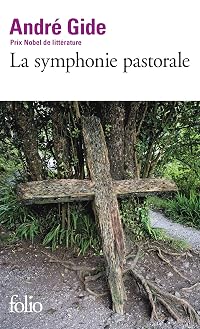
The Pastoral Symphony
by André Gide
On This Page
Description
In beautiful, evocative prose, Gide's short novel explores such themes as love, blindness, honor, and mortality.Tags
Recommendations




















Member Reviews
A bit disappointing. Gide sets up an interesting moral quandary -- what's a devout vicar, husband and father to do when he finds out he's attracted to a blind adolescent he's adopted? Gide follows his main character along a journey of ethical questions and pseudo-ethical justifications, but he does not maintain his momentum: instead of continuing to build on this structure, he settles for what I thought was a cheap cop-out. Two and a half stars, because the ending to a solid buildup could have been much more satisfying.
The moralist priest who adopts a blind girl to educate and civilized fall in the trap of love that is against his core beliefs! The kind of love that is fine for him to feel, but not as cool when it happens to others. How we prefer to shut our common sense when it comes to our own privileges and how we mix up ignorant with innocence is very well illustrated in this short novel. I actually liked this one much more than Isabelle!
Gide trata con su mano maestra y su estilo depuradísimo el amor, la religión y los conflictos que surgen del choque entre ambos. Las leyes de la pasión y las leyes de Dios arrastrando en direcciones opuestas a un pastor protestante que adopta a una muchacha ciega y analfabeta, y que cada día que pasa le despierta sentimientos más poderosos. Para perderse en sus frases, aparentemente sencillas pero afiladas y elaboradas hasta lograr un estilo sin imperfecciones.
Duke menduar se Zoti e ka thirrur të kujdeset për Gertrudën, vajzën e re të verbër e pa njeri, një pastor që jeton në Alpet e Zvicrës, vendos ta marrë në shtëpi. Ky veprim jo vetëm që do të shkaktojë çoroditje në familje, por do të bëhet shkas për të ndryshuar rrjedhën e jetëve të anëtarëve të saj dhe të vetë së birësuarës, Gertrudës.
Pastori kujdeset për edukimin dhe shoqërizimin e Gertrudës së verbër, gjë që e bën atë personazhin kryesor në botën e saj të kufizuar. Prania e tepruar e pastorit në jetën e saj, do ta bëjë Gertudën të mendojë se ndien dashuri për të, por ajo çka ndodh me shikimin e saj do të na tregojë tjetër gjë.
Pastori kujdeset për edukimin dhe shoqërizimin e Gertrudës së verbër, gjë që e bën atë personazhin kryesor në botën e saj të kufizuar. Prania e tepruar e pastorit në jetën e saj, do ta bëjë Gertudën të mendojë se ndien dashuri për të, por ajo çka ndodh me shikimin e saj do të na tregojë tjetër gjë.
Premio Nobel de Literatura en 1947, relata la historia de un pastor que vive en Neuchâtel, a finales del S. XIX. El pastor, casado acoge en su casa a una joven ciega (Gertrude), que se queda sin vínculos de ningún tipo, tras la muerte de su tía. Durante muchos años, el pastor hará lo posible para ayudarla a descubrir las riquezas de un mundo visible, vedado a sus sentidos. Para ello, empleará de un alfabeto nuevo, que irá adecuando a Gertrude. Valiéndose de imágenes sonoras y de metáforas musicales para que se imagine lo que no puede ver, le hará escuchar, al mismo tiempo, la Sinfonía Pastoral de Beethoven, para despertar y enriquecer sus emociones más profundas.
Histoire romantique au pire sens. Pasteur se trompe opposant un Jésus d’amour immoral à un Paul moraliste, pour justifier sa passion immorale pour une brébis ; sa mauvaise conduite alienne sa famille, pousse la brébis à la morte, e son fils au romanisme. Mauvais goût laissé à la bouche.
French Novella
Members
- Recently Added By
Lists

1910s
90 works; 16 members

Favourite Books
1,820 works; 316 members

Books You Read During High School (For School)
301 works; 52 members

Short and Sweet
246 works; 24 members

Mooie titels
80 works; 1 member
Author Information

382+ Works 16,803 Members
Gide, the reflective rebel against bourgeois morality and one of the most important and controversial figures in modern European literature, published his first book anonymously at the age of 18. Gide was born in Paris, the only child of a law professor and a strict Calvinist mother. As a young man, he was an ardent member of the symbolist group, show more but the style of his later work is more in the tradition of classicism. Much of his work is autobiographical, and the story of his youth and early adult years and the discovery of his own sexual tendencies is related in Si le grain ne meurt (If it die . . .) (1926). Corydon (1923) deals with the question of homosexuality openly. Gide's reflections on life and literature are contained in his Journals (1954), which span the years 1889--1949. He was a founder of the influential Nouvelle Revue Francaise, in which the works of many prominent modern European authors appeared, and he remained a director until 1941. He resigned when the journal passed into the hands of the collaborationists. Gide's sympathies with communism prompted him to travel to Russia, where he found the realities of Soviet life less attractive than he had imagined. His accounts of his disillusionment were published as Return from the U.S.S.R. (1937) and Afterthoughts from the U.S.S.R. (1938). Always preoccupied with freedom, a champion of the oppressed and a skeptic, he remained an incredibly youthful spirit. Gide himself classified his fiction into three categories: satirical tales with elements of farce like Les Caves du Vatican (Lafcadio's Adventures) (1914), which he termed soties; ironic stories narrated in the first person like The Immoralist (1902) and Strait Is the Gate (1909), which he called recits; and a more complex narrative related from a multifaceted point of view, which he called a roman (novel). The only example of the last category that he published was The Counterfeiters (1926). Throughout his career, Gide maintained an extensive correspondence with such noted figures as Valery, Claudel, Rilke, and others. In 1947, he received the Nobel Prize for Literature. (Bowker Author Biography) show less
Some Editions
Awards and Honors
Notable Lists
Series
Belongs to Publisher Series
Work Relationships
Is contained in
Common Knowledge
- Canonical title
- The Pastoral Symphony
- Original title
- La symphonie pastorale
- Original publication date
- 1919
- People/Characters*
- Le pasteur (Narrateur, père de la famille d'accueil, éducateur); Gertrude (L'orpheline aveugle recueillie); Amélie (Epouse du pasteur); Jacques (Le fils aîné de la famille)
- Important places
- France
- Dedication
- A Jean Schlumberger
- First words*
- PREMIER CAHIER
10 février 189
La neige qui n'a pas cessé de tomber depuis trois jours, bloque les routes. Je n'ai pu me rendre à R. où j'ai coutume depuis quinze ans de célébrer le culte deux fois par mois. Ce... (show all) matin trente fidèles seulement se sont rassemblés dans la chapelle de La Brévine.
[...] - Original language
- Francese
*Some information comes from Common Knowledge in other languages. Click "Edit" for more information.
Classifications
Statistics
- Members
- 1,202
- Popularity
- 20,808
- Reviews
- 14
- Rating
- (3.51)
- Languages
- 17 — Albanian, Chinese, Czech, Danish, Dutch, English, Finnish, French, German, Galician, Italian, Japanese, Norwegian, Polish, Portuguese, Swedish, Turkish
- Media
- Paper, Audiobook, Ebook
- ISBNs
- 54
- UPCs
- 1
- ASINs
- 64