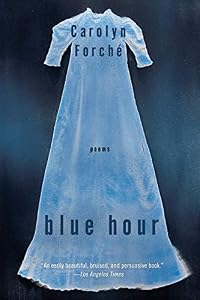
Blue Hour: Poems
by Carolyn Forché
On This Page
Description
"Blue Hour is an elusive book, because it is ever in pursuit of what the German poet Novalis called 'the lost] presence beyond appearance.' The longest poem, 'On Earth, ' is a transcription of mind passing from life into death, in the form of an abecedary, modeled on ancient gnostic hymns. Other poems in the book, especially 'Nocturne' and 'Blue Hour, ' are lyric recoveries of the act of remembering, though the objects of memory seem to us vivid and irretrievable, the rage to summon and show more cling at once fierce and distracted."The voice we hear in Blue Hour is a voice both very young and very old. It belongs to someone who has seen everything and who strives imperfectly, desperately, to be equal to what she has seen. The hunger to know is matched here by a desire to be new, totally without cynicism, open to the shocks of experience as if perpetually for the first time, though unillusioned, wise beyond any possible taint of a false or assumed innocence."-- Robert Boyers show lessTags
Recommendations



Member Reviews
http://www.newsreview.com/sacramento/Content?oid=oid%3A15079
My review of BLUE HOUR (5/29/03):
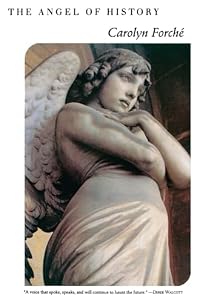
The late Elizabeth Bishop supposedly said that those who read poetry ought to be prepared to work at it. Carolyn Forché’s new collection contains several poems that require effort to read--and she’s included endnotes to help. Some, including the title poem, take the infancy of Forché’s son as a springboard to explore memory’s place in the poet’s imagination, a subject engaged in her 1994 collection, The Angel of History. Her language is precise, her images concrete, and her use of longer lines in many of the poems produces a rhythmic pattern that has the effect of a series of incantations. This effect is most pronounced in the long show more final poem, “On Earth,” an abecedary--stanzas are arranged in alphabetical order--that evokes the journey of the human spirit through life to its inevitable end. show less
My review of BLUE HOUR (5/29/03):
The late Elizabeth Bishop supposedly said that those who read poetry ought to be prepared to work at it. Carolyn Forché’s new collection contains several poems that require effort to read--and she’s included endnotes to help. Some, including the title poem, take the infancy of Forché’s son as a springboard to explore memory’s place in the poet’s imagination, a subject engaged in her 1994 collection, The Angel of History. Her language is precise, her images concrete, and her use of longer lines in many of the poems produces a rhythmic pattern that has the effect of a series of incantations. This effect is most pronounced in the long show more final poem, “On Earth,” an abecedary--stanzas are arranged in alphabetical order--that evokes the journey of the human spirit through life to its inevitable end. show less
Ratings
Members
- Recently Added By
Author Information

23+ Works 2,481 Members
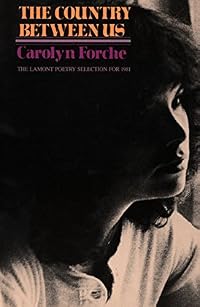
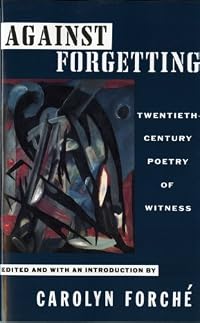
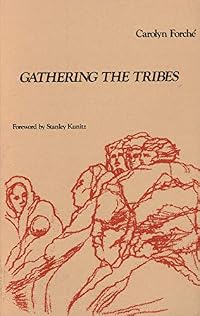
Carolyn Forche is the author of Gathering the Tribes, winner of the Yale Younger Poets Award; The Country Between Us, which received awards from the Academy of American Poets and the Poetry Society of America; and The Angel of History, winner of the Los Angeles Times Book Prize. She is also the editor of the anthology Against Forgetting: show more Twentieth-Century Poetry of Witness. Recently, she was presented with the Edita and Ira Morris Hiroshima Foundation Award for Peace and Culture in Stockholm. show less
Awards and Honors
Classifications
Statistics
- Members
- 222
- Popularity
- 147,046
- Reviews
- 1
- Rating
- (3.72)
- Languages
- English, Macedonian
- Media
- Paper, Ebook
- ISBNs
- 5
- ASINs
- 2