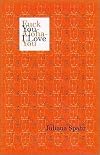
Fuck You-Aloha-I Love You
by Juliana Spahr
On This Page
Description
Here, Juliana Spahr uses details to explore Hawai'i's politics of location and her own place in it as an outsider: a hard core show where the singer shouts out fuck you-aloha-i love you over and over.Tags
Recommendations






























Member Reviews
In the space of six (lengthy) poems, Spahr weaves together issues of Hawaiian culture (such as land rights and language), the sense of place, the duality of how we move through the world (comparing how we are at a conference table to how we are in the bedroom), gender and age, and our interconnectedness.
When I started to read this book, I wasn’t sure how I felt about it. Very quickly, I got caught up in the flow of language and was able to let go of the need for many of the conventions I've been taught to consider in poetry.
Spahr's poetry is mesmerizing, truly, with her repetition of phrases and ideas. Each poem is quite rich in language and concept. With each poem spanning multiple pages, Spahr’s ability to use section breaks as show more part of the pacing of each piece is impressive.
For example, “Switching” moves across 22 pages with 16 different sections, ranging from a single-sentence stanza to a section with 22 stanzas (many consisting of a single sentence) to a section that contains a stanza with 15 sentences in it. Often times, as in the 15-sentence stanza, it is difficult to determine if line breaks are present at all or if the stanza is breaking simply due to page margins. While delineating the structure of the poem can show the diversity of the stanza and section breaks employed, it can’t begin to reflect how well the language within each poem also supports the pacing.
Several times, I wanted to share part of one of the poems with others but the poems have to be experienced in context to truly be appreciated. This book is more than something that is read; it is one to be experienced. Spahr’s ability to move the reader through each idea is a bit hypnotic.
Beyond Spahr’s skilled use of language are the underlying concepts mentioned earlier. Fuck you-Aloha-I love you blurs physical descriptions—like the detailed movements of acrobats in “a younger man, an older man, and a woman”—with cultural and social commentary:
In culture we have muscles and
we use these muscles to let us
move towards and on top and out
of each other.
We build ourselves into a
configuration.
We tremble as we do this.
Even after we have built, we
tremble.
(64)
This book deserves several reads, reading a poem per sitting with time in between to truly digest what has just been read/experienced. show less
When I started to read this book, I wasn’t sure how I felt about it. Very quickly, I got caught up in the flow of language and was able to let go of the need for many of the conventions I've been taught to consider in poetry.
Spahr's poetry is mesmerizing, truly, with her repetition of phrases and ideas. Each poem is quite rich in language and concept. With each poem spanning multiple pages, Spahr’s ability to use section breaks as show more part of the pacing of each piece is impressive.
For example, “Switching” moves across 22 pages with 16 different sections, ranging from a single-sentence stanza to a section with 22 stanzas (many consisting of a single sentence) to a section that contains a stanza with 15 sentences in it. Often times, as in the 15-sentence stanza, it is difficult to determine if line breaks are present at all or if the stanza is breaking simply due to page margins. While delineating the structure of the poem can show the diversity of the stanza and section breaks employed, it can’t begin to reflect how well the language within each poem also supports the pacing.
Several times, I wanted to share part of one of the poems with others but the poems have to be experienced in context to truly be appreciated. This book is more than something that is read; it is one to be experienced. Spahr’s ability to move the reader through each idea is a bit hypnotic.
Beyond Spahr’s skilled use of language are the underlying concepts mentioned earlier. Fuck you-Aloha-I love you blurs physical descriptions—like the detailed movements of acrobats in “a younger man, an older man, and a woman”—with cultural and social commentary:
In culture we have muscles and
we use these muscles to let us
move towards and on top and out
of each other.
We build ourselves into a
configuration.
We tremble as we do this.
Even after we have built, we
tremble.
(64)
This book deserves several reads, reading a poem per sitting with time in between to truly digest what has just been read/experienced. show less
Fuck You-Aloha-I Love You by Juliana Spahr is a collection of poetry with a Hawaiian theme. Spahr earned a BA in languages and literature from Bard College and a PhD in English from SUNY Buffalo. Spahr’s interests revolve around questions of transformation, language, and ecology. Concerned with politics without being overtly political, Spahr’s work crosses a variety of American landscapes, from the disappearing beaches of Hawaii to the small town of her Appalachian childhood. She has taught at Siena College and at the University of Hawaii at Manoa. She is currently an associate professor of English at Mills College.
I first ran across Spahr's writing in a collection of alternative poetry. I forgot what the poem was but, after show more reading it, it was enough to for me to order this collection. Spahr's work is interesting and takes an original look at life and our environment. She plays with here and there and joins it with tears. She takes a room and compares its function and the behavior of its occupants by a simple piece of furniture -- the difference that a table or a bed makes in the room. Separating and joining. Closed against open. Uncertainty and confidence.
She compares a parking lot and the stream that runs adjacent to it. The parking lot for some reason has no access. Two buildings block opposite sides. The stream blocks the other. The last side is closed off with a fence. It is space for simply space's sake. The parking lot is unused, but the stream is alive. This leads to a discussion of rights that we think we have and the rights that are written or limited. It is a call for the recognition of the rights of native Hawaiians have been slowly losing to urbanization and profits.
Spahr lines are short and her verses are short, sometimes just a single line. The style is enjoyable as well as clear and crisp. Despite the title, it is not offensive or distasteful. A very worthwhile read.
(I read this for my own enjoyment and not for review.) show less
I first ran across Spahr's writing in a collection of alternative poetry. I forgot what the poem was but, after show more reading it, it was enough to for me to order this collection. Spahr's work is interesting and takes an original look at life and our environment. She plays with here and there and joins it with tears. She takes a room and compares its function and the behavior of its occupants by a simple piece of furniture -- the difference that a table or a bed makes in the room. Separating and joining. Closed against open. Uncertainty and confidence.
She compares a parking lot and the stream that runs adjacent to it. The parking lot for some reason has no access. Two buildings block opposite sides. The stream blocks the other. The last side is closed off with a fence. It is space for simply space's sake. The parking lot is unused, but the stream is alive. This leads to a discussion of rights that we think we have and the rights that are written or limited. It is a call for the recognition of the rights of native Hawaiians have been slowly losing to urbanization and profits.
Spahr lines are short and her verses are short, sometimes just a single line. The style is enjoyable as well as clear and crisp. Despite the title, it is not offensive or distasteful. A very worthwhile read.
(I read this for my own enjoyment and not for review.) show less
Juliana Spahr is good and she sort of knows that. There's this quality in there, something going on in the knowing-everything of it. The poems should be a little more brittle than they are, they could be as paul says leaky or something so as to put to use all of her talent and intellegence and make the whole thing a little more brave and do it a little like we are humans and we are sort of talking.
Ok. The poems aren't really that impersonal, but she got on my very bad side when she said that nature poems were 'immoral.' That's an i, not an a. So let's be c-c-c-conscious of the political implications of etimological variations. Also let's all eat my shorts.
Ok. The poems aren't really that impersonal, but she got on my very bad side when she said that nature poems were 'immoral.' That's an i, not an a. So let's be c-c-c-conscious of the political implications of etimological variations. Also let's all eat my shorts.
Anyone who finds this book pretentious should try reading "switching" (which switches between a faculty meeting and an erotic encounter) at a faculty meeting. Bodies do as bodies are and Spahr makes us look - through colonialism, through appropriation, through repression.
Ratings
Members
- Recently Added By
Author Information

38+ Works 526 Members
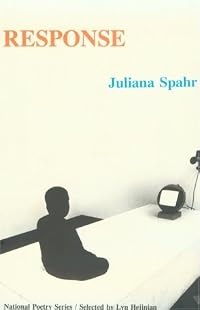
Juliana Spahr is a poet, scholar, and editor. She is the recipient of the 2009 O.B. Hardison Poetry Prize awarded by the Folger Shakespeare Library. Among her previous works are Response (Sun and Moon Press, 1996), for which she received the National Poetry Series Award; This Connection of Everyone with Lungs (University of California, 2005); and show more The Transformation (Atelos Press, 2007). show less
Series
Belongs to Publisher Series
Common Knowledge
- Canonical title
- Fuck You-Aloha-I Love You
Classifications
Statistics
- Members
- 68
- Popularity
- 458,310
- Reviews
- 4
- Rating
- (3.96)
- Languages
- English
- Media
- Paper
- ISBNs
- 2