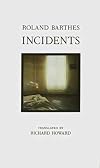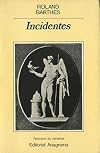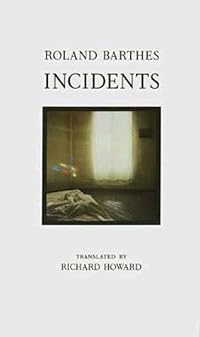
Incidents
by Roland Barthes
154 Members (3.50)
On This Page
Description
French philosopher and literary theorist Roland Barthes was one of the leading influences on the post-structuralist movement in twentieth-century literary thought, and some of his best-known works, like S/Z, speak directly to the essential and individual relationship between a reader and a literary text. In Incidents, readers have the privilege of going inside the life and thought of Barthes, through a book that is a testament to Barthes' belief that a literary work should invite the full, show more active participation of the reader. The essays collected in Incidents, originally published in French shortly after Barthes' death, provide unique insight into the author's life, his personal struggles, and his delights. Though Barthes questioned the act of keeping a journal with the aim of having it published, he decided to undertake a diary-like experiment in four parts. The first, which gives the collection its title, is a revealing personal account of his time living in Morocco. The second, "The Light of the Southwest," is an ode to Barthes' favorite region in France, while in "At Le Palace Tonight," Barthes describes a vibrant Paris night spot. Finally, the journal entries of "Evenings in Paris" reveal Barthes as an older gay man, struggling with his desire for young lovers. Rendered here in a lyrical new translation alongside the striking photographs of Bishan Samaddar, Incidents will delight fans of Barthes' other works, as well as anyone curious for a look inside the mind of one of the twentieth century's foremost intellectuals. show lessTags
Recommendations












Member Reviews
Members
- Recently Added By
Author Information

189+ Works 22,248 Members
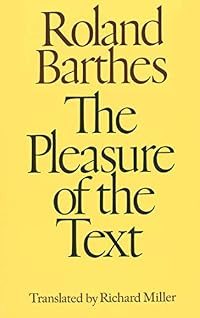
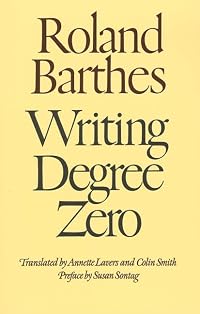
Roland Barthes (1915-1980), a French critic and intellectual, was a seminal figure in late twentieth-century literary criticism. Barthes's primary theory is that language is not simply words, but a series of indicators of a given society's assumptions. He derived his critical method from structuralism, which studies the rules behind language, and show more semiotics, which analyzes culture through signs and holds that meaning results from social conventions. Barthes believed that such techniques permit the reader to participate in the work of art under study, rather than merely react to it. Barthes's first books, Writing Degree Zero (1953), and Mythologies (1957), introduced his ideas to a European audience. During the 1960s his work began to appear in the United States in translation and became a strong influence on a generation of American literary critics and theorists. Other important works by Barthes are Elements of Semiology (1968), Critical Essays (1972), The Pleasure of the Text (1973), and The Empire of Signs (1982). The Barthes Reader (1983), edited by Susan Sontag, contains a wide selection of the critic's work in English translation. (Bowker Author Biography) show less
Series
Belongs to Publisher Series
Classifications
Statistics
- Members
- 154
- Popularity
- 212,015
- Rating
- (3.50)
- Languages
- 11 — Catalan, Dutch, English, Finnish, French, German, Italian, Japanese, Polish, Portuguese, Spanish
- Media
- Paper, Ebook
- ISBNs
- 13
- ASINs
- 4