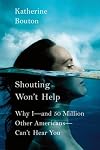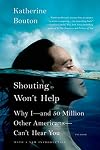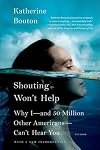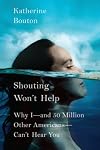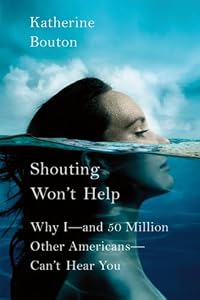
Shouting Won't Help: Why I and 50 Million Other Americans Can't Hear You
by Katherine Bouton
On This Page
Description
A memoir from the New York editor and writer in which she explores the invisible disability of deafness from personal, psychological, and physiological perspectives.Tags
Recommendations







Member Reviews
I learned about hearing loss and the different options and issues, which is something that I never considered, since my hearing (and my mom's too) is quite acute.
What annoyed me was the author's constant denial and vanity; her refusal to admit she was going deaf and her refusal to wear a hearing aid "out there", in public.
Eventually, towards the final 1/3 of the book, she notes that her vanity was annoying one of her therapists. I agree! If I wasn't able to hear things, I'd put that hearing aid in STAT. Who cares what others think?
I wear glasses because I want to see, so I think it's the same thing. If more people wore hearing aids, the stigma would become lessened, just like depression meds, etc.
What annoyed me was the author's constant denial and vanity; her refusal to admit she was going deaf and her refusal to wear a hearing aid "out there", in public.
Eventually, towards the final 1/3 of the book, she notes that her vanity was annoying one of her therapists. I agree! If I wasn't able to hear things, I'd put that hearing aid in STAT. Who cares what others think?
I wear glasses because I want to see, so I think it's the same thing. If more people wore hearing aids, the stigma would become lessened, just like depression meds, etc.
I lived this experience (the losing of much of the hearing in one ear, along with the tinnitus & a touch of vertigo) for a short time a few years back for apparently no better cause than "shifting of the cerebral arteries" - yes, that's apparently a thing. Mega-steroids provided the fix, but I'm haunted by what I nearly lost. Bouton reacted in much the same way I did - and since most of her hearing is permanently gone, she lives with it, in not always the most well-adjusted way. Do go read this for a look at the life that many people must live.
A discouraging read if you're among those of us with hearing loss. She details her struggles with profound hearing loss, although it does seem that most of her struggles were self-inflicted by vanity, denial, etc. But the current state of assistance is detailed, and seems to be well-researched. What I found most discouraging were the statments about how poorly hearing aids work and how expensive they are here in the States, as well as the fact that hearing loss isn't considered a debilitating loss! Hmpf!! I think this would be a good read for someone living with someone who is losing their hearing though - she does give pretty vivid descriptions of what it's like to be going deaf in a noisy world.
nonfiction/memoir - New York writer/journalist experiences sudden hearing loss as an adult which eventually results in her being profoundly deaf in both ears -- she sometimes can get by with lip reading (speechreading), a cochlear implant, and hearing aids but does not consider herself part of the Deaf community -- the supplemental stories of other deaf adults that she includes provide a nice representation of adult-onset experiences. Since the majority of people will experience some degree of hearing issues over their lifetime (starting at a younger and younger age--if you don't have hearing problems yourself you most likely know multiple people who secretly do but are too afraid to say so), it's helpful to get some perspective, even show more if the medical science and tech information is somewhat outdated by now since this was published in 2013 -- incidentally, you can probably skip a lot of those chapters since a lot of the amazing medical advances they were expecting to have happened by now have failed to materialize.
Regardless, it is very interesting how she describes her experiences (so that a hearing person can better understand), including how exhausting it can be to communicate with hearing people under typically inaccessible conditions, as well as what tinnitus and vertigo symptoms are like, as experienced by some hearing loss patients (and plenty of veterans). "Tone deafness" is actually a literal thing; former composers/musicians can experience hearing loss in a way that completely distorts the tones of their instruments so that they can no longer sing in tune and sometimes can't even enjoy recorded music.
p.s. want to try lip reading? Try these lessons/drills: https://www.lipreading.org/lipreading-lessons show less
Regardless, it is very interesting how she describes her experiences (so that a hearing person can better understand), including how exhausting it can be to communicate with hearing people under typically inaccessible conditions, as well as what tinnitus and vertigo symptoms are like, as experienced by some hearing loss patients (and plenty of veterans). "Tone deafness" is actually a literal thing; former composers/musicians can experience hearing loss in a way that completely distorts the tones of their instruments so that they can no longer sing in tune and sometimes can't even enjoy recorded music.
p.s. want to try lip reading? Try these lessons/drills: https://www.lipreading.org/lipreading-lessons show less
To quote the New Yorker summary: "Bouton's personal narrative, which offers essential insight into the subtle but crippling ways that this 'hidden disability, one often borne in secret', can upend relationships and threaten professional goals".
As the daughter of a mother with age-onset hearing issues, watching her struggle adapting to hearing aids that often need adjustments, tinnitus, dizziness and the other challenges accompanying hearing loss, as well as the grandmother of a two-year-old born premature and deaf (but now with cochlear implants learning both sign language and speech recognition), this book was extremely relevant. I found it full of useful information plus moving narratives, moments of optimism, moments of sorrow, and show more its excellent collection of first-person stories that reflect all the stages in-between. For anyone in a similar situation (experiencing hearing loss) or with family and/or friends who are either going deaf, born deaf, or even wanting to avoid going deaf, read this book and share it. It has already changed my behaviour with family friends and hopefully will help me cope better one day if I should find myself slowly discovering that I am becoming, with age, "hard of hearing". One immediate action was the downloading of an iPhone app to detect environmental noise levels. show less
As the daughter of a mother with age-onset hearing issues, watching her struggle adapting to hearing aids that often need adjustments, tinnitus, dizziness and the other challenges accompanying hearing loss, as well as the grandmother of a two-year-old born premature and deaf (but now with cochlear implants learning both sign language and speech recognition), this book was extremely relevant. I found it full of useful information plus moving narratives, moments of optimism, moments of sorrow, and show more its excellent collection of first-person stories that reflect all the stages in-between. For anyone in a similar situation (experiencing hearing loss) or with family and/or friends who are either going deaf, born deaf, or even wanting to avoid going deaf, read this book and share it. It has already changed my behaviour with family friends and hopefully will help me cope better one day if I should find myself slowly discovering that I am becoming, with age, "hard of hearing". One immediate action was the downloading of an iPhone app to detect environmental noise levels. show less
In this look at the widespread and commonly misunderstood phenomenon of hearing loss, Bouton recounts her own journey into deafness - and her return to the hearing world through the miracles of technology.
If you've ever wondered what it's like inside the head of someone who can't hear well or is deaf, this is a book I highly recommend reading.
While its focus on adults losing their hearing as adults, there's a lot of data (anecdotal and scientific) to provide insight for those of us with lifelong hearing loss as well.
While its focus on adults losing their hearing as adults, there's a lot of data (anecdotal and scientific) to provide insight for those of us with lifelong hearing loss as well.
Members
- Recently Added By
Author Information
4+ Works 113 Members
Awards and Honors
Distinctions
Common Knowledge
- Canonical title
- Shouting Won't Help: Why I and 50 Million Other Americans Can't Hear You
- Quotations
- Jay Alan Zimmerman, a composer, turned his hearing loss into the material for Jay Alan Zimmerman's Incredibly Deaf Musical, a spirited autobiographical account of his adult-onset hearing loss. On the afternoon I saw hi... (show all)s show, there were roars of laughter and recognition, and some tears, among the many hearing-impaired people in the audience. (Supertitles projected on the backdrop allowed the hearing impaired to understand every word.) (Chapter 5)
Classifications
Statistics
- Members
- 106
- Popularity
- 304,226
- Reviews
- 7
- Rating
- (3.75)
- Languages
- English
- Media
- Paper, Ebook
- ISBNs
- 4
- ASINs
- 1