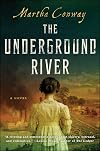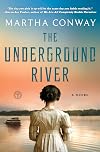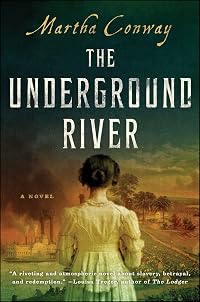
The Underground River
by Martha Conway 
On This Page
Description
"Set aboard a nineteenth century riverboat theater, this is the moving, page-turning story of a charmingly frank and naive seamstress who is blackmailed into saving Ranaways on the Underground Railroad, jeopardizing her freedom, her livelihood, and a new love. It's 1838, and May Bedloe works as a seamstress for her cousin, the famous actress Comfort Vertue--until their steamboat sinks on the Ohio River. Though they both survive, both must find new employment. Comfort is hired to give show more lectures by noted abolitionist, Flora Howard, and May finds work on a small flatboat, Hugo and Helena's Floating Theatre, as it cruises the border between the northern states and the southern slave-holding states. May becomes indispensable to Hugo and his troupe, and all goes well until she sees her cousin again. Comfort and Mrs. Howard are also traveling down the Ohio River, speaking out against slavery at the many riverside towns. May owes Mrs. Howard a debt she cannot repay, and Mrs. Howard uses the opportunity to enlist May in her network of shadowy characters who ferry babies given up by their slave mothers across the river to freedom. Lying has never come easy to May, but now she is compelled to break the law, deceive all her new-found friends, and deflect the rising suspicions of Dr. Early who captures Ranaways and sells them back to their southern masters. As May's secrets become more tangled and harder to keep, the Floating Theatre readies for its biggest performance yet. May's predicament could mean doom for all her friends on board, including her beloved Hugo, unless she can figure out a way to trap those who know her best"-- show lessTags
Recommendations












Member Reviews
After the death of her parents, May Bedloe acts as companion, dresser and seamstress to her cousin Comfort Vertue, an actress. After a catastrophe from which both barely escape with their lives, Comfort is taken in by the wealthy Mrs Howard, whereas May is encouraged to return home. Instead she takes the money Mrs Howard offers her to secure her a position onboard the Floating Theatre, a barge that makes its way along the Ohio River where the actors perform to settlements on both banks of the river, one belonging to the free states of the North, the other to the slave states of the South. But May, Comfort and Mrs Howard will cross paths again, and May will be forced to help the abolitionist cause, putting her life and those close to her show more in danger.
Set in 1838, this novel feels like a slice of the authentic old Midwest, but it won’t appeal to everyone. May, who is the narrator, is an intriguing character: she’s quiet yet outspoken, and just as her sewing and embroidery are careful and meticulous, so is her prose; I felt there weren’t any wasted words there. I repeatedly got the impression that she has a mild form of autism as she often struggles to read other people’s moods and takes their words literally. The plot moves forward in a slow and gentle way, with touches of quiet humour, meandering like the Ohio River itself, with occasional turbulences that the characters have to navigate. The small cast of characters she encounters appears to encompass the kaleidoscope of human behaviour, and each one is colourfully and carefully drawn.
One reviewer commented that in her view the issue of slavery was treated in a lightweight manner and wasn’t hard-hitting enough; I can’t agree with that. Having lived her entire life in the North, May has never had cause to reflect on the matter, and when she first encounters casual racism, not just in the South but also in the so-called more liberal North, where profit comes before principles, she is forced to take sides, especially when she participates in the activities of the Underground Railroad, at first against her will. The fact that almost everyone she meets doesn’t want to get involved in other people’s affairs and is minding their own business, that slavery is an everyday occurrence and a fact of life in the settlements bordering the Ohio River and further south, makes the novel appear more realistic and authentic, as I can believe that this was truly the prevailing attitude until the American Civil War was fought over the issue. There are still enough sections where May’s unflinching prose brings home the stark reality of what it meant to be a slave – the image that remains most vivid in my mind is when May and Hugo come across a deserted barn in Kentucky where they see a slave hold with fetters fitted for both adults and small children, the cell too small for a person to lie down, the fetters too high to allow someone to sit, “too narrow for a horse and too tall for a pig”; May calls this her first real moment of understanding.
While the plot could have been paced a little quicker here and there, the voice feels entirely authentic and proves to be thought-provoking reading, which shows that people choosing to look away from something bad happening are complicit in its perpetuation, something that was as valid then as it is now. show less
Set in 1838, this novel feels like a slice of the authentic old Midwest, but it won’t appeal to everyone. May, who is the narrator, is an intriguing character: she’s quiet yet outspoken, and just as her sewing and embroidery are careful and meticulous, so is her prose; I felt there weren’t any wasted words there. I repeatedly got the impression that she has a mild form of autism as she often struggles to read other people’s moods and takes their words literally. The plot moves forward in a slow and gentle way, with touches of quiet humour, meandering like the Ohio River itself, with occasional turbulences that the characters have to navigate. The small cast of characters she encounters appears to encompass the kaleidoscope of human behaviour, and each one is colourfully and carefully drawn.
One reviewer commented that in her view the issue of slavery was treated in a lightweight manner and wasn’t hard-hitting enough; I can’t agree with that. Having lived her entire life in the North, May has never had cause to reflect on the matter, and when she first encounters casual racism, not just in the South but also in the so-called more liberal North, where profit comes before principles, she is forced to take sides, especially when she participates in the activities of the Underground Railroad, at first against her will. The fact that almost everyone she meets doesn’t want to get involved in other people’s affairs and is minding their own business, that slavery is an everyday occurrence and a fact of life in the settlements bordering the Ohio River and further south, makes the novel appear more realistic and authentic, as I can believe that this was truly the prevailing attitude until the American Civil War was fought over the issue. There are still enough sections where May’s unflinching prose brings home the stark reality of what it meant to be a slave – the image that remains most vivid in my mind is when May and Hugo come across a deserted barn in Kentucky where they see a slave hold with fetters fitted for both adults and small children, the cell too small for a person to lie down, the fetters too high to allow someone to sit, “too narrow for a horse and too tall for a pig”; May calls this her first real moment of understanding.
While the plot could have been paced a little quicker here and there, the voice feels entirely authentic and proves to be thought-provoking reading, which shows that people choosing to look away from something bad happening are complicit in its perpetuation, something that was as valid then as it is now. show less
May Bedloe has two serious problems, about to be multiplied by a third in this year of 1838. First, she takes care to speak the precise truth as she perceives it, and not a word more or less, refusing to countenance a lie, in herself or anyone else.
Her concrete approach to life amuses some and puzzles or puts off others, but in either case, leaves May feeling as if she’s not fit to make friends or be among people.
Secondly, she’s in thrall to her actress cousin, Comfort Vertue, who’s as self-absorbed and exploitive as they come. When Comfort isn’t abusing her younger cousin’s pliant nature, as in draining her life savings or demanding that she use her superb dressmaking skills to fix up the elder’s wardrobe, she lectures May show more about her character and tells her what she, May, wants.
But the cousins are abruptly sundered (and left destitute) when the Ohio River steamboat on which they’re traveling blows up near Cincinnati. All you need to know is that May saves a little girl she’s never met, whereas Comfort doesn’t even bother to let her cousin know she’s still alive, having been looking out for Number One.
Her skill at this game has led her to the home of a well-to-do abolitionist, Mrs. Howard, who promptly informs May that her presence is unwelcome. Elder cousin will now be retained as a stump speaker for the abolitionist cause, by which she’ll earn her keep; May should simply go elsewhere, right away. Home, maybe.
But home, in Oxbow, Ohio, no longer has anything to sustain May, and—you guessed it—Comfort doesn’t speak up for her. However, Thaddeus, a roguish actor of Comfort’s acquaintance, coaches May in her first lesson in lying, with which she pries twenty dollars out of Mrs. Howard, presumably for travel expenses back to Oxbow. Instead, that twenty goes to repair a certain boat in which the actor has an interest. Captain Cushing’s Floating Theater, which sails up and down the Ohio, mooring at towns where the citizenry might wish dramatic entertainment, now has a new seamstress/pianist/ticket taker.
No longer relegated to her cousin’s dressing room (from which Comfort often locked her out), May now lives and works among theater folk, eight of them. Consequently, her difficulties with artifice emerge and cause conflict with people who live by pretending to be what they’re not. Much humor ensues, and this unusual coming-of-age story boasts a raft (almost literally) of delightful stage types, from the acquisitive, overbearing Mrs. Niffen, whose husband never says a word, to Thaddeus, the trouper past his prime.
But there’s much more here. As May slowly wakes to the life of emotion and gray realities, she also wakes to slavery’s impact and the necessity to act against it. I won’t say more, except to note that her knowledge brings great danger, rendered with hair-raising vividness. And to keep the suspense, don’t read the jacket flap, which gives away too much, as though the publisher feared that potential readers would otherwise find the story lightweight.
I like how Conway has portrayed the towns along the Ohio River, whether on free soil or in Kentucky, a slave state, and how she doles out period details with a deft hand. I also admire her gift for characterization; I love tales about the theater, and these performers ring true to that lively art.
I also like how Conway refrains from granting May a full-character makeover. Our heroine learns a little, tasting the pleasures of suspension of disbelief and glimpses of human warmth. But she remains herself, ever concrete, seeking rules to live by, which seems psychologically accurate.
Comfort may be a little over the top, but there again, psychology holds sway: a masochist like May will invent reasons to bond to a narcissist, so Comfort's excess has a purpose. I mind more that the author, though normally careful with language, occasionally uses words like “feedback,” which don’t fit the era, and inserts the rare modern thought pattern. But these are quibbles. The Underground River is a wonderful book, and I recommend it. show less
Her concrete approach to life amuses some and puzzles or puts off others, but in either case, leaves May feeling as if she’s not fit to make friends or be among people.
Secondly, she’s in thrall to her actress cousin, Comfort Vertue, who’s as self-absorbed and exploitive as they come. When Comfort isn’t abusing her younger cousin’s pliant nature, as in draining her life savings or demanding that she use her superb dressmaking skills to fix up the elder’s wardrobe, she lectures May show more about her character and tells her what she, May, wants.
But the cousins are abruptly sundered (and left destitute) when the Ohio River steamboat on which they’re traveling blows up near Cincinnati. All you need to know is that May saves a little girl she’s never met, whereas Comfort doesn’t even bother to let her cousin know she’s still alive, having been looking out for Number One.
Her skill at this game has led her to the home of a well-to-do abolitionist, Mrs. Howard, who promptly informs May that her presence is unwelcome. Elder cousin will now be retained as a stump speaker for the abolitionist cause, by which she’ll earn her keep; May should simply go elsewhere, right away. Home, maybe.
But home, in Oxbow, Ohio, no longer has anything to sustain May, and—you guessed it—Comfort doesn’t speak up for her. However, Thaddeus, a roguish actor of Comfort’s acquaintance, coaches May in her first lesson in lying, with which she pries twenty dollars out of Mrs. Howard, presumably for travel expenses back to Oxbow. Instead, that twenty goes to repair a certain boat in which the actor has an interest. Captain Cushing’s Floating Theater, which sails up and down the Ohio, mooring at towns where the citizenry might wish dramatic entertainment, now has a new seamstress/pianist/ticket taker.
No longer relegated to her cousin’s dressing room (from which Comfort often locked her out), May now lives and works among theater folk, eight of them. Consequently, her difficulties with artifice emerge and cause conflict with people who live by pretending to be what they’re not. Much humor ensues, and this unusual coming-of-age story boasts a raft (almost literally) of delightful stage types, from the acquisitive, overbearing Mrs. Niffen, whose husband never says a word, to Thaddeus, the trouper past his prime.
But there’s much more here. As May slowly wakes to the life of emotion and gray realities, she also wakes to slavery’s impact and the necessity to act against it. I won’t say more, except to note that her knowledge brings great danger, rendered with hair-raising vividness. And to keep the suspense, don’t read the jacket flap, which gives away too much, as though the publisher feared that potential readers would otherwise find the story lightweight.
I like how Conway has portrayed the towns along the Ohio River, whether on free soil or in Kentucky, a slave state, and how she doles out period details with a deft hand. I also admire her gift for characterization; I love tales about the theater, and these performers ring true to that lively art.
I also like how Conway refrains from granting May a full-character makeover. Our heroine learns a little, tasting the pleasures of suspension of disbelief and glimpses of human warmth. But she remains herself, ever concrete, seeking rules to live by, which seems psychologically accurate.
Comfort may be a little over the top, but there again, psychology holds sway: a masochist like May will invent reasons to bond to a narcissist, so Comfort's excess has a purpose. I mind more that the author, though normally careful with language, occasionally uses words like “feedback,” which don’t fit the era, and inserts the rare modern thought pattern. But these are quibbles. The Underground River is a wonderful book, and I recommend it. show less
When the steamboat Moselle sinks, May and her cousin Comfort, survive when many others did not. Together for many years, Comfort on the stage, May as her seamstress, making and maintaining her costumes, their lives now take different paths. Comfort becomes the spokesman for a a woman fighting against the horrible institution of slavery. May now alone, eventually gets a job on a travelling show run on a steamboat that travels up and down the Ohio River.
In 1838, the Ohio River separated the slave states from the free states. The Underground Railroad used this river to ferry slaves over from the Kentucky side, something May will become very familiar with, albeit at the beginning very much against her will. Very interesting story as we see show more May grow and become attuned to the evils that slavery is as she comes to learn and fit in with the actors on the steamboat. May is a wonderful character as are many others including the captain of the steamboat.
The writing is wonderfully smooth, evenly paced. The atmosphere of the times, the divisions and differing opinions of slavery are realistically portrayed. A story that is both entertaining and informative. The sinking of the Moselle was a real life event that the author used in which to base her story. Well done! show less
In 1838, the Ohio River separated the slave states from the free states. The Underground Railroad used this river to ferry slaves over from the Kentucky side, something May will become very familiar with, albeit at the beginning very much against her will. Very interesting story as we see show more May grow and become attuned to the evils that slavery is as she comes to learn and fit in with the actors on the steamboat. May is a wonderful character as are many others including the captain of the steamboat.
The writing is wonderfully smooth, evenly paced. The atmosphere of the times, the divisions and differing opinions of slavery are realistically portrayed. A story that is both entertaining and informative. The sinking of the Moselle was a real life event that the author used in which to base her story. Well done! show less
This is really May Bedlow’s story; the author has us walking in her shoes, from the first page to the end. A young woman who cannot tell a lie, or when she does she is reciting the Greek alphabet, or will she learn with all that happens in her life.
Can you imagine being on a steamboat and having it blow up around you, and then having to swim for your life, thank goodness she knew how, and then she helps others.
It does take over half the book to set up the side story of helping rescue babies across the Ohio River and to freedom. What a concept, when you think about the sacrifices these mothers made for their infants, a heart breaking decision for sure.
May has a gift with a sewing needle, and because of that she is at the right place at show more the right time, and it becomes her life to live on a show boat, making all the costumes and helping put on the performances.
Watch what happens when evil rears it ugly head and greed tries to take over, will our girl survive, and will this be then end of these daring rescues?
I received this book through Touchstone Publishing and was not required to give a positive review. show less
Can you imagine being on a steamboat and having it blow up around you, and then having to swim for your life, thank goodness she knew how, and then she helps others.
It does take over half the book to set up the side story of helping rescue babies across the Ohio River and to freedom. What a concept, when you think about the sacrifices these mothers made for their infants, a heart breaking decision for sure.
May has a gift with a sewing needle, and because of that she is at the right place at show more the right time, and it becomes her life to live on a show boat, making all the costumes and helping put on the performances.
Watch what happens when evil rears it ugly head and greed tries to take over, will our girl survive, and will this be then end of these daring rescues?
I received this book through Touchstone Publishing and was not required to give a positive review. show less
Underground River has a quality of powerful quietude centered around the main character inside of whom you stand observing the chaos all around. Conway has written this character so precisely and intimately that I felt a raw connection and investment in her welfare and celebration in her growth beyond the small world and pettiness in which she was trapped. It was a profoundly satisfying read. I've read all of Conway's previous books and they just get better and better.
May Bedloe is the seamstress for her famous actress cousin, Comfort Vertue. May has been with Comfort since her parents passed away and feels secure in her routine and Comfort's knowledge of May's irregularities. May has always been very direct in her speech and has a hard time with anything that isn't exactly the truth. May's life changes when the steamboat she and Comfort are travelling on explodes on the Ohio River in 1838. May and Comfort lose everything. Comfort is soon snapped up by benefactress and abolitionist Flora Howard who will have Comfort speak for her cause. May is not included in this plan; so she decides that she will find employment on her own. May is hired on Hugo and Helena's Floating Theatre; but she needed to use show more the money Flora gave her to go home in order to get established. May soon finds herself an integral part of the Floating Theatre and comes into her own. When The Floating Theatre and Comfort's speaking tour cross paths, Flora uses May's place on a boat traveling from south to north for her own deed of transporting people to freedom, jeopardizing May's place in the Theatre.
The Underground River is a different look at how the Underground Railroad functioned and some of it's players. Interesting characters and the unique setting pulled me in. May's character has several quirks and might be on the autism spectrum if she lived in the present. Her directfulness and untouched insight gave a very honest look at the people around her; abolitionist Flora Howard is a bully using others to further her own cause, even Comfort kept May hidden and kept putting her down in order to raise herself up. The true heroes, Leo, Donaldson and Hugo shine through May's eyes. Though the book is about the Underground Railroad, the process and danger of the transport is really only half the story. Most of the story revolves around life on the river and the theatre. Through May's perspective, we get a good look at how the towns along the river in the North and South are all pretty similar except for the presence or absence of slavery and peoples attitudes about it. There is also an intimate look into theatre life and the distinctiveness of a riverboat theatre. The teamwork, diligence and creativeness of the entire crew is apparent. I do wish May had been a willing player in the transport instead of being blackmailed, she had the compassion for the job and believed in the cause, but the fact that she is being forced marred my view a bit. Overall, an exciting and insightful historical fiction read about the Underground Railroad and Theatre life.
This book was received for free in return for an honest review. show less
The Underground River is a different look at how the Underground Railroad functioned and some of it's players. Interesting characters and the unique setting pulled me in. May's character has several quirks and might be on the autism spectrum if she lived in the present. Her directfulness and untouched insight gave a very honest look at the people around her; abolitionist Flora Howard is a bully using others to further her own cause, even Comfort kept May hidden and kept putting her down in order to raise herself up. The true heroes, Leo, Donaldson and Hugo shine through May's eyes. Though the book is about the Underground Railroad, the process and danger of the transport is really only half the story. Most of the story revolves around life on the river and the theatre. Through May's perspective, we get a good look at how the towns along the river in the North and South are all pretty similar except for the presence or absence of slavery and peoples attitudes about it. There is also an intimate look into theatre life and the distinctiveness of a riverboat theatre. The teamwork, diligence and creativeness of the entire crew is apparent. I do wish May had been a willing player in the transport instead of being blackmailed, she had the compassion for the job and believed in the cause, but the fact that she is being forced marred my view a bit. Overall, an exciting and insightful historical fiction read about the Underground Railroad and Theatre life.
This book was received for free in return for an honest review. show less
This is not going to be a book for everyone but I truly did enjoy it. It is the story of May, a young woman who ends up living with her cousin, Comfort Vertue – an actress of questionable talents. May is an excellent seamstress so she is brought along when Comfort needs to find a way to support herself upon the death of her husband. Life changes dramatically for both of them when the steamship they are taking explodes. Both survive but the trajectory of both of their lives changes as they are separated in the confusion.
They ultimately reunite but Comfort’s current benefactor does not want May around so pays her to go away. She does and finds work on a floating theatre as a seamstress. She finally comes into her own and feels as if show more she is among friends. Until she is forced into doing something she does not want to do – ferry the babies of runaway slaves across the river. May initially has no feelings about the issue other than how it will impact her life. Ultimately she realizes it’s a bigger issue than just herself.
I was engrossed in the story as I found the descriptions of life on the floating theatre fascinating. The author brought the period alive for me. Slavery was not the main issue in this story – May’s feelings and thoughts drove the tale. The focus was how things impacted her, not how vile slavery was. It’s definitely one woman’s story.
As I noted above, not everyone is going to like this book because it doesn’t take a firm stand one way or the other. May does not go into her “mission” full of righteous anger with thoughts of saving babies lives. This takes place pre-Civil War so the issues of slavery and the freedom of the slaves had not become so present in people’s minds. May is a young girl concerned only with her survival. It’s a bold way to tell a story about such a sensitive issue. It was a very different viewpoint to tell this type of tale. show less
They ultimately reunite but Comfort’s current benefactor does not want May around so pays her to go away. She does and finds work on a floating theatre as a seamstress. She finally comes into her own and feels as if show more she is among friends. Until she is forced into doing something she does not want to do – ferry the babies of runaway slaves across the river. May initially has no feelings about the issue other than how it will impact her life. Ultimately she realizes it’s a bigger issue than just herself.
I was engrossed in the story as I found the descriptions of life on the floating theatre fascinating. The author brought the period alive for me. Slavery was not the main issue in this story – May’s feelings and thoughts drove the tale. The focus was how things impacted her, not how vile slavery was. It’s definitely one woman’s story.
As I noted above, not everyone is going to like this book because it doesn’t take a firm stand one way or the other. May does not go into her “mission” full of righteous anger with thoughts of saving babies lives. This takes place pre-Civil War so the issues of slavery and the freedom of the slaves had not become so present in people’s minds. May is a young girl concerned only with her survival. It’s a bold way to tell a story about such a sensitive issue. It was a very different viewpoint to tell this type of tale. show less
Members
- Recently Added By
Lists

Top Five Books of 2018
802 works; 265 members

Books Read in 2023
5,638 works; 147 members

Vine Reads
60 works; 1 member
Author Information
5 Works 301 Members
Martha Conway is a LibraryThing Author, an author who lists their personal library on LibraryThing.
Common Knowledge
- Canonical title
- The Underground River
- Alternate titles
- The Floating Theatre
- Original publication date
- 2017-06-15
- People/Characters
- May Bedloe; Comfort Vertue; Flora Howard; Donaldson; Hugo Cushing; Leo (show all 17); Lydia 'Liddy' Foote; Sam Trotter; James 'Jemmy' Grieve; Mr Niffen; Mrs Niffen; Celia; Thaddeus Mason; Dr Early; Lula; Mrs Nedel; Helena Cushing
- Important places
- Cincinnati, Ohio, USA; Paducah, Kentucky, USA; Cleveland, Ohio, USA
- Dedication
- For my father, Richard Conway, who toured the Ohio River with me.
- First words
- When the steamboat Moselle blew apart just off its Cincinnati landing, I was sitting below deck in the ladies' cabin, sewing tea leaves into little muslin bags and plotting revenge on my cousin Comfort for laughing at ... (show all)me during dinner.
- Last words
- (Click to show. Warning: May contain spoilers.)"I'm ready," I said.
- Blurbers
- Grissom, Kathleen; Treger, Louisa
- Original language
- English US
Classifications
Statistics
- Members
- 133
- Popularity
- 246,348
- Reviews
- 16
- Rating
- (3.64)
- Languages
- Dutch, English
- Media
- Paper, Audiobook, Ebook
- ISBNs
- 17
- ASINs
- 4