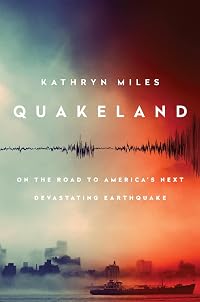
Quakeland: On the Road to America's Next Devastating Earthquake
by Kathryn Miles
On This Page
Description
A journey around the United States in search of the truth about the threat of earthquakes leads to spine-tingling discoveries, unnerving experts, and ultimately the kind of preparations that will actually help guide us through disasters. It’s a road trip full of surprises.Earthquakes. You need to worry about them only if you’re in San Francisco, right? Wrong. We have been making enormous changes to subterranean America, and Mother Earth, as always, has been making some of her own. . show more . . The consequences for our real estate, our civil engineering, and our communities will be huge because they will include earthquakes most of us do not expect and cannot imagine—at least not without reading Quakeland. Kathryn Miles descends into mines in the Northwest, dissects Mississippi levee engineering studies, uncovers the horrific risks of an earthquake in the Northeast, and interviews the seismologists, structual engineers, and emergency managers around the country who are addressing this ground shaking threat.
As Miles relates, the era of human-induced earthquakes began in 1962 in Colorado after millions of gallons of chemical-weapon waste was pumped underground in the Rockies. More than 1,500 quakes over the following seven years resulted. The Department of Energy plans to dump spent nuclear rods in the same way. Evidence of fracking’s seismological impact continues to mount. . . . Humans as well as fault lines built our “quakeland”.
What will happen when Memphis, home of FedEx's 1.5-million-packages-a-day hub, goes offline as a result of an earthquake along the unstable Reelfoot Fault? FEMA has estimated that a modest 7.0 magnitude quake (twenty of these happen per year around the world) along the Wasatch Fault under Salt Lake City would put a $33 billion dent in our economy. When the Fukushima reactor melted down, tens of thousands were displaced. If New York’s Indian Point nuclear power plant blows, ten million people will be displaced. How would that evacuation even begin?
Kathryn Miles’ tour of our land is as fascinating and frightening as it is irresistibly compelling. show less
Tags
Recommendations












Member Reviews
This book gets 5 stars for being both informative and readable, with both the human element (personal drama, and getting to know the scientists) and the technical information (written for the lay person). I learned a lot. I knew that fracking caused seismic activity, but didn't know how much or where before this book.
I live in California not too far from a high risk area. Though I do have earthquake insurance, my home is mostly concrete block -- not good! It's time for more earthquake drills with the kids! And also to make sure our one-year supply of water bottles is still fresh enough. We need enough to share with our dear neighbors since, like most people, they probably have NO plan in place.
One typo worth mentioning: On Page 126, the show more Loma Prieta earthquake was listed as 1992, though it was actually 1989. But the author knows this, as she got it right elsewhere, so it's just a typo. (I know the year of Loma Prieta because, though too far away to be at risk, I was close enough to feel it, and heard my co-workers racing down the hall yelling: "Earthquake, earthquake!" It's a day I won't forget.
This book is good motivation to improve my preparations. Thanks Kathryn! show less
I live in California not too far from a high risk area. Though I do have earthquake insurance, my home is mostly concrete block -- not good! It's time for more earthquake drills with the kids! And also to make sure our one-year supply of water bottles is still fresh enough. We need enough to share with our dear neighbors since, like most people, they probably have NO plan in place.
One typo worth mentioning: On Page 126, the show more Loma Prieta earthquake was listed as 1992, though it was actually 1989. But the author knows this, as she got it right elsewhere, so it's just a typo. (I know the year of Loma Prieta because, though too far away to be at risk, I was close enough to feel it, and heard my co-workers racing down the hall yelling: "Earthquake, earthquake!" It's a day I won't forget.
This book is good motivation to improve my preparations. Thanks Kathryn! show less
Kathryn Miles' 'Quakeland' offers readers a broad and engaging view on earthquake histories, current risks, and future threats in the United States. Drawing on what appears to be considerable research, the author sheds light on areas of the contiguous U.S. not currently considered seismically active by the general population, but which nevertheless either were active in the past, or will one day likely become active.
I found it particularly entertaining when I woke up on April 5th to find there had been a magnitude 4.8 earthquake in the Northeast U.S. - just the previous evening, I had read with some surprise about the plethora of fault lines criss-crossing the New York area and surrounding region. Talk about bringing a book to life. show more
This is a valuable read for those wishing to learn more about future seismic risks in the U.S., as well as current seismic theory in the less-discussed parts of the country (i.e. San Andreas is of course discussed, but is nowhere near the only topic). The author keeps the book light-hearted and entertaining, without overdoing it and causing the book to lose credibility. It is in the realm of 'introductory' reading for the field, but to me this is a plus - everyone knows about San Andreas, but do you know about the Nemaha Ridge and the seismic risk it possesses for cities like Omaha, Nebraska? (Hint: a lot). Kathryn Miles will lead the way discussing this and more.
Four stars for a pleasing-to-read book laced with a considerable amount of fun facts and tidbits about the current seismic state of the country. show less
I found it particularly entertaining when I woke up on April 5th to find there had been a magnitude 4.8 earthquake in the Northeast U.S. - just the previous evening, I had read with some surprise about the plethora of fault lines criss-crossing the New York area and surrounding region. Talk about bringing a book to life. show more
This is a valuable read for those wishing to learn more about future seismic risks in the U.S., as well as current seismic theory in the less-discussed parts of the country (i.e. San Andreas is of course discussed, but is nowhere near the only topic). The author keeps the book light-hearted and entertaining, without overdoing it and causing the book to lose credibility. It is in the realm of 'introductory' reading for the field, but to me this is a plus - everyone knows about San Andreas, but do you know about the Nemaha Ridge and the seismic risk it possesses for cities like Omaha, Nebraska? (Hint: a lot). Kathryn Miles will lead the way discussing this and more.
Four stars for a pleasing-to-read book laced with a considerable amount of fun facts and tidbits about the current seismic state of the country. show less
In July, 1964 my husband and his family took a vacation out West. Although my husband was only twelve years old, he never forgot the "road that went into the lake" at Yellowstone National Park. In 1959 there had been an earthquake that caused a massive landslide into a lake. The lake rose 22 feet, so that the roads that once went to the Cabin Creek Campground ended at the lake, and new roads had to be made.
Here he was, camping with his family in an area that had been hit by a killer earthquake in his time. It was memorable.
Across the road was the canyon wall that caused the country's largest landslide ; it had buried nineteen people.
The first chapter of Quakeland recounts the story of a family, just like my husband's, who had gone show more camping in Yellowstone. The author takes us through their day, searching for the 'right' camping spot, setting up camp, and getting ready for bed. And then we are taken through the horrendous experience the campers endured when the earthquake collapsed the mountain side, sloshed the lake back and forth, creating winds so strong it ripped the clothing off campers, and then deluged the area with a wall of water that drove a stick into a camper's knee socket. Afterwards the lake was 22 feet higher.
It's enough to make me grateful my folks never took me out West camping.
Quakeland is full of stories that will send shivers up your spine. Not only because naturally occurring fault lines that transverse our country cause quakes, which in our ignorance we have built upon--cities like Memphis and Salt Lake City--but also because of human activity that causes earthquakes: dams and mines and fracking and even building tall buildings.
I used to be pretty smug about my home state being 'safe'. We can be hit by tornadoes, but no hurricanes. We aren't known for earthquakes. Yet, Michigan has had its earthquakes and likely will again. There are fault lines in the Upper Peninsula, through the center of the state, and on the Lake Huron side in the "thumb." The state can be shaken by quakes from the New Madrid fault.
When our son was growing up we went to the Upper Peninsula of Michigan to camp. We took day trips, apparently all along fault lines! One day we toured the Quincy Mine. This copper mine was effectively closed in 1946. We were almost the only ones there that day. The tour took us to the 7th level of the mine. In 1914 the miners working at the Quincy mine caused a rock burst. Any time we redistribute pressure the earth will respond. Mining is a human-created cause of earthquakes, and the Keweenaw mining area has a history of quakes.
The biggest earthquake in Michigan history, magnitude 4.6, occurred in 1947 near Coldwater, MI, a flat, agricultural area in Southern Michigan just above the state line. In 1994 the state was hit by a magnitude 3.4 quake centered near Potterville, just west of Lansing. And in 2015 a magnitude 4.2 quake was centered in Galesburg just south of Kalamazoo. We have lived in Lansing, and a half-hour down the road from Coldwater and Kalamazoo. Four months ago a 2.2 quake occurred in Grosse Point, just east of Detroit.
So much for being 'safe' from earthquakes.
Miles style was entertaining and the information very accessible. Readers who enjoy learning about the natural world, disasters or potential disasters, and the implications of the energy industry's impact on our natural world will enjoy this book. Just be warned: this book may keep you awake at night.
I received a free book from the publisher through a Goodreads giveaway. show less
Here he was, camping with his family in an area that had been hit by a killer earthquake in his time. It was memorable.
Across the road was the canyon wall that caused the country's largest landslide ; it had buried nineteen people.
The first chapter of Quakeland recounts the story of a family, just like my husband's, who had gone show more camping in Yellowstone. The author takes us through their day, searching for the 'right' camping spot, setting up camp, and getting ready for bed. And then we are taken through the horrendous experience the campers endured when the earthquake collapsed the mountain side, sloshed the lake back and forth, creating winds so strong it ripped the clothing off campers, and then deluged the area with a wall of water that drove a stick into a camper's knee socket. Afterwards the lake was 22 feet higher.
It's enough to make me grateful my folks never took me out West camping.
Quakeland is full of stories that will send shivers up your spine. Not only because naturally occurring fault lines that transverse our country cause quakes, which in our ignorance we have built upon--cities like Memphis and Salt Lake City--but also because of human activity that causes earthquakes: dams and mines and fracking and even building tall buildings.
I used to be pretty smug about my home state being 'safe'. We can be hit by tornadoes, but no hurricanes. We aren't known for earthquakes. Yet, Michigan has had its earthquakes and likely will again. There are fault lines in the Upper Peninsula, through the center of the state, and on the Lake Huron side in the "thumb." The state can be shaken by quakes from the New Madrid fault.
When our son was growing up we went to the Upper Peninsula of Michigan to camp. We took day trips, apparently all along fault lines! One day we toured the Quincy Mine. This copper mine was effectively closed in 1946. We were almost the only ones there that day. The tour took us to the 7th level of the mine. In 1914 the miners working at the Quincy mine caused a rock burst. Any time we redistribute pressure the earth will respond. Mining is a human-created cause of earthquakes, and the Keweenaw mining area has a history of quakes.
The biggest earthquake in Michigan history, magnitude 4.6, occurred in 1947 near Coldwater, MI, a flat, agricultural area in Southern Michigan just above the state line. In 1994 the state was hit by a magnitude 3.4 quake centered near Potterville, just west of Lansing. And in 2015 a magnitude 4.2 quake was centered in Galesburg just south of Kalamazoo. We have lived in Lansing, and a half-hour down the road from Coldwater and Kalamazoo. Four months ago a 2.2 quake occurred in Grosse Point, just east of Detroit.
So much for being 'safe' from earthquakes.
Miles style was entertaining and the information very accessible. Readers who enjoy learning about the natural world, disasters or potential disasters, and the implications of the energy industry's impact on our natural world will enjoy this book. Just be warned: this book may keep you awake at night.
I received a free book from the publisher through a Goodreads giveaway. show less
A very interesting and informative book that still manages to be entertaining.it is sobering to think that some of the information is unlikely to be heeded by those that most need to hear it. I’d have liked a few more first person impact stories, but I think it was a conscious choice made by the author to avoid turning it into a book version of the 70’s disaster movies
This attempts to be a catch-all on everything earthquakes, going through money loss, eyewitness reports, and a pretty substantial expose on dams. As an opener, I suppose it could have had a few more exciting starts... but later on, when we got into the historical accounts of earthquakes, I think it got better.
Especially when we got to fracking.
Later, when we got into the real science of seismology, I really began to enjoy it. I was looking for real science, after all, but, of course, there's plenty about this that still seems to encourage con men. "I will predict! For a low, low cost of..." :)
I hope, one of these days, some REAL money will be poured into the field so we have real data.
This book was okay. Not the best, but it isn't bad.
Especially when we got to fracking.
Later, when we got into the real science of seismology, I really began to enjoy it. I was looking for real science, after all, but, of course, there's plenty about this that still seems to encourage con men. "I will predict! For a low, low cost of..." :)
I hope, one of these days, some REAL money will be poured into the field so we have real data.
This book was okay. Not the best, but it isn't bad.
Very interesting.
I won this in a GOODREADS giveaway.
Members
- Recently Added By
Author Information

5+ Works 552 Members
Kathryn Miles is the author of Adventures with Ari and dozens of articles that have appeared in publications including Alimentum, Best American Essays, History, Outside, and Terrain. She also serves on the faculty of Chatham University's MFA program. She lives-and sails-in midcoast Maine.
Awards and Honors
Common Knowledge
- Epigraph
- It cannot be expected that an examination of the phenomena connected with this disturbance will throw any light on the origin of earthquakes. Scientific men do not seem to have gained from the terrible earthquake that devasta... (show all)ted the islland of Ischia, one year ago, or the great catastrophe of Krakatoa and the Straits of Sunda, one month later, much useful information in addition to that which they already possessed upon which to form new theories or reconstruct old ones. Whatever may be the cause - whether it is the falling of the roof of subterranean caves or the raging of a molten sea in the interior of the earth or the contraction of portions of the earth's crust caused by the gradual cooling of the entire ball - this fact is plain enough to nonscientific persons, that such disturbances are beyond the control of men, and that the dangers that accompany them are best avoided by living beyond the limits of the earthquake and volcanic regions. Those who look back upon the experience of yesterday, either with fear or with curiosity, may well rejoice that their lots are cast in a country where earthquakes do no harm. -New York Times, 11 August 1884
- First words
- Two years ago, a good friend returned from a mapmakers' conference with a gift for me: an enormous poster of the world. -Prologue
Picture a campsite - one of the standard-issue kinds replicated in national forests and parks around the country. -Chapter One - Canonical DDC/MDS
- 551.220973
- Canonical LCC
- QE538.8
Classifications
- Genres
- Science & Nature, Nonfiction, General Nonfiction, History
- DDC/MDS
- 551.220973 — Natural sciences & mathematics Earth sciences; geology Geology, Hydrology Meteorology Volcanoes, earthquakes, thermal waters and gases Earthquakes
- LCC
- QE538.8 — Science Geology Geology Dynamic and structural geology Volcanoes and earthquakes
- BISAC
Statistics
- Members
- 123
- Popularity
- 264,952
- Reviews
- 7
- Rating
- (4.12)
- Languages
- English
- Media
- Paper, Audiobook, Ebook
- ISBNs
- 6
- ASINs
- 2