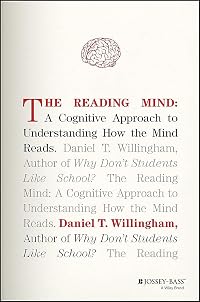
The Reading Mind: A Cognitive Approach to Understanding How the Mind Reads
by Daniel T. Willingham
On This Page
Description
A Map to the Magic of Reading Stop for a moment and wonder: what's happening in your brain right now ́as you read this paragraph? How much do you know about the innumerable and amazing connections that your mind is making as you, in a flash, make sense of this request?℗ Why does it matter ? The Reading Mind ℗ is a brilliant, beautifully crafted, and accessible exploration of arguably life's most important skill: reading. Daniel T. Willingham, the bestselling author of℗ Why show more Don't Students Like School ?, offers a perspective that is rooted in contemporary cognitive research. He deftly describes the incredibly complex and nearly instantaneous series of events that occur from the moment a child sees a single letter to the time they finish reading.℗ The Reading Mind ℗ explains the fascinating journey from seeing letters, then words, sentences, and so on, with the author highlighting each step along the way. This resource covers every aspect of reading, starting with two fundamental processes: reading by sight and reading by sound. It also addresses reading comprehension at all levels, from reading for understanding at early levels to inferring deeper meaning from texts and novels in high school. The author also considers the undeniable connection between reading and writing, as well as the important role of motivation as it relates to reading. Finally, as a cutting-edge researcher, Willingham tackles the intersection of our rapidly changing technology and its effects on learning to read and reading. Every teacher, reading specialist, literacy coach, and school administrator will find this book invaluable. Understanding the fascinating science behind the magic of reading is essential for every educator. Indeed, every "reader" will be captivated by the dynamic but invisible workings of their own minds. show lessTags
Recommendations



Member Reviews
This book contains an overview of cognitive models of the different tasks involved in reading. The strength of this book is its clarity. Each chapter is focused and well structured to make it easy to understand the key points. Each chapter opens with an agenda for that chapter and ends with a summary and implications. The separation of the summary and implications highlights another strength of the books: Willingham's careful separation of what we know from research and ways that can be applied, e.g., in the classroom.
On the theoretical side, the tasks involved in reading are letter recognition, translating letters to sounds, translating sounds to words, figuring out the meanings of words, connecting the meanings of words to extract the show more meanings of sentences, of sentences to get the meaning of passages, and extracting ideas to get an overall sense of a text. The common theme among these is that at all levels, reading is a statistical process. We see information and it activates an information network. Identification is accomplished when one option is sufficiently more strongly activated than the rest. This is especially interesting in the context of word meanings. We do not represent words with concrete meanings. Rather words/concepts are connected with each other and the strength of connections define words.
On the practical side, the most important tool for improving all of the tasks involved in reading is to do more reading, especially in ways that encourage positive emotional attitudes. This may make improving reading skills seem like a hopeless, circular task. However, Willingham presents some ways of kickstarting the cycle. We can provide opportunities to read for utility (e.g., if kids are interested in pets or cooking, encourage them to read about the topic). We can also encourage positive associations with reading, e.g., bedtime reading, books as gifts, and reading as a family value.
Overall, this was a good read, despite the occasional flow-impacting meta that comes from reading a book about reading. :-) show less
On the theoretical side, the tasks involved in reading are letter recognition, translating letters to sounds, translating sounds to words, figuring out the meanings of words, connecting the meanings of words to extract the show more meanings of sentences, of sentences to get the meaning of passages, and extracting ideas to get an overall sense of a text. The common theme among these is that at all levels, reading is a statistical process. We see information and it activates an information network. Identification is accomplished when one option is sufficiently more strongly activated than the rest. This is especially interesting in the context of word meanings. We do not represent words with concrete meanings. Rather words/concepts are connected with each other and the strength of connections define words.
On the practical side, the most important tool for improving all of the tasks involved in reading is to do more reading, especially in ways that encourage positive emotional attitudes. This may make improving reading skills seem like a hopeless, circular task. However, Willingham presents some ways of kickstarting the cycle. We can provide opportunities to read for utility (e.g., if kids are interested in pets or cooking, encourage them to read about the topic). We can also encourage positive associations with reading, e.g., bedtime reading, books as gifts, and reading as a family value.
Overall, this was a good read, despite the occasional flow-impacting meta that comes from reading a book about reading. :-) show less
Ratings
Members
- Recently Added By
Lists

Books for Educators
164 works; 6 members
Author Information

14 Works 1,105 Members
Daniel T. Willingham is Professor of Psychology at the University of Virginia. He is the author of several educational books, the columnist for "Ask the Cognitive Scientist" for American Educator, and a fellow of the American Psychological Association. He was appointed in 2017 by President Obama to serve as a Member of the National Board for show more Education Sciences. show less
Classifications
Statistics
- Members
- 87
- Popularity
- 367,414
- Reviews
- 1
- Rating
- (4.20)
- Languages
- English, Swedish
- Media
- Paper, Ebook
- ISBNs
- 5
- ASINs
- 1