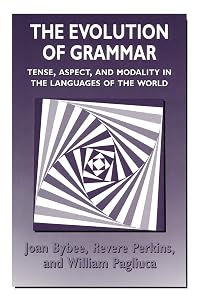
The Evolution of Grammar: Tense, Aspect, and Modality in the Languages of the World
by Joan Bybee, William Pagliuca, Revere Perkins
41 Members (5.00)
On This Page
Description
Joan Bybee and her colleagues present a new theory of the evolution of grammar that links structure and meaning in a way that directly challenges most contemporary versions of generative grammar. This study focuses on the use and meaning of grammatical markers of tense, aspect, and modality and identifies a universal set of grammatical categories. The authors demonstrate that the semantic content of these categories evolves gradually and that this process of evolution is strikingly similar show more across unrelated languages. Through a survey of seventy-six languages in twenty-five different phyla, the authors show that the same paths of change occur universally and that movement along these paths is in one direction only. This analysis reveals that lexical substance evolves into grammatical substance through various mechanisms of change, such as metaphorical extension and the conventionalization of implicature. Grammaticization is always accompanied by an increase in frequency of the grammatical marker, providing clear evidence that language use is a major factor in the evolution of synchronic language states. The Evolution of Grammar has important implications for the development of language and for the study of cognitive processes in general. show lessTags
Recommendations














Member Reviews
Members
- Recently Added By
Author Information
11+ Works 186 Members
Joan Bybee is Distinguished Professor Emerita in the Department of Linguistics at the University of New Mexico. Her previous publications include Phonology and Language Use (Cambridge, 2001) and Frequency of use and the Organization of Language (2007).
2+ Works 44 Members
1 Work 40 Members
Classifications
Statistics
- Members
- 41
- Popularity
- 717,845
- Rating
- (5.00)
- Languages
- Chinese, English
- Media
- Paper
- ISBNs
- 3