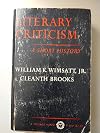
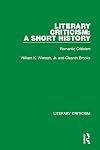
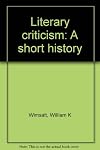
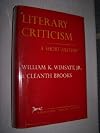
Literary Criticism: A Short History
by W. K. Wimsatt, Cleanth Brooks
On This Page
Description
First published in 1957, Literary Criticism: A Short History traces our aesthetic heritage from its classical origins up to the contemporary state of criticism in the English-speaking world. Divided into four volumes, each book adopts a fair and objective position in the presentation of various critical positions, and each critical theory is considered not only in competition with other critical theories, but also in vital dialectic with the creative literature of its own time. Volume Two show more focuses on Neo-Classical criticism and covers Medieval themes, the Sixteenth Century, English Neo-Classicism, late seventeenth-century themes, rhetoric and Neo-Classic wit, poetry as pictures, genius, emotion, and association, and Samuel Johnson. show lessTags
Recommendations
















Member Reviews
How can this have an average rating of three paltry stars? It's so well-written and considered.
OK, OK, so I'm doing my time-dishonored 'review way before finished' thing, here, but -- Wimsatt and Brooks give great attention to Plato and Aristotle before moving on. The coverage and discussion, at least in what I have read, is truly fine.
OK, OK, so I'm doing my time-dishonored 'review way before finished' thing, here, but -- Wimsatt and Brooks give great attention to Plato and Aristotle before moving on. The coverage and discussion, at least in what I have read, is truly fine.
Ratings
Members
- Recently Added By
Author Information
20+ Works 330 Members
Wimsatt, Sterling Professor of English at Yale, where he taught for over 35 years, was one of the most important literary critics of his generation. He and Yale colleague Cleanth Brooks were arguably the key disseminators of the New Criticism, which was extremely influential from the 1940s through the 1960s. The basic tenets of New Criticism were show more outlined in England during the 1920s and 1930s by T. S. Eliot, William Empson, and I. A. Richards, and in America at about the same time by a group of southern writers, among them Cleanth Brooks. Wimsatt's 1954 collection of essays, The Verbal Icon, was one of the most important statements of New Critical methodology, and along with the works of Brooks, was frequently taught in college and university courses as New Criticism became the standard approach to literature, virtually synonymous with criticism itself. Two essays from the volume, coauthored with Monroe Beardsley, have provided particularly enduring catch phrases and key indicators of New Critical assumptions. "The Intentional Fallacy" describes what Wimsatt and Beardsley saw as an excessive emphasis on the author's psyche and self-expression at the expense of the work itself, so that the critic reduces the meaning of a text to the author's ostensible intentions, the feelings or ideas he or she meant it to convey (if these can even be discovered). "The Affective Fallacy" describes the opposite, the mistake of determining the meaning and success of a work by its emotional or didactic effect on the reader, again at the expense of a close reading of the text itself. For New Critics like Wimsatt, a work of literature should be a self-contained, organic whole to be understood and evaluated "objectively," as a linguistic structure apart from its production or consumption, according to formal and supposedly internal criteria, such as complexity, irony, and unity. To consider the feelings or ideas presumed to be expressed in a work or to result from reading it is, according to New Criticism, to be swayed by moral, philosophical, or sociological criteria external and therefore extraneous to the work. Many literary theorists now suggest that the objectivity and apoliticism for which formalist New Criticism strove is impossible and actually resulted in biased, politically conservative readings of literature. However, most contemporary critics still find close reading and explication of textual elements as crucial to the critical activity as the biographical, psychobiographical, historical, and ethico-philosophical studies whose importance they have renewed. (Bowker Author Biography) show less

58+ Works 2,000 Members
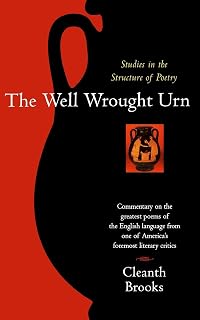
Cleanth Brooks was born in Murray, Kentucky on October 16, 1906. He was educated at Vanderbilt, Tulane, and Oxford universities. From 1932 to 1947, he taught English at Louisiana State University and then moved on to Yale University. At Yale, he helped to articulate the principles of New Criticism, which dominated literary studies in the 1940s and show more 1950s. He coedited the journal Southern Review with Robert Penn Warren. He also wrote several titles in collaboration with Warren, including Understanding Poetry and Understanding Fiction. A third work Understanding Drama was written in collaboration with Robert Heilman. His other works included The Well Wrought Urn: Studies in the Structure of Poetry and Modern Poetry and the Tradition. He died on May 10, 1994. (Bowker Author Biography) show less
Classifications
- Genres
- Nonfiction, Literature Studies and Criticism, Fiction and Literature, Philosophy
- DDC/MDS
- 801.95 — Literature & rhetoric Literature, rhetoric & criticism Philosophy and theory Nature and character Literary theory and criticism
- LCC
- PN86 .W5 — Language and Literature Literature (General) Literature (General) Criticism
- BISAC
Statistics
- Members
- 87
- Popularity
- 367,532
- Reviews
- 1
- Rating
- (3.67)
- Languages
- English
- Media
- Paper, Ebook
- ISBNs
- 10
- ASINs
- 6