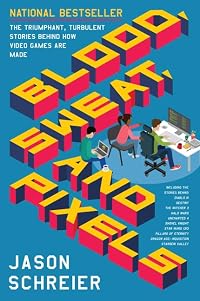
Blood, Sweat, and Pixels: The Triumphant, Turbulent Stories Behind How Video Games Are Made
by Jason Schreier
Video Game Industry (1)
On This Page
Description
Developing video games-hero's journey or fool's errand? The creative and technical logistics that go into building today's hottest games can be more harrowing and complex than the games themselves, often seeming like an endless maze or a bottomless abyss. In Blood, Sweat, and Pixels, Jason Schreier takes readers on a fascinating odyssey behind the scenes of video game development, where the creator may be a team of 600 overworked underdogs or a solitary geek genius. Exploring the artistic show more challenges, technical impossibilities, marketplace demands, and Donkey Kong-sized monkey wrenches thrown into the works by corporate, Blood, Sweat, and Pixels reveals how bringing any game to completion is more than Sisyphean-it's nothing short of miraculous. Taking some of the most popular, bestselling recent games, Schreier immerses readers in the hellfire of the development process, whether it's RPG studio Bioware's challenge to beat an impossible schedule and overcome countless technical nightmares to build Dragon Age: Inquisition; indie developer Eric Barone's single-handed efforts to grow country-life RPG Stardew Valley from one man's vision into a multi-million-dollar franchise; or Bungie spinning out from their corporate overlords at Microsoft to create Destiny, a brand new universe that they hoped would become as iconic as Star Wars and Lord of the Rings-even as it nearly ripped their studio apart. Documenting the round-the-clock crunches, buggy-eyed burnout, and last-minute saves, Blood, Sweat, and Pixels is a journey through development hell-and ultimately a tribute to the dedicated diehards and unsung heroes who scale mountains of obstacles in their quests to create the best games imaginable. show lessTags
Recommendations















































Member Reviews
This is an easy book to like. Schreier is a good writer and his access to key figures in the industry is exciting for a behind the scenes on big moments in gaming. Indeed, the first couple chapters he covers are interesting as broad surveys into the perils of game development such as scope creep, marketing and the crunch.
But the longer you go on, the more you get the sense that his attempts to cover the crunch and similar dysfunctions of project and business management in the industry are more an apologia for insiders with survivor bias than a critique of toxic work environments.
In that respect, I found myself getting more irritated as the case studies went on, since every developer's inevitable deadline push and 100hr work week just show more felt banal and awful rather than a triumph of creative passion. I'm not in game development (thank goodness!) and it's largely because the norms that go relatively unchallenged in this book work really well for select game devs with credibility and power, whereas the common employee is treated like garbage and told that this is for the great good. I doubt this was Schreier's intent, but the sum total of the book reads more like an attempt to spin complete management dysfunction as normal operating parameters. show less
But the longer you go on, the more you get the sense that his attempts to cover the crunch and similar dysfunctions of project and business management in the industry are more an apologia for insiders with survivor bias than a critique of toxic work environments.
In that respect, I found myself getting more irritated as the case studies went on, since every developer's inevitable deadline push and 100hr work week just show more felt banal and awful rather than a triumph of creative passion. I'm not in game development (thank goodness!) and it's largely because the norms that go relatively unchallenged in this book work really well for select game devs with credibility and power, whereas the common employee is treated like garbage and told that this is for the great good. I doubt this was Schreier's intent, but the sum total of the book reads more like an attempt to spin complete management dysfunction as normal operating parameters. show less
Made my blood boil. The author takes everything managers tell him uncritically. This is an extremely sympathetic (sycophantic) account of game development. It paints this ridiculous picture of people doing what they love and killing themselves and ruining their lives for the players. What a load of bollocks. Uncharted isn't some labour of love, it's a number in a spreadsheet and the developers aren't heros, they are expenses. And they don't do unpaid overtime because they love it, they do it because there is an infinite supply of idiots who are eager to take their place and the studio will not hesitate for a second to replace them. Welcome to the world of game development.
It's an interesting survey of how games get made, but it would be a much better book if it actually grappled with the hugely problematic aspects of the industry that here get shrugged off at best and considered necessary at worst.
Сейчас, когда на видеоигры стали вешать всех собак даже в России, пожалуй, самое время заглянуть за кулисы их производства. Российский издатель выбрал несколько двузначный вариант перевода названия, но нет, в книге почти ничего нет об экономических реалиях продвижения в ритейле или исследованиях о влиянии стрелялок на неоформившийся мозг. Зато много другой эксклюзивной информации из этого мало show more понятного вида бизнеса: как эффективно управлять креативной командой, как работать с требовательным заказчиком (например, Microsoft) и как устроены фандрайзинговые кампании на Kickstarter, ведь за собранные с фанатов деньги придется держать еженедельный ответ. Быть детально знакомым со всеми упомянутыми играми необязательно, ведь вряд ли даже щедро вкладывающийся в них Алишер Усманов играет во что-то сложнее Candy Crush. show less
I enjoyed this book. It was written in a light breezy style that was like reading magazine profiles about companies, but with more human interest. That might be due to the fact that the author Jason Schreier is a reporter who writes about the tech industry and specializes in video games.
The book is divided into 10 chapters. Each chapter features a video game. Some of them are famous hits that have become cultural touchstones of the gaming world, and some of the chapters are about the colossal failures. Both kinds of chapters are full of information about why the designers, programmers, and writers succeeded or failed. In the end, each chapter is about organization and organizational psychology. These, combined with a bit of good luck show more created some hits and explained why some of the games failed. Some of the businesses that succeeded did so against really bad odds, and others that had plenty of money and personnel to throw at problems failed. In at least one case, the mitigation of a big failure after the release of the game resulted in a game that is still being played and that people really like, proves that sometimes failures can be fixed.
I found myself looking up terms like RPG, MMO, and RTG along with some of the jargon from the early chapters because the world of video gaming was unfamiliar territory. I soon felt more comfortable with the topic and am glad I read the book, as I have some background now when I hear the names of these games bandied about by the students and some of the faculty with whom I work. show less
The book is divided into 10 chapters. Each chapter features a video game. Some of them are famous hits that have become cultural touchstones of the gaming world, and some of the chapters are about the colossal failures. Both kinds of chapters are full of information about why the designers, programmers, and writers succeeded or failed. In the end, each chapter is about organization and organizational psychology. These, combined with a bit of good luck show more created some hits and explained why some of the games failed. Some of the businesses that succeeded did so against really bad odds, and others that had plenty of money and personnel to throw at problems failed. In at least one case, the mitigation of a big failure after the release of the game resulted in a game that is still being played and that people really like, proves that sometimes failures can be fixed.
I found myself looking up terms like RPG, MMO, and RTG along with some of the jargon from the early chapters because the world of video gaming was unfamiliar territory. I soon felt more comfortable with the topic and am glad I read the book, as I have some background now when I hear the names of these games bandied about by the students and some of the faculty with whom I work. show less
It's full of lots of interesting stories, most of them well cited but I found 4 fact checking errors in the witcher 3 chapter. Nothing too serious but the research into the game and the studio did not meet the quality bar that the other chapters hit. Sometimes incredibly simple things are overexplained in footnotes, things that anyone who has ever thought about video games would understand. That could be seen as a positive for those who aren't so into the hobby, but they wouldn't have much of a reason to read this book, would they? The big reason to give it a read is getting to see behind the curtain about how publishers interact with developers and about individual games that either didn't end up coming together or came together in the show more last moment in a crazy hail mary. Especially interesting was the meddling from George Lucas on Star Wars 1313. show less
Blood, Sweat, and Pixels is a celebration of crunch time, and of all the pieces that have to come together to make a video game work. Video games are as complex an entertainment medium as we have, yet making them is a process beset by managerial chaos, incredibly bad tools (and I thought SQL Management Studio was a drag), and long long hours.
It's weird that 35 years on from video games becoming more than just a toy for geeks, the process for making them is so chaotic and poorly understood. Worse, what makes a game good is an emergent property of many different systems, all of which could depend on the tiniest details, so problems don't emerge until the game is almost done. And that doesn't even get into online games, which depend on show more thousands of real humans to make them work.
Schreier's stories are interesting, but his ten case studies tend to blend together, aside from the indie studios behind Stardew Valley and Shovel Knight. Video games are big business, bigger than the movies these days, but we still don't seem to know to make them, aside from whipping programmers and artists. show less
It's weird that 35 years on from video games becoming more than just a toy for geeks, the process for making them is so chaotic and poorly understood. Worse, what makes a game good is an emergent property of many different systems, all of which could depend on the tiniest details, so problems don't emerge until the game is almost done. And that doesn't even get into online games, which depend on show more thousands of real humans to make them work.
Schreier's stories are interesting, but his ten case studies tend to blend together, aside from the indie studios behind Stardew Valley and Shovel Knight. Video games are big business, bigger than the movies these days, but we still don't seem to know to make them, aside from whipping programmers and artists. show less
Members
- Recently Added By
Lists

Books Read in 2021
5,361 works; 114 members
Author Information
3 Works 1,024 Members
Jason Schreier is the news editor at Kotaku, a leading website covering the industry and culture of video games. He has also covered the video-game world for Wired and has contributed to a wide range of outlets including the New York Times, Edge, Paste, Kill Screen, and the Onion News Network.
Series

Common Knowledge
- Original publication date
- 2017
- People/Characters
- Josh Sawyer; Chris Avellone; Adam Brennecke; Feargus Urquhart; Amy Hennig; Neil Druckmann (show all 13); Bruce Straley; Eric Barone; Amber Hageman; Finn Brice; Yasuhiro Wada; Josh Mosqueira; Wyatt Cheng
- Important places
- Los Angeles, California, USA; Seattle, Washington, USA
- First words
- Say you want to make a video game.
- Original language
- English
Classifications
- Genres
- General Nonfiction, Nonfiction, Business, Technology, History
- DDC/MDS
- 794.8 — Arts & recreation Recreation, sports, and performing arts Chess, Computer Games / Card Games Electronic games
- LCC
- GV1469.3 .S37 — Geography, Anthropology and Recreation Recreation. Leisure Recreation. Leisure Games and amusements Indoor games and amusements Board games. Move games
- BISAC
Statistics
- Members
- 678
- Popularity
- 42,152
- Reviews
- 20
- Rating
- (3.81)
- Languages
- English, Polish, Portuguese (Portugal), Turkish
- Media
- Paper, Audiobook, Ebook
- ISBNs
- 8
- ASINs
- 6