On This Page
Description
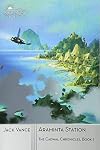
"The planet Cadwal is forever set aside as a natural preserve, owned and administered by the Naturalist Society of Earth, and inhabited by a very limited number of skilled human scientists and their families. But this system has been complicated by the passing centuries, and has become a byzantine culture where every place in the Houses of Cadwal is the object of savage competition." --provided by Goodreads.Tags
Recommendations


















Member Reviews
This book was very hard to rate, since one part of it (the plot and intrigue) was very good, while another (the dialogue and characterisation) was dismal.
I didn't know this was going to be a mystery, so the sudden appearance of one gave me a new lease of interest on what had so far appeared to be the story of Glawen cruising his way through life and meeting with very little in the way of challenge.
Soon I was engrossed in the web of mysteries, which were very skillfully handled, with minor details often becoming significant only much later. This alone would give the book re-read value, if not for...
All the dialogue was written in a bafflingly verbose and obscure manner, almost as if the author were a skilled second language speaker of show more English with a vast vocabulary but an incomplete grasp of nuance. In fact, I actually googled the author to check if that was the case (no).
Then I thought maybe it was done on purpose to show how alien the culture of Cadwal is to our own, but then why does everyone speak this way? Why does a precocious 10-year-old girl speak the same way as a grizzled old cop, who speaks the same way as a bunch of 20-year-olds ribbing each other? I couldn't get a full sense of the characters or the personalities of the different houses because there was no variety.
Other issues were the somewhat weird ideas Jack Vance seemed to be presenting. The Yips had an air of "yellow peril" and I'm not sure the author doesn't think exterminating them wouldn't be a fine solution to the Yip "problem". The police force is a corrupt old-boys club that practices summary execution and blackmail and that seems to be promoted as a good thing. Peace and love types are mocked as daft idealists.
I'm so torn about whether I want to continue this series! I want the rest of the plot, but I definitely don't want more of the pompous jerk that Glawen seemed to morph into once he left his home planet, and I don't know if I can deal with more of that weird stilted dialogue. show less
I didn't know this was going to be a mystery, so the sudden appearance of one gave me a new lease of interest on what had so far appeared to be the story of Glawen cruising his way through life and meeting with very little in the way of challenge.
Soon I was engrossed in the web of mysteries, which were very skillfully handled, with minor details often becoming significant only much later. This alone would give the book re-read value, if not for...
All the dialogue was written in a bafflingly verbose and obscure manner, almost as if the author were a skilled second language speaker of show more English with a vast vocabulary but an incomplete grasp of nuance. In fact, I actually googled the author to check if that was the case (no).
Then I thought maybe it was done on purpose to show how alien the culture of Cadwal is to our own, but then why does everyone speak this way? Why does a precocious 10-year-old girl speak the same way as a grizzled old cop, who speaks the same way as a bunch of 20-year-olds ribbing each other? I couldn't get a full sense of the characters or the personalities of the different houses because there was no variety.
Other issues were the somewhat weird ideas Jack Vance seemed to be presenting. The Yips had an air of "yellow peril" and I'm not sure the author doesn't think exterminating them wouldn't be a fine solution to the Yip "problem". The police force is a corrupt old-boys club that practices summary execution and blackmail and that seems to be promoted as a good thing. Peace and love types are mocked as daft idealists.
I'm so torn about whether I want to continue this series! I want the rest of the plot, but I definitely don't want more of the pompous jerk that Glawen seemed to morph into once he left his home planet, and I don't know if I can deal with more of that weird stilted dialogue. show less
I've read this long novel twice. It appears that I can forgive Jack Vance nearly anything. This book has all the plot elements and structure of a Stratemeyer Factory kids' adventure book. And yet the prose, perspective, and even characterizations -- and general inventiveness -- causes the reader to be drawn in. This is light reading, but suffused, somehow, with greatness. It's not quite like most other popular genre fiction. It is, in fact, almost as if the author had read a how-to manual on contemporary genre fiction, but had no models at hand, other than a few works by Lord Dunsany, James Branch Cabell, and, perhaps, a Ken Holt mystery. Very odd. Very good.
I first read this many years ago, probably soon after it was published in 1989, which was a few years before I started recording the books I read. For some reason, I never got around to picking up copies of the two sequels, Ecce and Old Earth and Throy, until many, many years later… Then I never got around to actually reading them. And now, of course, they’re in storage. Happily, all three books of the trilogy are available as ebooks from the SF Gateway, so I picked up the first as a reread. The planet of Cadwal has been declared off-limits to development and is ostensibly policed by a group based at the eponymous station. Which has existed so long its workings have come to define its society. Glawen Clattuc is a teenager likely to show more take a middling position in the Araminta bureaucracy. But enemies of his father arrange for him to be given a much lower ranking than he deserves. He goes to work for the station’s police force. At a festival, Glawen’s girlfriend disappears, believed murdered and her body shipped off-world in a wine cask. There’s a suspect, but no evidence to charge him. There’s also a plot brewing in Yipton, an offshore community composed entirely of Yips, a human subspecies used as temporary labour at Araminta Station. All of which results in Glawen being sent on a mission to another world, where he ends up imprisoned in a monastery. And that, and the plot in Yipton, seems to link into mutterings about opening up Cadwal for development… I remember reading Vance’s last couple of sf novels in the late 1990s and early 2000s, and being disappointed by them. And the Cadwal Chronicles trilogy were the novels published prior to those. So my expectations weren’t especially high. Happily, Araminta Station proved to be Vance on fine form. It’s busier than most of his other novels, but it’s also better plotted. The characterisation also seemed less arbitrary than I recalled in other novels. And the comic lines were good too. show less
I enjoyed it, but it was not like I was expecting. I knew it was a coming of age story, and that part I got right. It's about a youngster named Glawen Clattuc who lives in Cadwal, a world that is set a a planet-wide natural reserve where immigration is heavily restricted. The Naturalist Society of Earth, the institution that set the reserve, has basically disbanded on Earth, but Cadwal continues operating according to its charter, although there are political pressures trying to change that. The planet is managed by a few families, dating back to the original conservators. According to dynastic considerations, on their 16th birthday young people from these families are given "agency status" meaning that they officially belong to the show more family and can live on Cadwal and have their future solved, or they become "collaterals", with limited rights, who basically have to fend for themselves and possibly migrate. Glawen is close to the cutoff, so it could go both ways for him, depending on who dies or is born before his 16th birthday.
Glawen is a serious, conscientious and hard-working young man. Some could say a bit boring and pompous (although his whole culture is a bit pompous, actually). However, he is very competent at his studies and his part-time job on Bureau B, Cadwal's police force, where his father also works. The Bureau has a lot of work, with the disappearance of a young woman and a possible plot by the Yips to take control of Cadwal.
The Yips are human but have formed a different subspecies, because they can't inter-breed with non-Yips. They are in Cadwal as illegal immigrants, doing menial jobs or otherwise confined to a small island. They are a strange, hermetic people, who are difficult to deal with and never intermingle with outsiders unless there's money in it for them. They aspire to be allowed to settle in Cadwal freely.
So this is the setup... It's a mystery/investigation story, with several plots and intrigues. The political point of view seemed Heinlein-like to me. Our sympathies are supposed to be with the conservators. That's made easier by the fact that the Yips are not natives, but arrived later, and by their being very strange and untrustworthy (yellow peril, anyone?). But still, it seemed debatable that the conservators should have the right to keep the Yips confined because of the planet being a natural reserve. To be fair, it is debated, and there are those in Cadwal who think the Charter needs to be reformed or abolished. But, the people who defend that are depicted unsympathetically, and I think that's a weakness of the book, because there could be a legitimate ethical argument there. It's perhaps, because the book is a product of its time. Also, it is worth mentioning the cavalier attitude of law enforcement towards executing criminals without a proper trial. It's all rather Far West.
The plot, although a bit rambling, is entertaining, and most of the loose ends are tied in the end, although the story is not self-contained, since there are a few plot threads that end in a cliffhanger. The settings are vivid and the dialog is sometimes stilted and sometimes ingenious. I enjoyed it enough to read the sequels. I want to know what happens next. show less
Glawen is a serious, conscientious and hard-working young man. Some could say a bit boring and pompous (although his whole culture is a bit pompous, actually). However, he is very competent at his studies and his part-time job on Bureau B, Cadwal's police force, where his father also works. The Bureau has a lot of work, with the disappearance of a young woman and a possible plot by the Yips to take control of Cadwal.
The Yips are human but have formed a different subspecies, because they can't inter-breed with non-Yips. They are in Cadwal as illegal immigrants, doing menial jobs or otherwise confined to a small island. They are a strange, hermetic people, who are difficult to deal with and never intermingle with outsiders unless there's money in it for them. They aspire to be allowed to settle in Cadwal freely.
So this is the setup... It's a mystery/investigation story, with several plots and intrigues. The political point of view seemed Heinlein-like to me. Our sympathies are supposed to be with the conservators. That's made easier by the fact that the Yips are not natives, but arrived later, and by their being very strange and untrustworthy (yellow peril, anyone?). But still, it seemed debatable that the conservators should have the right to keep the Yips confined because of the planet being a natural reserve. To be fair, it is debated, and there are those in Cadwal who think the Charter needs to be reformed or abolished. But, the people who defend that are depicted unsympathetically, and I think that's a weakness of the book, because there could be a legitimate ethical argument there. It's perhaps, because the book is a product of its time. Also, it is worth mentioning the cavalier attitude of law enforcement towards executing criminals without a proper trial. It's all rather Far West.
The plot, although a bit rambling, is entertaining, and most of the loose ends are tied in the end, although the story is not self-contained, since there are a few plot threads that end in a cliffhanger. The settings are vivid and the dialog is sometimes stilted and sometimes ingenious. I enjoyed it enough to read the sequels. I want to know what happens next. show less
An interesting book, despite what for me felt like a bit of a slow start. I kept waiting for it to turn into an all out "good guys fight guerrilla war against bad guys who have usurped control of a distant planetary colony" story, but it remained at its heart a mystery, while raising surprisingly nuanced ethical questions. Some of the plotting felt predictable, and some aspects of the resolution felt rushed and superficial, and just about all of the characters seem to speak with the same voice, but all that aside, an entertaining and even thought provoking read.
The general consensus seems to be that this series goes downhill from here, but I plan to eventually move on to books 2 and 3.
The general consensus seems to be that this series goes downhill from here, but I plan to eventually move on to books 2 and 3.
A longish space opera that is, essentially, a string of boy's adventures some of which are like those of John Carter himself. Many resemble a police procedural. This is the number one volume of the book seller's delight, a trilogy, and I will read on. All of the plot lines are tied up, but one is added in the last adventure that serves as a lead into volume 2.
It is always interesting to see how our view of the future is limited by the present. This book is copyright 1988, just before the internet became widely available and before the mobile phone took off. The characters in this book send written letters across space and in one adventure they search for a telephone.
It is always interesting to see how our view of the future is limited by the present. This book is copyright 1988, just before the internet became widely available and before the mobile phone took off. The characters in this book send written letters across space and in one adventure they search for a telephone.
Glawen Clattuc lives on the strictly managed, nature-preserve planet Cadwal. He joins the local police, Bureau B, to investigate a disappearance and corruption; he uncovers a plot to illegally open the planet to developers.
Cadwal is a pristine, preserved planet managed by the Naturalist Society of Earth. Glawen Clattuc, a young resident, matures into a detective, navigating a rigid, bureaucratic, and competitive society. He tries to find his missing romantic interest, Sessily Veder, while uncovering a conspiracy involving his enemy Arles and a missing legal charter that determines ownership of the planet.
Cadwal is a pristine, preserved planet managed by the Naturalist Society of Earth. Glawen Clattuc, a young resident, matures into a detective, navigating a rigid, bureaucratic, and competitive society. He tries to find his missing romantic interest, Sessily Veder, while uncovering a conspiracy involving his enemy Arles and a missing legal charter that determines ownership of the planet.
Members
- Recently Added By
Lists

Best Science Fiction Novels
816 works; 426 members
Author Information

373+ Works 34,749 Members
John Holbrook Vance (August 28, 1916 - May 26, 2013) was an American mystery, fantasy and science fiction writer. Most of his work was published under the name Jack Vance. He also wrote 11 mystery novels as John Holbrook Vance and three as Ellery Queen, and once each used pseudonyms Alan Wade, Peter Held, John van See, and Jay Kavanse. Vance won show more the World Fantasy Award for Life Achievement in 1984. The Science Fiction Hall of Fame inducted him in 2001. Among his awards for particular works were: Hugo Awards, in 1963 for The Dragon Masters, in 1967 for The Last Castle, and in 2010 for his memoir This is Me, Jack Vance!; a Nebula Award in 1966, also for The Last Castle; the Jupiter Award in 1975; the World Fantasy Award in 1990 for Lyonesse: Madouc. He also won an Edgar (the mystery equivalent of the Nebula) for the best first mystery novel in 1961 for The Man in the Cage. He died at his home in Oakland, California, on May 26, 2013, aged 96. (Bowker Author Biography) show less
Some Editions
Awards and Honors
Awards
Notable Lists
Series

Belongs to Publisher Series
Heyne Science Fiction & Fantasy (06/5300)
Work Relationships
Is contained in
Contains
Common Knowledge
- Canonical title*
- De Kronieken van Cadwal - Station Araminta
- Original title
- Araminta Station
- Original publication date
- 1987-09
- Original language*
- Englisch
*Some information comes from Common Knowledge in other languages. Click "Edit" for more information.
Classifications
Statistics
- Members
- 713
- Popularity
- 39,604
- Reviews
- 14
- Rating
- (3.72)
- Languages
- 6 — Dutch, English, French, German, Italian, Russian
- Media
- Paper, Ebook
- ISBNs
- 19
- ASINs
- 13