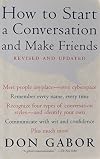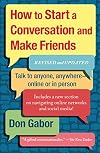
How To Start A Conversation And Make Friends
by Don Gabor
On This Page
Description
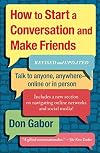
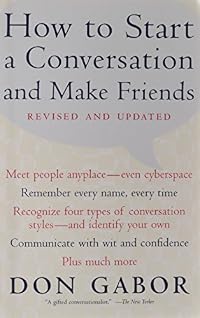
For more than twenty-five years, small-talk expert Don Gabor has helped thousands of people communicate with wit, confidence, and enthusiasm with his bestseller How to Start a Conversation and Make Friends . This newly revised and updated edition combines classic techniques in the art of conversation with necessary skills for communicating in the twenty-first century. By following the simple and dynamic guidelines you{u2019}ll be ready to strike up a great conversation anytime, anywhere. show more Learn how to keep the conversation going by asking the right questions, using body language effectively, and avoiding conversation pitfalls. Combining his tried-and-true methods with a whole new section on communicating online and through social networking, Don Gabor shows you how to: ? Identify your personal conversation style ? Engage in online conversations using proper etiquette and security ? Turn online conversations into face-to-face relationships ? Boost your personal and professional speaking skills to the next level How to Start a Conversation and Make Friends is sure to help you connect with others at home, work, and everywhere in between for years to come. show lessTags
Recommendations























Member Reviews
Contains some great practical ideas on how to, well, start conversations and make friends. Tips on how to open your body language, break the ice, remember names, and graciously end conversations. In our family, we struggle with many of these issues, so I thought it might be helpful to read a book about it. The first half was useful; the second half was more about networking in the business world, which was not as applicable to me/us right now, so I just skimmed/skipped that part. There is also an abridged audiobook version that we listened to.
Feels a bit out of date in places but that's probably inevitable in a practical book on conversation. Overall a great guide to unlearning bad conversational habits and improving conversational skill.
I listened to the audio version and it's pretty much common sense with a little bit of pop psychology (is that the correct term?). It could be helpful for those with social awkwardness (which I do), but honestly - I can't see myself using any of these tips (except the polite and obvious ones). I do know of a couple of people in my life that could possibly benefit from it. 3 stars really, but 4 for the effort.
This book had some good insights, but rather simply written and a bit redundant...like a 5th grade text book.
This book had some good insights, but rather simply written and a bit redundant...like a 5th grade text book.
I am always looking to improve my communication/conversation skills with people.This book was very easy to read and gave helpful hints on how to do so. I even made note cards of important information that I will use.
A lot of good ideas.NOthing especially powerful but short and handy"Handling the Complainer", :Reveak tiyr Giaks:""Don't
Members
- Recently Added By
Author Information

25 Works 693 Members
Don Gabor is a small-talk expert, communications trainer, and the author of ten self-help books and audio programs. He is a frequent media guest and the 2010-2011 president of the New York City chapter of the National Speakers Association.
Common Knowledge
- Original publication date
- 1983
- Epigraph
- Good conversation is what makes us interesting. After all, we spend a great deal of our time talking and a great deal of our time listening. Why be bored, why be boring—when you don't have to be either? —Edwin Newman (191... (show all)9-2010), news commentator
It's a luxury to be understood. —Ralph Waldo Emerson (1803-1882), American poet and essayist
Ideal conversation must be an exchange of thought, and not, as many of those who worry most about their shortcomings believe, an eloquent exhibition of wit or oratory. —Emily Post (1872-1960), writer and authority on etique... (show all)tte - Dedication
- I dedicate this book to my parents, Trude and Fred, and my sister, Ellen. Thank you for giving me the confidence and encouragement to talk to anyone, anyplace, about anything. I also dedicate this book to my wife and the love... (show all) of my life, Eileen.
- First words
- The next time you walk into a room full of people, just listen to them talking!
- Quotations
- Remember that risk taking and rejection are part of life, and being overly sensitive about how others react to you is counterproductive.
To enter a conversation in progress, you must be withing listening and speaking range. Move close to the people speaking and show interest in what is being said. Use plenty of eye contact, nodding, and smiling to send the sig... (show all)nal to the speakers that you want to hear more. Often, when a speaker sees you are interested in what he is saying, he will begin to include you as a listener.
Spontaneously commenting to someone about what you both observe is a way of instantly sharing an experience that can easily lead to more conversation. The trick to extending a brief comment into a chat is to follow it with li... (show all)ght, upbeat remarks—not complaints or grim views. Because this method of breaking the ice reveals how you see the world, others will assume that you will see them in a negative way if your comments tend toward the negative. That's why complaining rarely leads to extended conversations. On the other hand, lighthearted comments reveal your sense of humor and make you appear friendly and appealing to talk to.
If you're rejected when reaching out to people, don't automatically assume it's your fault. The other person may have several reasons for not responding the way you want, none of which may have anything to do with you.
The most common reason for forgetting names is failing to focus on the moment of introduction, so you never hear them in the first place.
Repeating the name also has several additional benefits. First, it lets the other person know that you listened and that you are making a concentrated effort to remember her name. This is flattering. Second, if you got the na... (show all)me wrong, it allows the other person to correct you. Finally, by repeating the name, you think it, say it, and then hear it again, thus giving yourself three more repetitions in addition to hearing the name the first time. - Last words
- (Click to show. Warning: May contain spoilers.)All you have to do is look somebody in the eye, smile, and start a conversation!
Classifications
Statistics
- Members
- 517
- Popularity
- 57,676
- Reviews
- 7
- Rating
- (3.37)
- Languages
- Chinese, English, Hungarian
- Media
- Paper, Audiobook, Ebook
- ISBNs
- 14
- ASINs
- 5