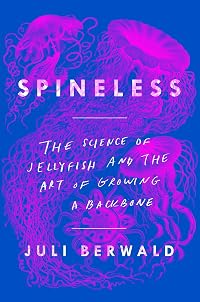
Spineless: The Science of Jellyfish and the Art of Growing a Backbone
by Juli Berwald
On This Page
Description
A former ocean biologist describes how she rediscovered her passion for marine science while investigating the enigmatic jellyfish and what the species' unique physiologies can teach about engineering and environmental stability. "Jellyfish have been swimming in our oceans for well over half a billion years, longer than any other animal that lives on the planet. They make a venom so toxic it can kill a human in three minutes. Their sting--microscopic spears that pierce with five million show more times the acceleration of gravity--is the fastest known motion in the animal kingdom. Made of roughly 95 percent water, some jellies are barely perceptible virtuosos of disguise, while others glow with a luminescence that has revolutionized biotechnology. Yet until recently, jellyfish were largely ignored by science, and they remain among the most poorly understood of ocean dwellers. More than a decade ago, Juli Berwald left a career in ocean science to raise a family in landlocked Austin, Texas. But then jellyfish drew her back to the sea. Recent, massive blooms of billions of jellyfish have clogged power plants, decimated fisheries, and caused millions of dollars of damage. Driven by questions about how overfishing, coastal development, and climate change were contributing to a jellyfish population explosion, Juli embarked on a scientific odyssey. She traveled the globe to meet the biologists who devote their careers to jellies, hitched rides on Japanese fishing boats to see giant jellyfish in the wild, raised jellyfish in her dining room, and throughout it all marveled at the complexity of these alluring and ominous biological wonders. Gracefully blending personal memoir with crystal-clear distillations of science, Spineless is the story of how Juli learned to navigate and ultimately embrace her ambition, her curiosity, and her passion for the natural world. She discovers that jellyfish science is more than just a quest for answers. It's a call to realize our collective responsibility for the planet we share."--Dust jacket flaps. show lessTags
Recommendations












Member Reviews
Every chapter of this book seemed filled with stuff that astonished me. I didn't realize how little I knew about jellyfish before! The author is, quite simply, a woman who became enthralled with jellyfish. She read about them, watched documentaries, traveled to visit scientists who studied them and fishermen who caught them. She kept some in a special tank in her living room, and several times ate jellyfish- once cooking it herself. She took her family on detours during vacations to visit beaches where jellyfish had been sighted. And more. The details are mind-boggling. Jellyfish have a very complex and curious life cycle- and one species at least, is known to reverse the process. The way they physically move through the water is show more intriguing- so different from how we do that it's hard to understand. They can be incredibly fragile- literally dissolving away once in open air- and yet jellyfish blooms- when certain populations suddenly reach staggering numbers- can dramatically change local oceanic ecosystems, causing fish numbers to crash. Then there's the jellyfish toxins- their sting can be mildly irritating, or deadly. Jellyfish stinging cells move faster than anything- even the mantis shrimp, whose strike is so fast it literally makes the water boil. I'm boggled. I was also blown away by the verve the author had to follow her growing passion- she had a job in a different field, an everyday family life with kids- yet sought out people and events revolving around jellyfish, even sitting down at conferences about them. There's a lot in here not only about the physiology and mystery of jellyfish (so much we still don't know), but also what jellyfish indicate about ocean conditions, which throws light on what we are doing to the ecosystem. It's a book I'm very glad to have read, which has fired my mind with so many questions and curiosity for more.
from the DogearDiary show less
from the DogearDiary show less
This book is more of the author's personal memoir than any type of science book about jellyfish. Berwald's enthusiasm for jellyfish is obvious and the writing style flows nicely. She includes some incredibly interesting information about the creatures, but there is simply too much personal "stuff" about her, her kids, her husband, her travel trips adn the people she meets to wade through. After a while the biographical pages became boring and wading through all the irrelevant "stuff" to get to the interesting jellyfish information became annoying.
If you are looking for actual science about jellyfish, try the wikipedia entry. If you like biography with some interesting jellyfish information, then you might like this book.
If you are looking for actual science about jellyfish, try the wikipedia entry. If you like biography with some interesting jellyfish information, then you might like this book.
The author takes us along as she pursues her passionate interest in jellyfish by traveling the world speaking to scientists, fishermen and other experts, searching for jellies in the wild, and doing everything from cooking them to attempting to keep them as pets. In the process, she talks about the biology of these animals, their interactions with humans, and their place, for good and ill, in the ocean's ecosystem, although it turns out that a lot of questions about all of these topics are still lacking answers.
The ecological message here is important, and the jellyfish themselves are very interesting. I did find that this book was a bit of a slow read for me in places, though, perhaps partly because some of the information could have show more been better organized and partly because the author's discussions about her own life were often much less interesting than the jellyfish facts, even if she does manage a fairly stirring few paragraphs tying environmental themes and her personal journey together at the end. show less
The ecological message here is important, and the jellyfish themselves are very interesting. I did find that this book was a bit of a slow read for me in places, though, perhaps partly because some of the information could have show more been better organized and partly because the author's discussions about her own life were often much less interesting than the jellyfish facts, even if she does manage a fairly stirring few paragraphs tying environmental themes and her personal journey together at the end. show less
I really didn't know much of anything about jellyfish, just bits and bobs. This book definitely gave me an education on this amazing animal. The only part about the book I have a complaint about is how the author kept throwing in personal details of her life, which is fine in small doses, like how the person became interested in the subject they're writing about, etc., but she writes about her relationship troubles and other irrelevant personal stories that, I think, did not add anything to the subject of jellyfish but more like a semi-biography. Not to be cold, but I really don't care about your personal life when it adds nothing to the subject, which is what I'm interested in reading about.
I know I just wrote a lot about what I didn't show more like, but overall the book is pretty interesting and I would recommend it. show less
I know I just wrote a lot about what I didn't show more like, but overall the book is pretty interesting and I would recommend it. show less
So, this book might have been a bit lighter on the science of jellyfish then I would have liked, but the author tells a good story about how she got to the place where she had an actual "well, how did I get here" moment in her life, and rediscovered her vocation for science. About 55% jellyfish and the conduct of science, 40% the author's life story and travel writing, and 5% environmental advocacy.
This book was a bit of a mixed bag, but mostly positive. The jellyfish science was fascinating, and some of the memoir bits really resonated (I started as a marine biology major, and while I switched majors, I did end up with two science M.S. degrees, and I often miss academia), but perhaps because it was so close, it also grated. Like, it must be nice to be able to decide to just fly to Japan because you want to see jellyfish. Maybe sour grapes? I don't know. But overall it felt like the author tried to fit her experiences to a narrative frame that didn't always work and was unsatisfying in the end.
I read about half of this a few years ago but finally checked out the audiobook and started over anew. I’m not sure if the book itself knows how it should be categorized, but I enjoyed the blend of science, travel, and memoir as the author discovers more in her jellyfish journey.
Members
- Recently Added By
Lists

Books Read in 2023
5,547 works; 145 members
Author Information

6 Works 438 Members
Juli Berwald received her PhD in ocean science from the University of Southern California. A science textbook writer and editor, she has written for a number of publications, including The New York Times, Nature, National Geographic, Discover. The Guardian, and Slate. She lives in Austin with her husband and their son and daughter.
All Editions
Some Editions
Awards and Honors
Awards
Notable Lists
Common Knowledge
- Original publication date
- 2017-11
- Dedication
- For Keith
- Blurbers
- Ozeki, Ruth; Montgomery, Sy; Barrett, Andrea; Horn, Miriam
- Original language
- English
Classifications
Statistics
- Members
- 349
- Popularity
- 90,175
- Reviews
- 13
- Rating
- (3.61)
- Languages
- English
- Media
- Paper, Audiobook, Ebook
- ISBNs
- 10
- ASINs
- 3