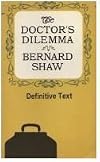
The Doctor's Dilemma
by George Bernard Shaw
On This Page
Description
If you could choose to save the life of either a brilliant but unbalanced artist or a stable, kindly medical student, what would you do? That's the dilemma at the heart of Shaw's play The Doctor's Dilemma. This fascinating work delves into a Pandora's Box of ethical and moral questions about the value of human life and the decision-making process itself..
Tags
Recommendations
























Member Reviews
This edition of ‘The Doctor’s Dilemma: A tragedy’ comprises of a preface, which consists of a rather long commentary on the behaviour and scandal of doctors during the turn of the twentieth century, and a play, which typifies Bernard Shaw’s wit and skill as satirist.
The criticisms in the preface may not seem to be pertinent to modern medicine, however, I did feel that they were relevant in the wider debate surrounding alternative medicines such as homeopathy today. “And every hypochondriacal rich lady or gentleman that can be persuaded that he or she is a lifelong invalid means anything from fifty to five hundred pounds a year to the doctor.” The role of the private practitioner as a trusted authority is compromised by the show more financial incentives involved by keeping patients ill for longer.
In the play, the ‘dilemma’ faced by Sir Colenso Ridgeon (who is the exceptional case of a doctor who does make ‘a very notable contribution to science’) is whether to treat a young, morally bankrupt but incredibly talented artist or to treat a poor, honest but slightly dull, doctor friend of his. The plot is complicated by the fact that Ridgeon is in love with the artist’s doting wife.
I found that the play was hugely enjoyable and made me laugh out loud in many places, which was more than enough compensation for the fact that none of the characters were all that likeable. show less
The criticisms in the preface may not seem to be pertinent to modern medicine, however, I did feel that they were relevant in the wider debate surrounding alternative medicines such as homeopathy today. “And every hypochondriacal rich lady or gentleman that can be persuaded that he or she is a lifelong invalid means anything from fifty to five hundred pounds a year to the doctor.” The role of the private practitioner as a trusted authority is compromised by the show more financial incentives involved by keeping patients ill for longer.
In the play, the ‘dilemma’ faced by Sir Colenso Ridgeon (who is the exceptional case of a doctor who does make ‘a very notable contribution to science’) is whether to treat a young, morally bankrupt but incredibly talented artist or to treat a poor, honest but slightly dull, doctor friend of his. The plot is complicated by the fact that Ridgeon is in love with the artist’s doting wife.
I found that the play was hugely enjoyable and made me laugh out loud in many places, which was more than enough compensation for the fact that none of the characters were all that likeable. show less
I listened to this full cast audiobook while skimming/reading the play in my Kindle omnibus "The Plays of Shaw".
I realized fairly quickly after starting this play that I had seen a film version of it with Leslie Caron. While I enjoyed listening to the play, I would recommend the 1958 movie over this audiobook to anyone interested in it. The pace of the audiobook (too slow) and the necessary (but not always complete) stage directions interrupting the flow both detracted from my enjoyment.
Regarding the plot: Shaw has some funny scenes in Act 1 satirizing the successful "Harley Street" physician (Harley Street is a street in London that was well-known for being the location of society doctors; it is similar to the term "Fleet Street" show more meaning the location of publishers of newspapers). I was surprised by how apt some of the satire still is over 100 years later!
The main dilemma is one of morality: is it ethical or right to deny possibly life-saving treatment to someone who is a cad? If the availability of treatment is limited, should the moral and potential future usefulness of the patient be a consideration? Shaw also uses Dubedat to challenge the views of the doctors (and audience) as to the relative importance of artistic genius compared to obeying society's rules. Even the ending raises some interesting questions:Dr. Ridgeon believes that he has saved Jennifer Dubedat unhappiness and pain by preventing her from finding out what a bounder Dubedat really was and letting her go through life with her idealized view of him intact. Regardless of the moral issue of whether he should be making such a decision in the first place, is he right? Perhaps she wouldn't have cared! Her sense of right and wrong are not necessarily the same as Ridgeon's. To add to the "dilemma", the good but poor doctor who got the treatment denied to Dubedat has become something of a know-it-all, no longer the nice man he was before. So doubt is thrown on using character as a guide to who deserves treatment from both sides. show less
I realized fairly quickly after starting this play that I had seen a film version of it with Leslie Caron. While I enjoyed listening to the play, I would recommend the 1958 movie over this audiobook to anyone interested in it. The pace of the audiobook (too slow) and the necessary (but not always complete) stage directions interrupting the flow both detracted from my enjoyment.
Regarding the plot: Shaw has some funny scenes in Act 1 satirizing the successful "Harley Street" physician (Harley Street is a street in London that was well-known for being the location of society doctors; it is similar to the term "Fleet Street" show more meaning the location of publishers of newspapers). I was surprised by how apt some of the satire still is over 100 years later!
The main dilemma is one of morality: is it ethical or right to deny possibly life-saving treatment to someone who is a cad? If the availability of treatment is limited, should the moral and potential future usefulness of the patient be a consideration? Shaw also uses Dubedat to challenge the views of the doctors (and audience) as to the relative importance of artistic genius compared to obeying society's rules. Even the ending raises some interesting questions:
In the twentieth Century, a medical doctor could, of proper circumstances arose commit an undetectable murder. Shaw explores the possibility, with darkly comic emphasis. He wasn't a great fan of intrusive medicine, so the profession, overall, comes under some scrutiny. The play was produced in 1906.
A small bit of historical memorabilia, interesting for the moralizing nature of the Victorian values, and the author's attempt to speak out against them; while his intent is glaringly obvious, it is a message not likely to be picked up by audiences today, who will probably see the character bearing Shaw's message as the cad that the other characters view him, thereby diluting the anti-moralizing message. The ethical dilemma suffered by the doctor is too obvious, the answer too plain, in the days of modern ethics. And few will find the underlying message palatable: that the artist is producing something of value, while the doctor is a wastrel that produces nothing anyone wants. Shaw cannot be faulted for failing to foresee that medicine show more in the future would become much more respected as it progressed suddenly from the rather stagnant position it had been in for centuries when Shaw was writing. The ethical issues of medicine are still there, but they have shifted; this play could be a good conversation starter. show less
Book 133
The Doctors Dilemma.
George Bernard Shaw.
The Doctor's Dilemma is a play by George Bernard Shaw first staged in 1906. It is a problem play about the moral dilemmas created by limited medical resources, and the conflicts between the demands of private medicine as a business and a vocation.
Nick Wannan
The Doctors Dilemma.
George Bernard Shaw.
The Doctor's Dilemma is a play by George Bernard Shaw first staged in 1906. It is a problem play about the moral dilemmas created by limited medical resources, and the conflicts between the demands of private medicine as a business and a vocation.
Nick Wannan
The preface, written in 1906 is as relevant today.
The preface, written in 1906 is as relevant today.
Members
- Recently Added By
Lists

To Read - Medicine
18 works; 1 member

Books Read in 2022
5,164 works; 113 members
Author Information

753+ Works 32,023 Members
Renowned literary genius George Bernard Shaw was born on July 26, 1856 in Dublin, Ireland. He later moved to London and educated himself at the British Museum while several of his novels were published in small socialist magazines. Shaw later became a music critic for the Star and for the World. He was a drama critic for the Saturday Review and show more later began to have some of his early plays produced. Shaw wrote the plays Man and Superman, Major Barbara, and Pygmalion, which was later adapted as My Fair Lady in both the musical and film form. He also transformed his works into screenplays for Saint Joan, How He Lied to Her Husband, Arms and the Man, Pygmalion, and Major Barbara. Shaw won the Nobel Prize for Literature in 1925. George Bernard Shaw died on November 2, 1950 at Ayot St. Lawrence, Hertfordshire, England. (Bowker Author Biography) show less
Some Editions
Series
Belongs to Publisher Series
Penguin Plays (PL1)
Penguin Books (564)
Work Relationships
Is contained in
Has as a supplement
Common Knowledge
Classifications
Statistics
- Members
- 375
- Popularity
- 83,124
- Reviews
- 7
- Rating
- (3.69)
- Languages
- English, German
- Media
- Paper, Audiobook, Ebook
- ISBNs
- 60
- ASINs
- 34