On This Page
Description
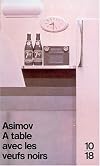
Twelve more mystery stories chronicling the cerebral adventures of the seven-member Black Widowers Club, who with their trusted waiter, Henry, gather once a month to solve mysteries over dinner.Tags
Recommendations


















Member Reviews
A collection of Isaac Asimov's mystery stories featuring the monthly banquets of the Black Widowers, a group of well-to-do intellectuals who invite a guest each month, and end up solving a bafflement plaguing the guest. The problems and solutions are drolly humorous and occasionally of a trivial nature, but the whole setup is so good-naturedly enjoyable that it doesn't matter. And Henry, the waiter who nearly always ends up the one who solves the puzzle, is one of Asimov's more intriguing creations. I picture him as the erudite and dignified old black butler who replaced Benson on "Soap". Each story comes with an afterword from Asimov, and I wish more authors would take up this practice.
Asimov's Black Widowers mystery stories are fun and logical.
#478 in our old book database. Not rated.
He aquí doce relatos de misterio que deleitarán al lector al mismo tiempo que le harán reflexionar. Isaac Asimov hace gala en este libro no sólo de sus excepcionales dotes de divulgador científico, sino también de su extraordinario ingenio. Una vez al mes, los siete miembros del Club de los Viudos Negros se reúnen para cenar en su restaurante favorito, en donde siempre les sirve un camarero llamado Henry, también miembro del club. Con motivo de cada cena se invita a alguien especial, quien expone a sus anfitriones un problema de ardua solución. Los Viudos Negros deberán unir sus esfuerzos mentales para resolver el enigma, si bien Henry, el camarero, es quien suele dar la última sorpresa...
Nov 2, 2010Spanish
Les veufs noirs se réunissent pour résoudre une énigme proposée par un détective. Deux hommes, dont l'un âpre collectionneur, se disputent. En se quittant, le second lance au premier un regard acquisiteur, le regard d'un homme ayant acquis ou pris un objet. Le collectionneur, persuadé qu'il a été volé, ne parvient cependant pas à trouver ce qui lui a été volé, car possédant trop de collections. Ce regard le poursuivra jusqu'à sa tombe. Qu'est-ce qui a été pris ?
Jul 2, 2011French
Members
- Recently Added By
Lists

Favorite Short Fiction
228 works; 99 members

Books Read in 2015
3,298 works; 126 members

Books Read in 2026
1,717 works; 62 members
Author Information

2,405+ Works 292,150 Members
Isaac Asimov was born in Petrovichi, Russia, on January 2, 1920. His family emigrated to the United States in 1923 and settled in Brooklyn, New York, where they owned and operated a candy store. Asimov became a naturalized U.S. citizen at the age of eight. As a youngster he discovered his talent for writing, producing his first original fiction at show more the age of eleven. He went on to become one of the world's most prolific writers, publishing nearly 500 books in his lifetime. Asimov was not only a writer; he also was a biochemist and an educator. He studied chemistry at Columbia University, earning a B.S., M.A. and Ph.D. In 1951, Asimov accepted a position as an instructor of biochemistry at Boston University's School of Medicine even though he had no practical experience in the field. His exceptional intelligence enabled him to master new systems rapidly, and he soon became a successful and distinguished professor at Columbia and even co-authored a biochemistry textbook within a few years. Asimov won numerous awards and honors for his books and stories, and he is considered to be a leading writer of the Golden Age of science fiction. While he did not invent science fiction, he helped to legitimize it by adding the narrative structure that had been missing from the traditional science fiction books of the period. He also introduced several innovative concepts, including the thematic concern for technological progress and its impact on humanity. Asimov is probably best known for his Foundation series, which includes Foundation, Foundation and Empire, and Second Foundation. In 1966, this trilogy won the Hugo award for best all-time science fiction series. In 1983, Asimov wrote an additional Foundation novel, Foundation's Edge, which won the Hugo for best novel of that year. Asimov also wrote a series of robot books that included I, Robot, and eventually he tied the two series together. He won three additional Hugos, including one awarded posthumously for the best non-fiction book of 1995, I. Asimov. "Nightfall" was chosen the best science fiction story of all time by the Science Fiction Writers of America. In 1979, Asimov wrote his autobiography, In Memory Yet Green. He continued writing until just a few years before his death from heart and kidney failure on April 6, 1992. (Bowker Author Biography) show less
Some Editions
Series

Belongs to Publisher Series
Goldmann Krimi (4981)
Work Relationships
Is contained in
Contains
Common Knowledge
- Canonical title
- Banquets of the Black Widowers
- Original title
- Banquets of the Black Widowers
- Original publication date
- 1984
- People/Characters
- Geoffrey Avalon; James Drake; Mario Gonzalo; Roger Halsted; Henry Jackson; Darius Just (show all 18); Emmanuel Rubin; Thomas Trumbull; John Anderssen; Jonathan Dandle; Herb Graff (real person); Kurt Magnus (exobiologist, xenobiologist); Christopher Levan; Barbara Lindemann; Enrico Pavolini (curator of the City Museum of Ancient Art); Frank Russo; John Smith; Charles Soskind
- Important places
- New York, New York, USA
- Dedication
- To the memory of Gilbert Cant (1911-1982), who was inspiration for Thomas Trumbull, and to the memory of Frederic Dannay (1905-1982), without whom it is unlikely the Black widowers stories would ever have been written.
- First words
- Since it was Thomas Trumbull who was going to act as host for the Black Widowers that month, he did not, as was his wont, arrive at the last minute, gasping for his preprandial drink.
- Last words
- (Click to show. Warning: May contain spoilers.)"The man had performed a cruel deed," said Henry.
- Original language
- English
Classifications
Statistics
- Members
- 571
- Popularity
- 51,481
- Reviews
- 7
- Rating
- (3.84)
- Languages
- English, French, German, Italian
- Media
- Paper, Ebook
- ISBNs
- 9
- ASINs
- 5