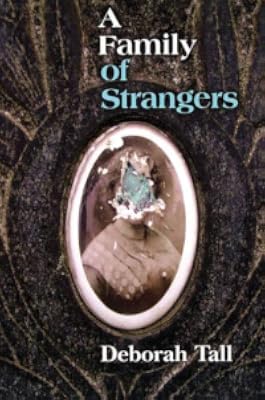
A Family of Strangers
by Deborah Tall
On This Page
Description
"Without self-absorption, Tall traces the self's emergence in a place which she recognized from the start as her testing place."--Seamus Heaney "In the literature of place, Deborah Tall's book stands out for its delicacy, range of learning, and refreshing frankness."--Phillip Lopate In her third book of nonfiction, Deborah Tall explores the genealogy of the missing. Haunted by her orphaned father's abandonment by his extended family, his secretive, walled-off trauma and absent history, show more she sets off in pursuit of the family he claims not to have. From the dutiful happiness of Levittown in the 1950s to a stricken formershtetl in Ukraine, we follow Tall's journey through evasions and lies. Reflecting on family secrecy, postwar American culture, and the urge for roots, Tall's search uncovers not just a missing family but an understanding of the part family and history play in identity.A Family of Strangers is Tall's life's work, told in such exacting, elegant language that the suppressed past vividly asserts its place in the present. Deborah Tall is the author of four books of poems, most recentlySummons, published by Sarabande Books after Charles Simic chose it for the Kathryn A. Morton Poetry Prize. She has also published two previous two books of nonfiction,The Island of the White Cow: Memories of an Irish Island andFrom Where We Stand: Recovering a Sense of Place, and co-edited the anthology The Poet's Notebook with Stephen Kuusisto and David Weiss. Tall has taught writing and literature at Hobart and William Smith Colleges and edited its literary journal, Seneca Review, since 1982. She lives in Ithaca, New York, with her husband David Weiss and their two daughters. show lessTags
Recommendations















Member Reviews
In this book, Tall, raised by parents who tell her very little about family history and who seem to have no living relatives, is driven to research her family and discover their origins. Her journey takes her to the Ukraine and what is left of her Jewish family in a very small village–so small it isn’t even a shtetl.
The writing style is that of a lyric essay–the text lives at the edge where poetry and prose meet. There is a lot of white space on the pages. It means that Tall didn’t have to add little physical details and actions to conversations. She summarizes sometimes instead of creating scenes. The book is full of non sequiturs. Instead of traditional transitions, she structures the book into tiny chapters. She re-uses show more chapter names to create connections across time and space. I’m fascinated by this style of writing and believe it forces the reader to be more assertive, to engage more with the text. The writer doesn't spoon food all the details to the reader.
A beautiful book. I think it would be most appreciated by family historians/genealogist, poets, and readers used to literary texts. show less
The writing style is that of a lyric essay–the text lives at the edge where poetry and prose meet. There is a lot of white space on the pages. It means that Tall didn’t have to add little physical details and actions to conversations. She summarizes sometimes instead of creating scenes. The book is full of non sequiturs. Instead of traditional transitions, she structures the book into tiny chapters. She re-uses show more chapter names to create connections across time and space. I’m fascinated by this style of writing and believe it forces the reader to be more assertive, to engage more with the text. The writer doesn't spoon food all the details to the reader.
A beautiful book. I think it would be most appreciated by family historians/genealogist, poets, and readers used to literary texts. show less
Ratings
Members
- Recently Added By
Author Information
9 Works 121 Members
Awards and Honors
Classifications
Statistics
- Members
- 21
- Popularity
- 1,229,977
- Reviews
- 1
- Rating
- (4.17)
- Languages
- English
- Media
- Paper
- ISBNs
- 2