The White City
by Roma Tearne
On This Page
Description
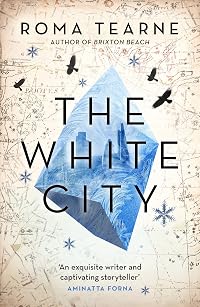
Hera has known great loss over decades of endless winter. The first snows coincided with the arrest of her brother on terrorism charges, and since then she has witnessed the total collapse of normal life in a devastated London. Her only source of comfort through it all has been her relationship with Raphael. Now, as the thaw begins, can she at last track down her elusive lover? Within this compelling vision of a dystopian near-future, Roma Tearne offers us a moving study of human endurance.Tags
Recommendations


















Member Reviews
‘The White City’ is an oddly structured novel and, in my opinion, alternately too literal and too allegorical to be considered truly dystopian. (For some arbitrary reason I require consistency in my dystopias.) It largely consists of two extended flashbacks, telling the stories of Hera and Raphael, a young Londoner and the man she loves. After the events of these flashbacks the narrative jumps forward 27 years, during which a long winter nearly depopulates London. I inferred that Hera’s survival was thanks to the winter being a blatant allegory for her emotional state. After expecting snowy London to dominate the narrative, I found it barely impinged.
Most characters in ‘The White City’ have names from ancient Greek mythology: show more Hera, Calypso, Hektor, Achilles, Helen, etc. Fittingly, Hera and Raphael’s lives are filled with Sophoclean tragedy. My favourite part of the novel was the beautifully observed and sharply moving family response to the arrest of Aslam, Hera’s brother. The sense of helpless unravelling was so well done. Subsequently, a hectic cascade of tragedy becomes more than the narrative could really deal with. The weakest element was Hera’s obsession with Raphael, which never quite convinced me. Tucked away in the flashbacks is some excellent, powerful writing on living with state terror, however I don’t think this meshes too well with the long winter framing mechanism. The titular concept felt strangely superfluous, although it was the whole reason I wanted to read the book in the first place. show less
Most characters in ‘The White City’ have names from ancient Greek mythology: show more Hera, Calypso, Hektor, Achilles, Helen, etc. Fittingly, Hera and Raphael’s lives are filled with Sophoclean tragedy. My favourite part of the novel was the beautifully observed and sharply moving family response to the arrest of Aslam, Hera’s brother. The sense of helpless unravelling was so well done. Subsequently, a hectic cascade of tragedy becomes more than the narrative could really deal with. The weakest element was Hera’s obsession with Raphael, which never quite convinced me. Tucked away in the flashbacks is some excellent, powerful writing on living with state terror, however I don’t think this meshes too well with the long winter framing mechanism. The titular concept felt strangely superfluous, although it was the whole reason I wanted to read the book in the first place. show less
In The White City, a dystopian fantasy that also at times comes across as social protest fiction and family tragedy, Roma Tearne imagines a time in the not so distant future when the world has endured a winter that has lasted for 27 years. The novel opens in London as the first thaw in decades has begun. As the longest blizzard in recorded history tapers off and the ice starts to recede, Tearne’s narrator, Hera, a Muslim, is drawn to recollections of her unhappy past. 27 years earlier, when the deep freeze was just beginning, Hera’s brother Aslam was arrested by British police and accused of terrorism, and, though not formally charged, was never seen again. Her emotionally fragile mother Calypso, devout father Hektor (the character show more names come from Greek mythology) and uncle Lyle, stymied in their inquiries by a monolithic and impenetrable British security agency, are never able to determine with certainty what Aslam did to raise suspicions, and never find out what became of him. And then, before the mystery can be solved, both of Hera’s parents are dead under tragic circumstances. To this point in the novel, Hera has been addressing her recollections to Raphael, a much older man with whom she has been conducting an affair, and who has his own tragic history: a native of Chile, Raphael fled to England to escape the brutalities of the Pinochet regime following the deaths of his wife and daughter. Gradually, the warming temperatures and melting ice expose the devastation caused by the decades-long winter. This is the most vividly drawn aspect of Tearne’s alarming vision: a broken city littered with rotting corpses in which the dazed survivors face imminent starvation. Hera’s story ends with her picking her way through the blasted remnants of human civilization, haunted by painful memories, searching for Raphael. The White City, powerfully dramatic, poetically intense, and written with a keen eye for evocative detail, is a novel dominated by grief and a profound sense of injustice. One cannot help but wonder though if it would have been more effective if Tearne had not felt compelled to enhance the disturbing and poignant story of Aslam’s disappearance with a speculative fantasy about the destruction of civilization. By incorporating both, Tearne’s novel seems divided against itself, with two themes or motifs that don’t necessarily complement one another vying for the reader’s attention show less
3.5 stars
Definitely a book that I wish I had a book group to discuss with!
Hera, the daughter of Muslim immigrants, lives in London. One day her brother is arrested and taken as a suspected terrorist. Her parents and "uncle" spend all of their time (and money) trying to get information on where he is and why they think he has done this.
Meanwhile, a 27 year winter settles over London. Hera, an art student, us regularly painting Raphael, a survivor of Pinochet's Chile. The only survivor of his family.
So many questions. How does anyone survive a 27-year winter? Where does the wood Hera uses for heating come from, and the bland tomatoes she eats? How are people not fighting as the city shuts down? Do most flee? So many questions. OR, does show more the 27-year winter simply represent the isolation and coldness faced by immigrants in modern-day London under the current government? show less
Definitely a book that I wish I had a book group to discuss with!
Hera, the daughter of Muslim immigrants, lives in London. One day her brother is arrested and taken as a suspected terrorist. Her parents and "uncle" spend all of their time (and money) trying to get information on where he is and why they think he has done this.
Meanwhile, a 27 year winter settles over London. Hera, an art student, us regularly painting Raphael, a survivor of Pinochet's Chile. The only survivor of his family.
So many questions. How does anyone survive a 27-year winter? Where does the wood Hera uses for heating come from, and the bland tomatoes she eats? How are people not fighting as the city shuts down? Do most flee? So many questions. OR, does show more the 27-year winter simply represent the isolation and coldness faced by immigrants in modern-day London under the current government? show less
Ratings
Members
- Recently Added By
Lists

Ninja book club
8 works; 1 member
Author Information

10+ Works 750 Members
Classifications
Statistics
- Members
- 28
- Popularity
- 981,926
- Reviews
- 4
- Rating
- (3.00)
- Languages
- English
- Media
- Paper, Ebook
- ISBNs
- 5
- ASINs
- 1