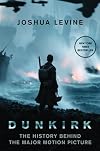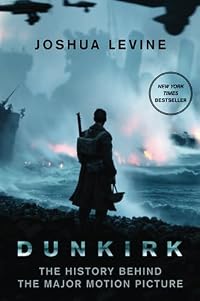
Dunkirk: The History Behind the Major Motion Picture
by Joshua Levine
On This Page
Description
The Battle of Dunkirk, in May/June 1940, is remembered as a stunning defeat, yet a major victory as well. The Nazis had beaten back the Allies and pushed them across France to the northern port of Dunkirk. In the ultimate race against time, more than 300,000 Allied soldiers were daringly evacuated across the Channel. This moment of German aggression was used by Winston Churchill as a call to Franklin Roosevelt to enter the war. Now, historian Joshua Levine explores the real lives of those show more soldiers, bombed and strafed on the beaches for days on end, without food or ammunition; the civilians whose boats were overloaded; the airmen who risked their lives to buy their companions on the ground precious time; and those who did not escape. show lessTags
Recommendations









Member Reviews
While at work I heard two people discussing the movie and ripping on it because of how historically inaccurate it was. They were talking about bad leaders and quick to surrender French and other typical armchair General stuff. If they had read this book, they probably would change their tune.
The entire situation was a giant clusterfck. Communications were sporadic if even available. Panic was at a high. The bravery of the BEF and French soldiers that held back the German advance can not be overlooked.
The book uses many first hand accounts of what was going on during the two weeks or so leading up to and during the evacuation which brings a nice personal touch instead of just listing large numbers. Also gives a sense of frustration that show more many of the soldiers must have felt when you read about someone who has lived through a week of pure hell only to have their ship bombed a mile off the coast.
I haven't seen the movie so I can't compare the two of them. show less
The entire situation was a giant clusterfck. Communications were sporadic if even available. Panic was at a high. The bravery of the BEF and French soldiers that held back the German advance can not be overlooked.
The book uses many first hand accounts of what was going on during the two weeks or so leading up to and during the evacuation which brings a nice personal touch instead of just listing large numbers. Also gives a sense of frustration that show more many of the soldiers must have felt when you read about someone who has lived through a week of pure hell only to have their ship bombed a mile off the coast.
I haven't seen the movie so I can't compare the two of them. show less
Christopher Nolan, the creative genius behind The Dark Knight (Batman), Inception and Memento turns his eye next to Dunkirk, which tells the true story of a major British military evacuation off the coast of Belgium during WWII.
Dunkirk is based on a book of the same name by historian Joshua Levine. Levine's 2011 book has been updated for the upcoming movie release, and it is bookended with an interview between Levine and Nolan at the beginning of the book about why Nolan chose this project, and a chapter at the end of the book discussing the process of making the movie, including comments from members of the production team. Movie buffs will love these extra chapters, giving them a fascinating insight into the process of show more moviemaking.
History buffs will love the actual story of Operation Dynamo itself. I confess to not being a big military history reader, so the sections of the book I found most intriguing had to do with the historical perspective of the events that led up to Britain's involvement in WWII.
Great Britain was still reeling from the effects of WWI, fought nearly twenty years prior. They lost an entire generation of men in WWI, and the thought of losing another generation to a war with Germany was not one that many people wanted to contemplate.
The worldwide depression severely impacted Great Britain, with unemployment high. With no system of welfare, there was tension between the classes, and extreme political parties were able to gain a foothold exploiting this. One can see echoes of this in today's world events as well.
Prime Minister Neville Chamberlain believed that he could work with Hitler's Nazi government to avoid war. He was accused of appeasement, and this led to the election of Winston Churchill as Prime Minister of Great Britain during the most trying time in history.
Churchill approved the plans for Operation Dynamo, which called for the evacuation of as many as 40,000 British troops from Dunkirk. The Germans were about to surround the British and French troops, and in order to save the troops from a certain slaughter or capture, they must arrange for an evacuation. Failure to save these troops would mean that the Allies would most likely lose the war, and the world today would be a much different place if that had happened.
The book goes into great detail about the actual logistics of the evacuation, a monumental task. Every available military and private ship and boat was recruited to make the trip to Dunkirk to ferry the soldiers back to England. There are many remembrances from people who make that voyage, and they are so interesting.
The troops were sent to the beach, and with tens of thousands of soldiers along the beach, some for many days, it became a little city of its own. Men played cards, built small shelters, and waited and waited until it was their turn to wade out in to the sea to be rescued, all while being attacked from the sky by German airplanes.
Levine compared this scene to the one of refugees from war and poverty who are taking any form of floating apparatus to get to the shores of Greece and Italy, an apt comparison.
Dunkirk is a fascinating look at a historical event that many people don't know about. While some people felt that this event was a story of a failed battle, Levine looks at it as an incredible story of survival. The goal was to save 40,000 troops, and the reality was that over 260,000 troops were rescued from the shores of Dunkirk, an astonishing number.
England used Dunkirk as a rallying cry and people in England today still speak of the "Dunkirk Spirit" when talking about bucking up and working together to achieve a goal that seems unattainable.
I highly recommend Dunkirk for movie fans, history and military history buffs. show less
Dunkirk is based on a book of the same name by historian Joshua Levine. Levine's 2011 book has been updated for the upcoming movie release, and it is bookended with an interview between Levine and Nolan at the beginning of the book about why Nolan chose this project, and a chapter at the end of the book discussing the process of making the movie, including comments from members of the production team. Movie buffs will love these extra chapters, giving them a fascinating insight into the process of show more moviemaking.
History buffs will love the actual story of Operation Dynamo itself. I confess to not being a big military history reader, so the sections of the book I found most intriguing had to do with the historical perspective of the events that led up to Britain's involvement in WWII.
Great Britain was still reeling from the effects of WWI, fought nearly twenty years prior. They lost an entire generation of men in WWI, and the thought of losing another generation to a war with Germany was not one that many people wanted to contemplate.
The worldwide depression severely impacted Great Britain, with unemployment high. With no system of welfare, there was tension between the classes, and extreme political parties were able to gain a foothold exploiting this. One can see echoes of this in today's world events as well.
Prime Minister Neville Chamberlain believed that he could work with Hitler's Nazi government to avoid war. He was accused of appeasement, and this led to the election of Winston Churchill as Prime Minister of Great Britain during the most trying time in history.
Churchill approved the plans for Operation Dynamo, which called for the evacuation of as many as 40,000 British troops from Dunkirk. The Germans were about to surround the British and French troops, and in order to save the troops from a certain slaughter or capture, they must arrange for an evacuation. Failure to save these troops would mean that the Allies would most likely lose the war, and the world today would be a much different place if that had happened.
The book goes into great detail about the actual logistics of the evacuation, a monumental task. Every available military and private ship and boat was recruited to make the trip to Dunkirk to ferry the soldiers back to England. There are many remembrances from people who make that voyage, and they are so interesting.
The troops were sent to the beach, and with tens of thousands of soldiers along the beach, some for many days, it became a little city of its own. Men played cards, built small shelters, and waited and waited until it was their turn to wade out in to the sea to be rescued, all while being attacked from the sky by German airplanes.
Levine compared this scene to the one of refugees from war and poverty who are taking any form of floating apparatus to get to the shores of Greece and Italy, an apt comparison.
Dunkirk is a fascinating look at a historical event that many people don't know about. While some people felt that this event was a story of a failed battle, Levine looks at it as an incredible story of survival. The goal was to save 40,000 troops, and the reality was that over 260,000 troops were rescued from the shores of Dunkirk, an astonishing number.
England used Dunkirk as a rallying cry and people in England today still speak of the "Dunkirk Spirit" when talking about bucking up and working together to achieve a goal that seems unattainable.
I highly recommend Dunkirk for movie fans, history and military history buffs. show less
We saw the movie, and as I've always carried a soft spot for this moment in history — it was a time that my grandfather spoke of as something quite special to him — I then felt like I needed even more information about this time. Certainly it came right on the heels of a series of disastrous defeats for the Allied forces (British, French, Belgians) in France, but when all was said and done, the British were most of the mindset that they had pulled together and created a huge success, an incredible evacuation of hundreds of thousands of troops trapped on a beach almost within sight of the British coast. Even the troops were surprised when the British population saw them as heroes, instead of failures. There was a hope that renewed show more the spirit of the nation.
The book supplied so much of the history and facts behind what I thought was an excellent example of film as a piece of art. This isn't to say that I won't be reading more on this time period. The power of hope in England at this time feels like something I would like to experience more of in my present orange-Cheetos-funk. show less
The book supplied so much of the history and facts behind what I thought was an excellent example of film as a piece of art. This isn't to say that I won't be reading more on this time period. The power of hope in England at this time feels like something I would like to experience more of in my present orange-Cheetos-funk. show less
I picked up this book in a charity shop drawn by the subject rather than its link to the recent film, which I haven't seen. As an insight into the experiences of some of the participants and some background to the general muddling through that, despite everything, succeeded in saving a large number of the soldiers and enabling the fight against Hitler's Germany to continue, it is interesting. However I did find the interview with the director at the start and the continual references to the film and director (the author was historical advisor on the film) rather distracting and unnecessary and seemed a bit of a 'puff' for the film.
There was also a chapter at the end about the film and I think all the film 'stuff' could have been show more relegated there so that it could be ignored if the reader wished. I didn't find it that interesting although I have in the past read 'Making of' books about various films and TV programmes. I also found it odd that the photograph section was continually switching between photos of the real events and colour pictures from the film. So with all that in mind I would rate this at 3 stars. show less
There was also a chapter at the end about the film and I think all the film 'stuff' could have been show more relegated there so that it could be ignored if the reader wished. I didn't find it that interesting although I have in the past read 'Making of' books about various films and TV programmes. I also found it odd that the photograph section was continually switching between photos of the real events and colour pictures from the film. So with all that in mind I would rate this at 3 stars. show less
Dunkirk: The History Behind the Major Motion Picture by Joshua Levine is a companion history book to the movie, Dunkirk, coming out. Mr. Levine’s 2001 book was the basis for the movie, this edition is an updated one.
I have to admit that I did not know much about Dunkirk until Christopher Nolan’s movie came out. The trailer looked great and a five minute single take tracking shot, all done as a single shot, floored me. As someone who takes an interest in the Second World War, I immediately jumped on the opportunity to read Dunkirk: The History Behind the Major Motion Picture by Joshua Levine.
Mr. Levine’s 2011 book was the basis for the motion picture, but this edition has interviews with Mr. Nolan at the beginning with much insight show more into the project, as well as a chapter at the end discussing the process of making the movie. Several people from the production team (which I can only guess would have been enormous), are also interviewed with gives the reader a fascinating look into the hard work and dedication it takes to re-create history.
The author takes a fascinating look about the logistics of the evacuation, which is no small feat. Every ship the English could get their hands on (fishing boats, pleasure boats, etc.) that could have possibly made the ride was recruited. The film even features a few or the original ships that were restored.
The scale and enormity of the operation is simply difficult to comprehend. There were tens of thousands of soldiers on the beach, evading German air attacks and waiting to be evacuated. The author also tells the stories of the soldier who were arranges in an ever shrinking circle around Dunkirk, protecting the shores and the men from constant attacks by the German army trying to break through.
This is a fascinating book on an amazing historical event which, if you are outside of England, rarely gets mentioned. While it may look like a huge loss, the “Dunkirk Spirit” was used as a rallying cry for the English, and still does from my understanding, to work hard as a team and achieve a hard earned goal.
For more reviews and bookish posts please visit: http://www.ManOfLaBook.com show less
I have to admit that I did not know much about Dunkirk until Christopher Nolan’s movie came out. The trailer looked great and a five minute single take tracking shot, all done as a single shot, floored me. As someone who takes an interest in the Second World War, I immediately jumped on the opportunity to read Dunkirk: The History Behind the Major Motion Picture by Joshua Levine.
Mr. Levine’s 2011 book was the basis for the motion picture, but this edition has interviews with Mr. Nolan at the beginning with much insight show more into the project, as well as a chapter at the end discussing the process of making the movie. Several people from the production team (which I can only guess would have been enormous), are also interviewed with gives the reader a fascinating look into the hard work and dedication it takes to re-create history.
The author takes a fascinating look about the logistics of the evacuation, which is no small feat. Every ship the English could get their hands on (fishing boats, pleasure boats, etc.) that could have possibly made the ride was recruited. The film even features a few or the original ships that were restored.
The scale and enormity of the operation is simply difficult to comprehend. There were tens of thousands of soldiers on the beach, evading German air attacks and waiting to be evacuated. The author also tells the stories of the soldier who were arranges in an ever shrinking circle around Dunkirk, protecting the shores and the men from constant attacks by the German army trying to break through.
This is a fascinating book on an amazing historical event which, if you are outside of England, rarely gets mentioned. While it may look like a huge loss, the “Dunkirk Spirit” was used as a rallying cry for the English, and still does from my understanding, to work hard as a team and achieve a hard earned goal.
For more reviews and bookish posts please visit: http://www.ManOfLaBook.com show less
I hadn't seen the movie ('heard it bombed) but I didn't at all mind the descriptions of the filming challenges. There are several important aspects to cover here, and as a result there's redundancy and a non-chronological flow to this book. The event is less that 10 days and the story (eg, the beach over the 10 days, the small boats over the 10 days, the RAF over the ten days, etc.) sometimes impedes the narrative story line. The story itself saves the day.
This book spends a lot of time talking about the movie and connecting the movie with the event. Ah, not my kind of book.
Members
- Recently Added By
Published Reviews
New York Times Bestseller
The epic true story of Dunkirk—now a major motion picture, written and directed by Christopher Nolan, and starring Kenneth Branagh, Tom Hardy, and Mark Rylance
In 1940, the Allies had been beaten back by the Nazis across France to the northern port of Dunkirk. In the ultimate race against time, more than 300,000 Allied soldiers were daringly evacuated across the show more Channel. This moment of German aggression was used by Winston Churchill as a call to Franklin Roosevelt to enter the war. Now, Joshua Levine, the film's official historian, explores the real lives of those soldiers, bombed and strafed on the beaches for days on end, without food or ammunition; the civilians whose boats were overloaded; the airmen who risked their lives to buy their companions on the ground precious time; and those who did not escape. show less
The epic true story of Dunkirk—now a major motion picture, written and directed by Christopher Nolan, and starring Kenneth Branagh, Tom Hardy, and Mark Rylance
In 1940, the Allies had been beaten back by the Nazis across France to the northern port of Dunkirk. In the ultimate race against time, more than 300,000 Allied soldiers were daringly evacuated across the show more Channel. This moment of German aggression was used by Winston Churchill as a call to Franklin Roosevelt to enter the war. Now, Joshua Levine, the film's official historian, explores the real lives of those soldiers, bombed and strafed on the beaches for days on end, without food or ammunition; the civilians whose boats were overloaded; the airmen who risked their lives to buy their companions on the ground precious time; and those who did not escape. show less
added by rothwell
Lists

THE WAR ROOM
813 works; 24 members
Author Information
16 Works 1,036 Members
Joshua Levine was born in the Bahamas. He has a law degree and practiced as a criminal barrister for several years in London. He gave up law and became an actor, appearing in amateur theatre productions. He also worked as an assistant producer, working on a documentary about Handel's Water Music. He wrote a stage play entitled, Crash, and went on show more to write programs for BBC Radio 4. He is the author of Forgotten Voices, Beauty and Atricity, On a Wing and a Prayer, Operation Fortitude, The Secret History of the Blitz, and Dunkirk. (Bowker Author Biography) show less
Common Knowledge
- Original publication date
- 2017
- Important places
- Dunkirk, Hauts-de-France, France
- Important events
- World War II (1939 | 1945); Fall of France (1940-05-10 | 1940-06-22); Battle of Dunkirk (1940-05-26 | 1940-06-04)
- Dedication
- To Lionel who inspired me.
To Peggy whom I hope to inspire.
To Philip Brown, Eric Roderick, Harold "Vic" Viner and Charlie Searle with thanks - First words
- Preface: One afternoon, sitting in the National Archives in Kew, I opened a file containing a report by Commander Michael Ellwood.
In the early summer of 1940, Anthony Irwin was a young officer in the Essex Regiment. - Last words
- (Click to show. Warning: May contain spoilers.)"That way," he says, "people will find the Dunkirk that they want to find."
Classifications
Statistics
- Members
- 455
- Popularity
- 66,753
- Reviews
- 7
- Rating
- (3.64)
- Languages
- 6 — Dutch, English, French, Italian, Portuguese (Portugal), Spanish
- Media
- Paper, Audiobook, Ebook
- ISBNs
- 30
- ASINs
- 6