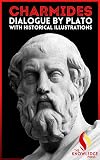
Charmides
by Plato
On This Page
Description
The Charmides is a dialogue of Plato, in which Socrates engages a handsome and popular boy in a conversation about the meaning of sophrosyne, a Greek word usually translated into English as ""temperance"", ""self-control"", or ""restraint"". As is typical with Platonic early dialogues, the two never arrive at a completely satisfactory definition, but the discussion nevertheless raises many important points.Tags
Recommendations













Member Reviews
I just seriously struggle with Plato. This dialogue in particular was awful. The amount of nonsense he puts in Socrates' mouth is something else. A particular choice example is when he tries to convince Charmides that doing things "quickly" is always better than doing things "slowly and quietly," complete with ridiculously cherry picked examples like athletics. And like basically all Plato's dialogues, every other character just accepts this faulty logic. Somehow none of them thought to bring up the many cases where taking your time and/or being quiet is superior to doing things quickly? Apparently not, since they're all just props to let Socrates-Plato make obviously faulty leaps in logic.
Sócrates é manipulado a inventar uma lorota afim de conversar com o charmoso mancebo Charmides, e então avança a ideia de que a temperança é o catalisador de uma erva tipo aspirina. Ao ser perguntado o que a virtude é, na boa conduta a resposta do jovem quanto a quietude é rejeitada, pois nem sempre boa, assim como a reserva. Será fazer o que é de cada um? Mas o que isso significa? o que conduz a uma discussão sobre o conhecimento e se a sabedoria é a ciência de conhecer o conhecer. Ela seria impossível, porque sem conteúdo próprio, e inútil, por adicionar algo vazio aos conteúdos específicos que estes sim, pertencem a cada arte que tem conteúdo. Talvez devessemos tentar então pensar na sabedoria quanto ao que é show more bom e o que não, mas certamente isso nos desviaria da temperança, terminando assim o diálogo sem conclusão alguma. show less
A simple and basic dialogue that gets to the point integrally and logically.
Overall, a good and quick read.
Overall, a good and quick read.
Ratings
Members
- Recently Added By
Author Information

2,722+ Works 100,544 Members
Plato was born c. 427 B.C. in Athens, Greece, to an aristocratic family very much involved in political government. Pericles, famous ruler of Athens during its golden age, was Plato's stepfather. Plato was well educated and studied under Socrates, with whom he developed a close friendship. When Socrates was publically executed in 399 B.C., Plato show more finally distanced himself from a career in Athenian politics, instead becoming one of the greatest philosophers of Western civilization. Plato extended Socrates's inquiries to his students, one of the most famous being Aristotle. Plato's The Republic is an enduring work, discussing justice, the importance of education, and the qualities needed for rulers to succeed. Plato felt governors must be philosophers so they may govern wisely and effectively. Plato founded the Academy, an educational institution dedicated to pursuing philosophic truth. The Academy lasted well into the 6th century A.D., and is the model for all western universities. Its formation is along the lines Plato laid out in The Republic. Many of Plato's essays and writings survive to this day. Plato died in 347 B.C. at the age of 80. (Bowker Author Biography) show less
Some Editions
Work Relationships
Common Knowledge
- Canonical title
- Charmides
- Original title
- Πλάτων : Χαρμίδης
Classifications
Statistics
- Members
- 122
- Popularity
- 266,446
- Reviews
- 3
- Rating
- (3.54)
- Languages
- 5 — English, Finnish, French, German, Greek (Ancient)
- Media
- Paper, Ebook
- ISBNs
- 23
- ASINs
- 4