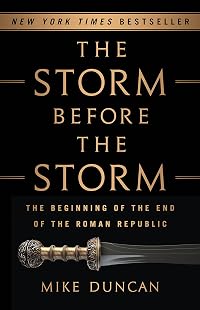
The Storm Before the Storm: The Beginning of the End of the Roman Republic
by Mike Duncan
On This Page
Description
The creator of the podcast series The History of Rome and Revolutions brings to life the bloody battles, political machinations, and human drama that set the stage for the fall of the Roman Republic. The Roman Republic was one of the most remarkable achievements in the history of civilization. Beginning as a small city-state in central Italy, Rome gradually expanded into a wider world filled with petty tyrants, barbarian chieftains, and despotic kings. Through the centuries, Rome's model of show more cooperative and participatory government remained remarkably durable and unmatched in the history of the ancient world. In 146 BC, Rome finally emerged as the strongest power in the Mediterranean. But the very success of the Republic proved to be its undoing. The republican system was unable to cope with the vast empire Rome now ruled: rising economic inequality disrupted traditional ways of life, endemic social and ethnic prejudice led to clashes over citizenship and voting rights, and rampant corruption and ruthless ambition sparked violent political clashes that cracked the once indestructible foundations of the Republic. Chronicling the years 146-78 BC, Michael Duncan dives headlong into the first generation to face this treacherous new political environment. Abandoning the ancient principles of their forbearers, men like Marius, Sulla, and the Gracchi brothers set dangerous new precedents that would start the Republic on the road to destruction and provide a stark warning about what can happen to a civilization that has lost its way. show lessTags
Recommendations






Member Reviews
This was a fast paced and well written account of the crucial decades leading up to the end of the Roman Republic. To someone who both had studied and has a particular interest in this area of history, most of the content was already quite familiar, but Duncan does a very good job at taking the complex political, social and economic issues from the period and tying them together into a cohesive ‘storyline’. I felt that the underpinning of the entire narrative with the collapse of the mos maiorum and the interweaving of relevant references to digestible excerpts of ancient sources was especially well done. There was unavoidably some simplification of certain events and relationships, and I did feel the treatment of certain elements show more was a little bit dated, such as the ‘optimates’ and ‘populares’ division. Overall though, a solid telling of some of the most underrated years of Roman Republican history, and an enjoyable read. show less
Back in its prime, I probably enjoyed Mike Duncan's blogging and pod-casting about the sweep of Roman history as much as anyone, so it was just a matter of time before I got to this book.
Having looked at other reviews on this work, yes, it is a little too jocular at times (a tone that probably goes better with a podcast). It's also probably inevitable that contemporary American political troubles are going to be invoked when speaking of Roman political conflict, whether justified or not. However, Duncan has really managed to fill a gap in popular discourse with his history of the conflict between the populist and the aristocratic political factions of Roman politics, and why they turned so destructive. You could do worse in terms of an show more introduction to the state of play before the terminal phase of the Roman Republic.
Also, PublicAffairs, or its printer, really needs to get better editing software. show less
Having looked at other reviews on this work, yes, it is a little too jocular at times (a tone that probably goes better with a podcast). It's also probably inevitable that contemporary American political troubles are going to be invoked when speaking of Roman political conflict, whether justified or not. However, Duncan has really managed to fill a gap in popular discourse with his history of the conflict between the populist and the aristocratic political factions of Roman politics, and why they turned so destructive. You could do worse in terms of an show more introduction to the state of play before the terminal phase of the Roman Republic.
Also, PublicAffairs, or its printer, really needs to get better editing software. show less
There are basically three things that I think about when reading history: is it accurate, how does the author interpret what was going on, and how good is the author at telling the story? And I admit that I rarely know a period of history well enough to judge the first two well. Still, from what I do know of this era, Duncan is getting the facts right—I'm always amazed at how much we know about a period over 2,000 years ago. And he's fairly restrained on offering interpretations, being the most direct in the author's note. That leaves the storytelling aspect, and Duncan is excellent at this. I knew perfectly well what was going to happen to the Gracchi brothers and how Marius and Sulla came to clash, and yet I was still eagerly show more turning pages to read more. The timeline at the beginning is quite helpful, although towards the end, I wished I also had a "cast of characters" to refer to (Roman names sound a lot alike after a while, especially when you're talking about a lot of Romans. Although footnotes like "Uncle of THE Julius Caesar" and "The father of THE Marcus Crassus" helped.) If you're interested in reading some Roman history that isn't about Caesar, Augustus, Mark Antony, etc., this would be a fine choice. show less
James McHenry famously wrote that when asked what sort of government the Constitutional Convention had birthed, Benjamin Franklin answered, “A republic, if you can keep it.” This story captures well the central anxiety of a democracy: that sooner or later, our vigilance will weaken just enough for liberty to slip into the hands of the tyrant.
I imagine that’s why we’re fascinated by the collapse of the senatorial Roman Republic into the autocratic Roman Empire. Even the most history-challenged probably has a vague grasp of the key event of that collapse: Julius Caesar setting himself up as dictator, senators stabbing him to death, “Et tu, Brute?” What we might not know is how Rome went from abolishing monarchy to the Divine show more Caesar.
Mike Duncan, the talented writer behind the History of Rome podcast, fills this gap. He picks up the story in 146 BC with the final desolation of Carthage and the destruction of Corinth. From here, Duncan narrates a highly readable tale of the last century of the Roman Republic, and of the ambitious characters who chipped away at the foundations of state until it fell into the hands of an emperor.
One of the themes Duncan returns to repeatedly is that each step toward empire was marked by incremental transgressions of the “mos maiorum,” the unwritten norms which governed respectable society — until someone decided that this or that particular tradition didn’t apply to him.
From this angle, the Roman Republic looks to me like an overgrown town council: part legal code, part gentlemen’s agreement, and part “the way we’ve always done it.” This might work for a municipality with local concerns, but it has none of the guardrails you might put up if you knew all the wealth and power in the Mediterranean was going to land in your minutes.
As an American, I take some comfort from this. I understand that any government can fall, but I also know that those who wrote our Constitution designed it with a strong sense of history, including that of the Roman Republic. With this history in mind, the Founders built the guardrails Rome lacked, as witnessed by the stability of the United States relative to the many democracies which have sprung up in its lifetime only to succumb to generals, demagogues, and autocrats.
If anything, reading this book has reaffirmed my confidence that my republic might not be as bad off as the television and Internet would have me believe. Maybe that’s childishly naive and I’ll eat my words in due course, but I think we’ve got some aces up our sleeve that the Roman Republic never had. I guess when it comes down to it, I’m still in Johnny Cash’s corner: that ragged old flag is in good shape for the shape she’s in. show less
I imagine that’s why we’re fascinated by the collapse of the senatorial Roman Republic into the autocratic Roman Empire. Even the most history-challenged probably has a vague grasp of the key event of that collapse: Julius Caesar setting himself up as dictator, senators stabbing him to death, “Et tu, Brute?” What we might not know is how Rome went from abolishing monarchy to the Divine show more Caesar.
Mike Duncan, the talented writer behind the History of Rome podcast, fills this gap. He picks up the story in 146 BC with the final desolation of Carthage and the destruction of Corinth. From here, Duncan narrates a highly readable tale of the last century of the Roman Republic, and of the ambitious characters who chipped away at the foundations of state until it fell into the hands of an emperor.
One of the themes Duncan returns to repeatedly is that each step toward empire was marked by incremental transgressions of the “mos maiorum,” the unwritten norms which governed respectable society — until someone decided that this or that particular tradition didn’t apply to him.
From this angle, the Roman Republic looks to me like an overgrown town council: part legal code, part gentlemen’s agreement, and part “the way we’ve always done it.” This might work for a municipality with local concerns, but it has none of the guardrails you might put up if you knew all the wealth and power in the Mediterranean was going to land in your minutes.
As an American, I take some comfort from this. I understand that any government can fall, but I also know that those who wrote our Constitution designed it with a strong sense of history, including that of the Roman Republic. With this history in mind, the Founders built the guardrails Rome lacked, as witnessed by the stability of the United States relative to the many democracies which have sprung up in its lifetime only to succumb to generals, demagogues, and autocrats.
If anything, reading this book has reaffirmed my confidence that my republic might not be as bad off as the television and Internet would have me believe. Maybe that’s childishly naive and I’ll eat my words in due course, but I think we’ve got some aces up our sleeve that the Roman Republic never had. I guess when it comes down to it, I’m still in Johnny Cash’s corner: that ragged old flag is in good shape for the shape she’s in. show less
I am endlessly amazed at the amount of detail uncovered from events that took place more than 2,000 years ago. Mike Duncan managed to piece together an entire narrative, introducing us to the main players in a society whose climb to greatness seemed to be its undoing.
I've read a lot about this period of history, but Duncan's unique approach gave me a different perspective on the unraveling of the empire. While academic, in the sense that this is not light reading, Duncan's writing style is enjoyable and engaging. This is absolutely not a dry, textbook kind of read.
We here in the U.S. often draw parallels between our nation and the Roman Empire. Those parallels are certainly here in this story. Duncan does not point them out to us, but show more you don't have to look hard to find them.
The most disheartening and disturbing aspect, to me, is how little politics - and people - have changed. We like to think we've evolved, grown, become more enlightened in our thoughts. To some degree, yes, we have. But, in reading this, it's all too easy to see that the more things change, the more they stay the same.
*I received an ebook copy from the publisher, via NetGalley, in exchange for my honest review.* show less
I've read a lot about this period of history, but Duncan's unique approach gave me a different perspective on the unraveling of the empire. While academic, in the sense that this is not light reading, Duncan's writing style is enjoyable and engaging. This is absolutely not a dry, textbook kind of read.
We here in the U.S. often draw parallels between our nation and the Roman Empire. Those parallels are certainly here in this story. Duncan does not point them out to us, but show more you don't have to look hard to find them.
The most disheartening and disturbing aspect, to me, is how little politics - and people - have changed. We like to think we've evolved, grown, become more enlightened in our thoughts. To some degree, yes, we have. But, in reading this, it's all too easy to see that the more things change, the more they stay the same.
*I received an ebook copy from the publisher, via NetGalley, in exchange for my honest review.* show less
Everybody know the story of the Fall of the Roman Republic. Julius Caesar, Mark Antony, Cicero, Cato, Octavian, Brutus, civil war, assassination, the last grasp of liberty, and the foundation of both tyranny and centuries of peace and prosperity. Roman politics are a common metaphor for our own times. In The Storm Before the Storm, veteran history podcaster Mike Duncan (Revolutions, The History of Rome), writes about one of his favorite periods, the Roman Republic between the Second Punic War and Caesar's Civil War.
As expected, Duncan ably brings weaves together the lives of his protagonists and their events, to describe a gradual degradation of Roman political norms to mob violence and military force, as the sclerotic Senate proved show more unable to decisively deal with concerns like corruption in the provinces, the lack of civil rights for Italian allies, transformation of the countryside from yeoman farmers to slave estates, and the ambitions of 'new men' without noble pedigrees. The abortive Gracchian agricultural reforms, Gauis Marius's remaking of the army, and Sulla's dictatorship are the centerpieces of this book.
Duncan ably uses primary sources (the Romans wrote a lot of history) to provide detail and spice to his world. He'll admit he's biased in favor of the Populares and against the Optimates. This is a well-sourced popular history, which is both its strength and weakness. Duncan doesn't have much theory about the collapse of political norms, and the lives of the figures eclipses some questions I had about how Roman politics normally operated, and the balance between formal bureaucracy, networks of patronage, and the ability of oratory to shift the mob at the right moment. show less
As expected, Duncan ably brings weaves together the lives of his protagonists and their events, to describe a gradual degradation of Roman political norms to mob violence and military force, as the sclerotic Senate proved show more unable to decisively deal with concerns like corruption in the provinces, the lack of civil rights for Italian allies, transformation of the countryside from yeoman farmers to slave estates, and the ambitions of 'new men' without noble pedigrees. The abortive Gracchian agricultural reforms, Gauis Marius's remaking of the army, and Sulla's dictatorship are the centerpieces of this book.
Duncan ably uses primary sources (the Romans wrote a lot of history) to provide detail and spice to his world. He'll admit he's biased in favor of the Populares and against the Optimates. This is a well-sourced popular history, which is both its strength and weakness. Duncan doesn't have much theory about the collapse of political norms, and the lives of the figures eclipses some questions I had about how Roman politics normally operated, and the balance between formal bureaucracy, networks of patronage, and the ability of oratory to shift the mob at the right moment. show less
Excellently written, Mike Duncan does a thorough job at communicating the years and decades of Roman history prior to the rise of figures like Crassus, Pompey, and Caesar. Besides covering major events, wars, and social tensions, this book highlights how these events frequently led to constitutional crises, and how these crises frequently resulted in violations of established laws and precedents, Additionally, Duncan frequently mentions and highlights how these events influenced later events and built upon each other. Highly recommend the book.
Members
- Recently Added By
Published Reviews
ThingScore 75
"Crucial decades in the history of the ancient world vividly rendered."
added by bookfitz
Lists

Recommend the 20 best books you've read in the last five years
2,168 works; 606 members

Top Five Books of 2024
795 works; 264 members

Books We Want To Read Again For The First Time
384 works; 160 members
Author Information

15+ Works 1,818 Members
Some Editions
Awards and Honors
Distinctions
Common Knowledge
- Canonical title
- The Storm Before the Storm: The Beginning of the End of the Roman Republic
- Original title
- The Storm Before the Storm: The Beginning of the End of the Roman Republic
- Original publication date
- 2017-10-24
- People/Characters
- Gaius Marius; Jugurtha; Cinna; Lucius Cornelius Sulla; Tiberius Sempronius Gracchus; Gaius Sempronius Gracchus (show all 7); Publius Cornelius Scipio Aemilianus
- Important places
- Rome, Roman Empire; Numidia
- Important events
- Assassination of Tiberius Gracchus; Servile War; Social War 91–88 BCE; Dictatorship of Sulla
- Dedication
- For Brandi, for everything
- First words
- Proconsul Publius Scipio Aemilianus stood before the walls of Carthage watching the city burn.
- Last words
- (Click to show. Warning: May contain spoilers.)But what looked like the dawning of a new age was really the last moments of light before the Roman Republic disappeared over the horizon.
- Blurbers
- Carlin, Dan; Brownworth, Lars; Wittes, Benjamin; Adamson, Peter
- Original language
- English
- Canonical DDC/MDS
- 937.05
- Canonical LCC
- DG254.D86
Classifications
- Genres
- History, General Nonfiction, Nonfiction
- DDC/MDS
- 937.05 — History & geography History of ancient world (to ca. 499) Italian Peninsula to 476 and adjacent territories to 476 Period of civil strife, 146-31 B.C.
- LCC
- DG254 .D86 — History of Europe, Asia, Africa and Oceania City History of Italy Ancient Italy. Rome to 476 History By period Kings and Republic, 753-27 B.C. Republic, 509-27 Fall of the Republic and establishment
- BISAC
Statistics
- Members
- 1,230
- Popularity
- 20,069
- Reviews
- 31
- Rating
- (4.12)
- Languages
- English, Spanish, Chinese, traditional
- Media
- Paper, Audiobook, Ebook
- ISBNs
- 13
- ASINs
- 6