On This Page
Description
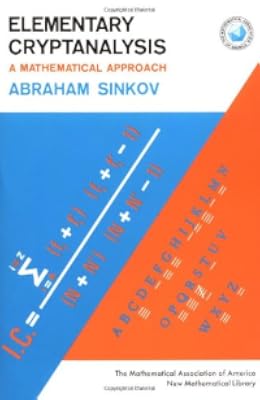
Originally published in the New Mathematical Library almost half a century ago, this charming book explains how to solve cryptograms based on elementary mathematical principles, starting with the Caesar cipher and building up to progressively more sophisticated substitution methods. Todd Feil has updated the book for the technological age by adding two new chapters covering RSA public-key cryptography, one-time pads, and pseudo-random-number generators. Exercises are given throughout the show more text that will help the reader understand the concepts and practice the techniques presented. Software to ease the drudgery of making the necessary calculations is made available. The book assumes minimal mathematical prerequisites and therefore explains from scratch such concepts as summation notation, matrix multiplication, and modular arithmetic. Even the mathematically sophisticated reader, however, will find some of the exercises challenging. (Answers to the exercises appear in an appendix.) show lessTags
Recommendations




















Member Reviews
Indeholder "Introduction".
"Chapter 1: Monoalphabetic Ciphers Using Direct Standard Alphabets", "1.1. The Caesar Cipher", "1.2. Modular arithmetic", "1.3. Direct standard alphabets", "1.4. Solution of direct standard alphabets by completing the plain component", "1.5. Solving direct standard alphabets by frequency considerations", "1.6. Alphabets based on decimations of the normal sequence", "1.7. Solution of decimated standard alphabets", "1.8. Monoalphabets based on linear transformations",
"Chapter 2: General Monoalphabetic Substitution". "2.1. Mixed alphabets", "2.2. Solution of mixed alphabet ciphers", "2.3. Solution of monoalphabets in five letter groupings", "2.4. Monoalphabets with symbols as cipher equivalents",
"Chapter 3: show more Polyalphabetic Substitution", "3.1 Polyalphabetic ciphers", "3.2. Recognition of polyalphabetic ciphers", "3.3. Determination of number of alphabets", "3.4. Solutions of individual alphabets, if standard", "3.5. Polyalphabetic ciphers with a mixed plain sequence", "3.6. Matching alphabets", "3.7. Reduction of a polyalphabetic cipher to a monoalphabet", "3.8. Polyalphabetic ciphers with mixed cipher sequences", "3.9. General Comments about polyalphabetic ciphers",
"Chapter 4: Polygraphic Systems", "4.1. Digraphic ciphers based on linear transformations - matrices", "4.2. Multiplication of matrices—Inverses", "4.3. Involutory transformations", "4.4. Recognition of digraphic ciphers", "4.5. Solution of a linear transformation", "4.6. How to make the Hill System more secure",
"Chapter 5: Transposition", "5.1. Columnar transposition", "5. Solution of transpositions with completely filled rectangles", "5.3. Incompletely filled rectangles", "5.4. Solution of incompletely filled rectangles - probable word method", "5.5. Incompletely filled rectangles - general case", "5.6. Repetitions between messages; Identical length messages".
"Appendix A. Table of Digraphic Frequencies", "Appendix B. Log Weights", "Appendix C. Frequencies of Letters of the Alphabet", "Appendix D: Frequencies of Initial Letters of Words", "Appendix E: Frequencies of Final Letters of Words",
"Solutions to Exercises",
"Suggestions for Further Reading", "Index",
"Supplement - Computer Programs by P. L. Irwin", "I. Trigraphic Frequency Distributions", "II. Index to Coincidence", "III. Matching Alphabets", "IV. Trigraphic Frequency Distribution for Individual Alphabets of a Periodic Polyalphabetic Cipher", "V. Digraphic Frequency Distributions".
Meget elementær og grundig indføring i mono- og polyalfabetiske koder og hvordan man kan bryde dem med statistiske metoder. Bogen indeholder BASIC programmer, så det giver en ide om hvor forældet den er. Der er mindst en nyere udgave af bogen, hvor RSA og one-time pads bliver behandlet. show less
"Chapter 1: Monoalphabetic Ciphers Using Direct Standard Alphabets", "1.1. The Caesar Cipher", "1.2. Modular arithmetic", "1.3. Direct standard alphabets", "1.4. Solution of direct standard alphabets by completing the plain component", "1.5. Solving direct standard alphabets by frequency considerations", "1.6. Alphabets based on decimations of the normal sequence", "1.7. Solution of decimated standard alphabets", "1.8. Monoalphabets based on linear transformations",
"Chapter 2: General Monoalphabetic Substitution". "2.1. Mixed alphabets", "2.2. Solution of mixed alphabet ciphers", "2.3. Solution of monoalphabets in five letter groupings", "2.4. Monoalphabets with symbols as cipher equivalents",
"Chapter 3: show more Polyalphabetic Substitution", "3.1 Polyalphabetic ciphers", "3.2. Recognition of polyalphabetic ciphers", "3.3. Determination of number of alphabets", "3.4. Solutions of individual alphabets, if standard", "3.5. Polyalphabetic ciphers with a mixed plain sequence", "3.6. Matching alphabets", "3.7. Reduction of a polyalphabetic cipher to a monoalphabet", "3.8. Polyalphabetic ciphers with mixed cipher sequences", "3.9. General Comments about polyalphabetic ciphers",
"Chapter 4: Polygraphic Systems", "4.1. Digraphic ciphers based on linear transformations - matrices", "4.2. Multiplication of matrices—Inverses", "4.3. Involutory transformations", "4.4. Recognition of digraphic ciphers", "4.5. Solution of a linear transformation", "4.6. How to make the Hill System more secure",
"Chapter 5: Transposition", "5.1. Columnar transposition", "5. Solution of transpositions with completely filled rectangles", "5.3. Incompletely filled rectangles", "5.4. Solution of incompletely filled rectangles - probable word method", "5.5. Incompletely filled rectangles - general case", "5.6. Repetitions between messages; Identical length messages".
"Appendix A. Table of Digraphic Frequencies", "Appendix B. Log Weights", "Appendix C. Frequencies of Letters of the Alphabet", "Appendix D: Frequencies of Initial Letters of Words", "Appendix E: Frequencies of Final Letters of Words",
"Solutions to Exercises",
"Suggestions for Further Reading", "Index",
"Supplement - Computer Programs by P. L. Irwin", "I. Trigraphic Frequency Distributions", "II. Index to Coincidence", "III. Matching Alphabets", "IV. Trigraphic Frequency Distribution for Individual Alphabets of a Periodic Polyalphabetic Cipher", "V. Digraphic Frequency Distributions".
Meget elementær og grundig indføring i mono- og polyalfabetiske koder og hvordan man kan bryde dem med statistiske metoder. Bogen indeholder BASIC programmer, så det giver en ide om hvor forældet den er. Der er mindst en nyere udgave af bogen, hvor RSA og one-time pads bliver behandlet. show less
Jul 21, 2011 (Edited)Danish
Ratings
Members
- Recently Added By
Author Information
3 Works 89 Members
Series

Common Knowledge
- Canonical title
- Elementary Cryptanalysis: A Mathematical Approach
Classifications
- Genres
- Nonfiction, Technology, General Nonfiction
- DDC/MDS
- 652.80151 — Applied science & technology Management & public relations Processes of written communication Cryptography
- LCC
- Z104 .S47 — Bibliography, Library Science and Information Resources Books (General). Writing. Paleography Writing Cryptography. Ciphers. Invisible writing
- BISAC
Statistics
- Members
- 79
- Popularity
- 402,972
- Reviews
- 1
- Rating
- (3.88)
- Languages
- English
- Media
- Paper, Ebook
- ISBNs
- 2
- ASINs
- 2