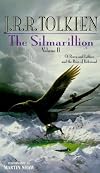
The Silmarillion, Vol. 2 {audiobook}
by J. R. R. Tolkien
On This Page
Description
These tales tell of the rebellion of Feanor and his kindred against the gods, and of the war, hopeless, despite great heroism, against the great enemy.Tags
Member Reviews
It is great to have excellent narrator Martin Shaw do the reading for me and let him worry about the pronunciations here. Subtitled, "Of Beren and Lúthien and the Ruin of Beleriand", this middle volume of this abridged audiobook there is a story in the classic mold of a knight in quest for love. Since Thingol refused to give Lúthien's hand in marriage to Beren, a mere mortal, he had to bring back a Silmaril from the Iron Crown of Morgoth in order to win her hand.
Using Lúthien's powers to place Morgoth's court into a deep sleep (kinda like the light of Eärendil for Frodo), they were able to enter Angband where Beren was able to cut a Silmaril from Morgoth's iron crown. However, as they escaped from Angband, the great wolf show more Carcharoth, whom Morgoth had personally bred, awoke. Beren held out the Silmaril, hoping that its radiance would avert the beast, but he was mistaken ((kinda like The Phial of Galadriel did not completely trounce Shelob for Frodo). Carcharoth bit off his hand, swallowing it along with the Silmaril, and proceeded to run rampant through Doriath. Lúthien and the unconscious Beren were rescued by the Eagles of Manwë. Beren participated in the hunting of Carcharoth, where the beast was slain and the Silmaril recovered; the quest was accomplished, but in the process Beren was mortally wounded.
With this tragedy, there are some intriguing asides about werewolves and vampires. Partly I was disappointed that Tolkien would incorporate such timeworn legends, but intrigued on what he would have done with them, had he given us more details and them a greater role. show less
Using Lúthien's powers to place Morgoth's court into a deep sleep (kinda like the light of Eärendil for Frodo), they were able to enter Angband where Beren was able to cut a Silmaril from Morgoth's iron crown. However, as they escaped from Angband, the great wolf show more Carcharoth, whom Morgoth had personally bred, awoke. Beren held out the Silmaril, hoping that its radiance would avert the beast, but he was mistaken ((kinda like The Phial of Galadriel did not completely trounce Shelob for Frodo). Carcharoth bit off his hand, swallowing it along with the Silmaril, and proceeded to run rampant through Doriath. Lúthien and the unconscious Beren were rescued by the Eagles of Manwë. Beren participated in the hunting of Carcharoth, where the beast was slain and the Silmaril recovered; the quest was accomplished, but in the process Beren was mortally wounded.
With this tragedy, there are some intriguing asides about werewolves and vampires. Partly I was disappointed that Tolkien would incorporate such timeworn legends, but intrigued on what he would have done with them, had he given us more details and them a greater role. show less
Ratings
Members
- Recently Added By
Author Information

600+ Works 516,544 Members
A writer of fantasies, Tolkien, a professor of language and literature at Oxford University, was always intrigued by early English and the imaginative use of language. In his greatest story, the trilogy The Lord of the Rings (1954--56), Tolkien invented a language with vocabulary, grammar, syntax, even poetry of its own. Though readers have show more created various possible allegorical interpretations, Tolkien has said: "It is not about anything but itself. (Certainly it has no allegorical intentions, general, particular or topical, moral, religious or political.)" In The Adventures of Tom Bombadil (1962), Tolkien tells the story of the "master of wood, water, and hill," a jolly teller of tales and singer of songs, one of the multitude of characters in his romance, saga, epic, or fairy tales about his country of the Hobbits. Tolkien was also a formidable medieval scholar, as evidenced by his work, Beowulf: The Monster and the Critics (1936) and his edition of Anciene Wisse: English Text of the Anciene Riwle. Among his works published posthumously, are The Legend of Sigurd and Gudrún and The Fall of Arthur, which was edited by his son, Christopher. In 2013, his title, TheHobbit (Movie Tie-In) made The New York Times Best Seller List. (Bowker Author Biography) show less
Work Relationships
Is contained in
Tolkien Fantasy Tales Box Set (The Tolkien Reader/The Silmarillion/Unfinished Tales/Sir Gawain and the Green Knight) by J. R. R. Tolkien (indirect)
Lord of the Rings Collection:The Hobbit-The Fellowship of the Ring-The Two Towers-Return of the King-The Silmarillion-Unfinished Tales (Lord of the Rings) by J. R. R. Tolkien (indirect)
The Children of Húrin Paperback Box Set: The Children of Hurin / The Silmarillion / Unfinished Tales by J. R. R. Tolkien (indirect)
Common Knowledge
- Canonical title
- The Silmarillion, Vol. 2 {audiobook}
- Disambiguation notice
- This LT Work is for part 2 only of a 3-volume audio edition of J.R.R. Tolkien's The Silmarillion. Please distinguish among the complete Work and any separate parts of a multi-volume edition such as this one. Thank you... (show all).
Classifications
Statistics
- Members
- 16
- Popularity
- 1,517,411
- Reviews
- 1
- Rating
- (3.67)
- Languages
- English
- Media
- Audiobook
- ISBNs
- 3