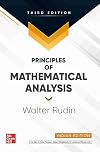
Principles of Mathematical Analysis
by Walter Rudin
On This Page
Description
The third edition of this well known text continues to provide a solid foundation in mathematical analysis for undergraduate and first-year graduate students. The text begins with a discussion of the real number system as a complete ordered field. (Dedekind's construction is now treated in an appendix to Chapter I.) The topological background needed for the development of convergence, continuity, differentiation and integration is provided in Chapter 2. There is a new section on the gamma show more function, and many new and interesting exercises are included. This text is part of the Walter Rudin Student Series in Advanced Mathematics. show lessTags
Recommendations










Member Reviews
Truly excellent book, 338 pages of mathematical TNT.
If I could only keep one of my maths library, this would be it.
That's not to say I'm not going to have a go at rewriting some of his proofs as I think they could be a bit clearer (in particular 5.15 Taylor's Theorem, which also needs correct attribution to James Gregory).
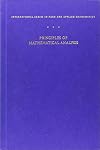
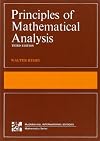
For the benefit of @Floyd3345 below, mine is the International 3rd edition (1976) as per the cover photo at left, if you want to check any text in particular
If I could only keep one of my maths library, this would be it.
That's not to say I'm not going to have a go at rewriting some of his proofs as I think they could be a bit clearer (in particular 5.15 Taylor's Theorem, which also needs correct attribution to James Gregory).
For the benefit of @Floyd3345 below, mine is the International 3rd edition (1976) as per the cover photo at left, if you want to check any text in particular
Rudin is exact, specific, and direct. This is a harsh and austere text, but allows for very meditative readings.
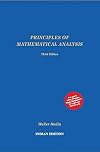
The copy of Principles of Mathematical Analysis by Walter Rudin that I own is interesting in one way; it states that it is the Indian Edition. Now I don’t know much about publishing, but the biggest issue for me was whether or not the book was in English since I don’t know any Indian languages. I mean, I suppose the paper making up the book is slightly thinner, and perhaps it uses a different measure of size, but other than that, it didn’t need to say that on the cover.
This mathematical book is much like any other mathematical textbook that I own and have read; it starts with the basics and builds upon those basics in a systematic manner. The book contains proofs of theorems and practice problems, making it a very good resource.
I show more have heard that this book is used as a textbook in classes, but I never had to take a class in Analysis. As I might have mentioned long ago, all of the books that I read are only for my own amusement. However, it would be neat if I also learned something along the way.
The book delivers in being amusing and informative. I suppose it might be less amusing if this were a book I was assigned, but that is beside the point. In being informative, the book contains eleven chapters and covers subjects from the Real and Complex Number Systems to Lebesgue Theory. Finally, the book has a bibliography, an index, and a list of the special symbols used in the book. show less
This mathematical book is much like any other mathematical textbook that I own and have read; it starts with the basics and builds upon those basics in a systematic manner. The book contains proofs of theorems and practice problems, making it a very good resource.
I show more have heard that this book is used as a textbook in classes, but I never had to take a class in Analysis. As I might have mentioned long ago, all of the books that I read are only for my own amusement. However, it would be neat if I also learned something along the way.
The book delivers in being amusing and informative. I suppose it might be less amusing if this were a book I was assigned, but that is beside the point. In being informative, the book contains eleven chapters and covers subjects from the Real and Complex Number Systems to Lebesgue Theory. Finally, the book has a bibliography, an index, and a list of the special symbols used in the book. show less
The copy of Principles of Mathematical Analysis by Walter Rudin that I own is interesting in one way; it states that it is the Indian Edition. Now I don’t know much about publishing, but the biggest issue for me was whether or not the book was in English since I don’t know any Indian languages. I mean, I suppose the paper making up the book is slightly thinner and perhaps it uses a different measure of size, but other than that it didn’t need to say that on the cover.
This mathematical book is much like any other mathematical textbook that I own and have read, it starts with the basics and builds upon those basics in a systematic manner. The book contains proofs of theorems and practice problems, making it a very good resource.
I show more have heard that this book is used as a textbook in classes, but I never had to take a class in Analysis. As I might have mentioned long ago, all of the books that I read are only for my own amusement. However, it would be neat if I also learned something along the way.
The book delivers in being amusing and informative. I suppose it might be less amusing if this was a book I was assigned, but that is beside the point. In being informative, the book contains eleven chapters and covers subjects from The Real and Complex Number Systems to Lebesgue Theory. Finally, the book has a bibliography, an index, and a list of the special symbols used in the book. show less
This mathematical book is much like any other mathematical textbook that I own and have read, it starts with the basics and builds upon those basics in a systematic manner. The book contains proofs of theorems and practice problems, making it a very good resource.
I show more have heard that this book is used as a textbook in classes, but I never had to take a class in Analysis. As I might have mentioned long ago, all of the books that I read are only for my own amusement. However, it would be neat if I also learned something along the way.
The book delivers in being amusing and informative. I suppose it might be less amusing if this was a book I was assigned, but that is beside the point. In being informative, the book contains eleven chapters and covers subjects from The Real and Complex Number Systems to Lebesgue Theory. Finally, the book has a bibliography, an index, and a list of the special symbols used in the book. show less
Made me hate myself but I came out stronger in the end.
great summary of classical analysis... not so wonderful to learn from.
The longest sustained rigorous thinking I've ever done on a subject. Analysis is beautiful.
Members
- Recently Added By
Lists

Most Popular Books Targeted at Mathematicians
26 works; 1 member

Mathematics and Physics
29 works; 1 member
Author Information

17 Works 1,530 Members
Walter Rudin is Emeritus Professor of Mathematics at the University of Wisconsin in Madison, Wisconsin, where he has taught since 1959.
Awards and Honors
Awards
Series
Belongs to Publisher Series
Common Knowledge
- Canonical title
- Principles of Mathematical Analysis
Classifications
Statistics
- Members
- 837
- Popularity
- 32,595
- Reviews
- 11
- Rating
- (4.12)
- Languages
- 5 — Chinese, English, French, Polish, Spanish
- Media
- Paper, Ebook
- ISBNs
- 14
- ASINs
- 14