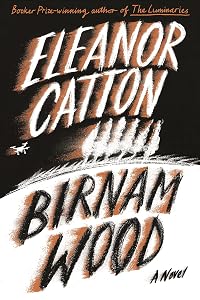
Birnam Wood
by Eleanor Catton
On This Page
Description
Five years ago, Mira Bunting founded a guerrilla gardening group: Birnam Wood. An undeclared, unregulated, sometimes criminal, sometimes philanthropic gathering of friends, this activist collective plants crops wherever no one will notice, on the sides of roads, in forgotten parks and neglected backyards. For years, the group has struggled to break even. Then Mira stumbles on an answer, a way to finally set the group up for the long term: a landslide has closed the Korowai Pass, cutting off show more the town of Thorndike. Natural disaster has created an opportunity, a sizable farm seemingly abandoned. But Mira is not the only one interested in Thorndike. Robert Lemoine, the enigmatic American billionaire, has snatched it up to build his end-times bunker, or so he tells Mira when he catches her on the property. Intrigued by Mira, Birnam Wood, and their entrepreneurial spirit, he suggests they work this land. But can they trust him? And, as their ideals and ideologies are tested, can they trust each other? show lessTags
Recommendations











Member Reviews
I didn't manage to finish reading Catton's last book The Luminaries but this book is sold as a thriller and I love thrillers and I like eco-lit, which this is, and so thought it might be more readable/accessible. It was.
I can't quite make up my mind if Catton was parodying thrillers or eco-lit because we have all the characters here that you might expect. A billionaire that is a baddie right from the start, an older man who has just been awarded a Knighthood for services to conservation when he owns a pest control company (she is having a laugh here), a wanna-be journalist who has a rant at the last meeting and leaves the group, and Shelley who is always second, does all the work and gets none of the praise for it.
Birnam Wood is an eco show more group that grows fruit and vegetables on parcels of land they do not own - guerilla gardening on a slightly larger scale, in New Zealand. Mira, the leader of the group, spots a plot of land that seems to be abandonned, private and ripe for developing only when she gets there she meets the billionaire Lemoine. He has mining works going on that are illegal and needs to protect his investments at all costs.
I have tried to work out why Catton chose the name Birnam Wood and this article is helpful. If everyone can be a villain, then everyone can be a Macbeth with ambitions or be tempted and in this book they are. The journalist is tempted by the thought of getting an expose based on the mining that Lemoine's company is undertaking, Owen Darvish the owner of the land is tempted by the Knighthood, Shelley by being the leader of the group and so on. In fact just like in Macbeth, Birnam Wood does move because it is the name of the group and they move about a five hour drive from Christchurch to get to the tract of land they will grow on as trespassers.
The thriller part really gets going about two thirds of the way into the book. I found myself reading faster and faster to find out how things ended and it is pretty explosive.
The whole book reads as if it is a last gasp at trying to get people to take notice of what is happening around us and tries to explain why it feels like nothing is changing or being done about it. No one comes out of this well. We have landslides, fires and floods and yet people sit around arguing about whether 'intersectionality is bullshit'. (I don't even know what that really means!) The book is fun way of letting us know that we are marching towards the end, wondering if anyone will move against the 'Kings' of today or whether extinction is the next step.
Catton's writing is very good, particularly her sentences. I always marvel at those who can control long sentences and there are many in this book.
This business about the radiometric survey, for instance: Sir Owen should have been relieved to learn that this so-called journalist - a blogger and a nobody, for goodness' sake - had plainly begun his investigations well before they'd hosted the Mulloys, which meant that they couldn't possibly bear any responsibility for whatever it was that he might or might not have found out about their agreement with Lemoine.
p215
One of the big themes in Macbeth is betrayal, alongside loyalty, and there is a fair amount of it in show less
I can't quite make up my mind if Catton was parodying thrillers or eco-lit because we have all the characters here that you might expect. A billionaire that is a baddie right from the start, an older man who has just been awarded a Knighthood for services to conservation when he owns a pest control company (she is having a laugh here), a wanna-be journalist who has a rant at the last meeting and leaves the group, and Shelley who is always second, does all the work and gets none of the praise for it.
Birnam Wood is an eco show more group that grows fruit and vegetables on parcels of land they do not own - guerilla gardening on a slightly larger scale, in New Zealand. Mira, the leader of the group, spots a plot of land that seems to be abandonned, private and ripe for developing only when she gets there she meets the billionaire Lemoine. He has mining works going on that are illegal and needs to protect his investments at all costs.
I have tried to work out why Catton chose the name Birnam Wood and this article is helpful. If everyone can be a villain, then everyone can be a Macbeth with ambitions or be tempted and in this book they are. The journalist is tempted by the thought of getting an expose based on the mining that Lemoine's company is undertaking, Owen Darvish the owner of the land is tempted by the Knighthood, Shelley by being the leader of the group and so on. In fact just like in Macbeth, Birnam Wood does move because it is the name of the group and they move about a five hour drive from Christchurch to get to the tract of land they will grow on as trespassers.
The thriller part really gets going about two thirds of the way into the book. I found myself reading faster and faster to find out how things ended and it is pretty explosive.
The whole book reads as if it is a last gasp at trying to get people to take notice of what is happening around us and tries to explain why it feels like nothing is changing or being done about it. No one comes out of this well. We have landslides, fires and floods and yet people sit around arguing about whether 'intersectionality is bullshit'. (I don't even know what that really means!) The book is fun way of letting us know that we are marching towards the end, wondering if anyone will move against the 'Kings' of today or whether extinction is the next step.
Catton's writing is very good, particularly her sentences. I always marvel at those who can control long sentences and there are many in this book.
This business about the radiometric survey, for instance: Sir Owen should have been relieved to learn that this so-called journalist - a blogger and a nobody, for goodness' sake - had plainly begun his investigations well before they'd hosted the Mulloys, which meant that they couldn't possibly bear any responsibility for whatever it was that he might or might not have found out about their agreement with Lemoine.
p215
One of the big themes in Macbeth is betrayal, alongside loyalty, and there is a fair amount of it in show less
I liked this book and unlike many of the reviewers below, did not have a problem with the pacing at the beginning. I was drawn into the inner thoughts and motivations of the characters. I think that's why I didn't like the ending. It seemed out of place in a book which, up until then, had been exploring relationships and motivations. Then bang! We've gone from a character-driven drama to an action thriller in no time flat.
I loved the writing. It is perhaps the best illustration of stream of thought writing I've seen. It flows well despite very, very long sentences and sentence fragments. There are so many thoughtful insights, including "the real choices you make in your life, the really difficult, defining choices, are never between show more what's right and what's easy. They're between what's wrong and what's hard." And "while people were quick to form opinions, they were just as show to change them, and -- to rephrase the aphorism slightly -- there are none so blind as those who had already decided what it was they saw."
I liked the way the author poked at young liberals who, in the midst of climate disasters, spend time arguing whether "intersectionality is bullshit". And at billionaires who have no social conscience at all. And at boomers who sell out by being knighted for conservation while running a pest control company. show less
I loved the writing. It is perhaps the best illustration of stream of thought writing I've seen. It flows well despite very, very long sentences and sentence fragments. There are so many thoughtful insights, including "the real choices you make in your life, the really difficult, defining choices, are never between show more what's right and what's easy. They're between what's wrong and what's hard." And "while people were quick to form opinions, they were just as show to change them, and -- to rephrase the aphorism slightly -- there are none so blind as those who had already decided what it was they saw."
I liked the way the author poked at young liberals who, in the midst of climate disasters, spend time arguing whether "intersectionality is bullshit". And at billionaires who have no social conscience at all. And at boomers who sell out by being knighted for conservation while running a pest control company. show less
Birnam Wood is Catton's (winner of the 2013 Booker Prize for her The Luminaries) third novel, and is a very different work to her earlier novels.
I did not 'get' her 800+ page prize winner which I regarded as very much a 'shaggy dog story', where the story was ok but not superlative, and the structure of the book (with the chapter lengths mimicking the passage of the phases of the moon) and the references to zodiac and other runes, doing little for me.
Birnam Wood adopts a much more traditional structure and no particular 'tricks' . The story itself combines contemporary themes:
- ecological action
- the internet and its merits and perils
- the electronic tracking of people by the private sector and government
- left vs right politics (and show more whether traditional manifestations or each are themselves outmoded)
- billionaires, and whether they 'live' outside the 'real' world
- trust in government
- doomsday preparations (including the purchase of 'safe spaces' in New Zealand (where the book is set)
All of that may seem a little heavy but the plot moves along at a good pace, a Jason Bourne like pace (though there are no JB super heroes), with readers left guessing until the very end "what is going to happen next?". One technique adopted by Catton to give this effect is to end one episode (being told from the perspective of one character) only for the next episode (being told from the perspective of another character) commencing at a time either before or after the end of the previous episode, leaving readers to speculate how to bring the 2 episodes together, and with Catton bringing of the various episodes together.
There are some bad people (not surprisingly, the billionaire included), but indeed virtually all if not all of the characters have flaws (eg Tony, a freelance journalist, who sensing something is wrong, stealthily investigates and discovers the dark secrets at the heart of the book, at one stage wallows in the thought that his disclosure of the truth will make his career and indeed may bring him glory and awards.
Said by some to be a 'literary thriller', I agree it is a (decent) thriller and 'literary' in the sense that PD James' crime novels are thought of as 'a literary crime/mystery.
The fact that I am encouraged to go back and read Catton's first novel (The Rehearsal) is the best indication that I am intrigued by Catton's work, and that perhaps you should be also.
Big Ship
23 May 2023 show less
I did not 'get' her 800+ page prize winner which I regarded as very much a 'shaggy dog story', where the story was ok but not superlative, and the structure of the book (with the chapter lengths mimicking the passage of the phases of the moon) and the references to zodiac and other runes, doing little for me.
Birnam Wood adopts a much more traditional structure and no particular 'tricks' . The story itself combines contemporary themes:
- ecological action
- the internet and its merits and perils
- the electronic tracking of people by the private sector and government
- left vs right politics (and show more whether traditional manifestations or each are themselves outmoded)
- billionaires, and whether they 'live' outside the 'real' world
- trust in government
- doomsday preparations (including the purchase of 'safe spaces' in New Zealand (where the book is set)
All of that may seem a little heavy but the plot moves along at a good pace, a Jason Bourne like pace (though there are no JB super heroes), with readers left guessing until the very end "what is going to happen next?". One technique adopted by Catton to give this effect is to end one episode (being told from the perspective of one character) only for the next episode (being told from the perspective of another character) commencing at a time either before or after the end of the previous episode, leaving readers to speculate how to bring the 2 episodes together, and with Catton bringing of the various episodes together.
There are some bad people (not surprisingly, the billionaire included), but indeed virtually all if not all of the characters have flaws (eg Tony, a freelance journalist, who sensing something is wrong, stealthily investigates and discovers the dark secrets at the heart of the book, at one stage wallows in the thought that his disclosure of the truth will make his career and indeed may bring him glory and awards.
Said by some to be a 'literary thriller', I agree it is a (decent) thriller and 'literary' in the sense that PD James' crime novels are thought of as 'a literary crime/mystery.
The fact that I am encouraged to go back and read Catton's first novel (The Rehearsal) is the best indication that I am intrigued by Catton's work, and that perhaps you should be also.
Big Ship
23 May 2023 show less
Surprisingly, a thriller. Deception, self-deception, psychopathy, timidity, cupidity, mistakes, fakes, and guerrilla gardening. Pacy, a twisty plot, and more character development and complex motivation than you usually get in a thriller. Its setting is that pivotal post-Trump, pre-Jacinda moment when we naively imagined all was lost. Catton's science is a little shaky; rare-earth element mining apparently involves digging up a lot of…earth. And trucking it away, and riches follow. A major plot event is murder by poisoning with 1080 rabbit bait. 1080 rabbit bait is brightly-coloured pellets rather than a subtle paste or powder, the human lethal dose is a LOT of pellets, and it takes hours for a mammal to die once poisoned—all bad show more news for Catton's denouement. show less
I read this book too recently and I've not really recovered yet. With clear inspiration from Macbeth, it's full of characters with strong personal goals and ambitions, and with obvious blind spots where their morality collides with their self-interest. I loved Mira and Shelley in particular, and getting to know them from inside their own heads. The shifting of perspective was really effective; even point-of-view characters I didn't much like, I felt like I recognized. With the shifting points of view including a detailed exploration of each character's willful self-deceit, the book was also often softly amusing, in a quiet, Kiwi way—until it was decidedly, brutally, not. I didn't need this novel to tell me billionaires are unethical show more in their very existence and thus have an extremely distant personal relationship with ethics, I have all of reality to tell me that—but I have the impression that other people, who have gotten very different messages from reality, might get something very different out of this book. show less
Some things in Eleanor Catton’s novel are clever and well observed, but I found that these broke down in the last third of the book, where it becomes an action-driven suspense story.
I felt that the first parts of the novel were like a contemporary Middlemarch (a literary allusion that makes more sense to me than Macbeth). In the first third of the book, we are introduced to a range of contemporary characters and their relations to each other and to their small society. Catton takes readers into their heads as they try to work out what they want from themselves and from each other. Shelley’s conflicted feelings toward Mira, Mira’s charismatic leadership undermined by self-doubt, Tony’s idealistic quest for ideological purity as show more well as personal recognition make an interesting setting for an examination of radical personal politics.
I especially liked the comic earnestness with which the characters in the Birnam Wood collective try to work together to create the social relationships that they want to see in an ideal society. Naturally, these conflict with their material conditions under capitalism, with their emotional lives and with their differing interpretations of their ideals. These scenes play with such authenticity that I imagine that Catton has lived through similar experiences herself (as I have, and recognize clearly). Catton’s wit in describing the scenes and the interactions brings a humour similar to that in Eliot’s asides in Middlemarch.
Catton goes into a few other characters, but with much less depth that suggest she is filling out a few stereotypes rather than creating living characters. Owen and Jill are plausible as good-hearted New Zealanders who have build up a small fortune in business, but we don’t know anything about their business practices, and that’s relevant here. Robert Lemoine as the socially charming, sociopathic billionaire is provided with childhood trauma to twist his psyche, but it doesn’t get him beyond stereotypes. Mira shares some of Robert’s manipulative traits, but not his skill or self-confidence. And the humorous insight that Catton brings to the Birnam Wood group is absent here.
So the suspense builds in the second third of the novel when ambitious, idealistic Tony works out Lemoine’s world-dominating plot. It goes full paranoid in the last third, and over the top in the last dozen pages. The suspense-movie plot takes over the psychosocial drama, although Catton makes a valiant effort to pull the characters’ psyches to the front. Mira is relieved when she realizes that if the Birnam Wood ideal blows up, it absolves her of responsibility. Jill goes back to her New Zealand self-reliance to protect her home from the evil (American) intruder. Does Catton intend it to be meaningful when the nouveau bourgeois has to defeat the superrich billionaire to save her world? Does Tony survive through his determination, idealism and backwoods skills? It’s all a bit confused by the end.
Catton gives realism and texture to the story in the details of everyday life, as she did with the details of frontier life in her historical novel, The Luminaries. She highlights the communications technology that has become both a tool and a trap in contemporary life. The useful, but slightly creepy, location tracking that Shelley uses to keep touch with Mira becomes a life-threatening danger in the hands of a malevolent techie. Yet it is central to plans of both the idealist and the sociopath. This, I would say, is a more likely threat to society than the private ambitions of one billionaire, although Catton doesn’t take the story in this direction.
I had a similar response to reading this novel as I did to The Luminaries – it started out interesting and intriguing, but become rushed and less interesting by the end. show less
I felt that the first parts of the novel were like a contemporary Middlemarch (a literary allusion that makes more sense to me than Macbeth). In the first third of the book, we are introduced to a range of contemporary characters and their relations to each other and to their small society. Catton takes readers into their heads as they try to work out what they want from themselves and from each other. Shelley’s conflicted feelings toward Mira, Mira’s charismatic leadership undermined by self-doubt, Tony’s idealistic quest for ideological purity as show more well as personal recognition make an interesting setting for an examination of radical personal politics.
I especially liked the comic earnestness with which the characters in the Birnam Wood collective try to work together to create the social relationships that they want to see in an ideal society. Naturally, these conflict with their material conditions under capitalism, with their emotional lives and with their differing interpretations of their ideals. These scenes play with such authenticity that I imagine that Catton has lived through similar experiences herself (as I have, and recognize clearly). Catton’s wit in describing the scenes and the interactions brings a humour similar to that in Eliot’s asides in Middlemarch.
Catton goes into a few other characters, but with much less depth that suggest she is filling out a few stereotypes rather than creating living characters. Owen and Jill are plausible as good-hearted New Zealanders who have build up a small fortune in business, but we don’t know anything about their business practices, and that’s relevant here. Robert Lemoine as the socially charming, sociopathic billionaire is provided with childhood trauma to twist his psyche, but it doesn’t get him beyond stereotypes. Mira shares some of Robert’s manipulative traits, but not his skill or self-confidence. And the humorous insight that Catton brings to the Birnam Wood group is absent here.
So the suspense builds in the second third of the novel when ambitious, idealistic Tony works out Lemoine’s world-dominating plot. It goes full paranoid in the last third, and over the top in the last dozen pages. The suspense-movie plot takes over the psychosocial drama, although Catton makes a valiant effort to pull the characters’ psyches to the front. Mira is relieved when she realizes that if the Birnam Wood ideal blows up, it absolves her of responsibility. Jill goes back to her New Zealand self-reliance to protect her home from the evil (American) intruder. Does Catton intend it to be meaningful when the nouveau bourgeois has to defeat the superrich billionaire to save her world? Does Tony survive through his determination, idealism and backwoods skills? It’s all a bit confused by the end.
Catton gives realism and texture to the story in the details of everyday life, as she did with the details of frontier life in her historical novel, The Luminaries. She highlights the communications technology that has become both a tool and a trap in contemporary life. The useful, but slightly creepy, location tracking that Shelley uses to keep touch with Mira becomes a life-threatening danger in the hands of a malevolent techie. Yet it is central to plans of both the idealist and the sociopath. This, I would say, is a more likely threat to society than the private ambitions of one billionaire, although Catton doesn’t take the story in this direction.
I had a similar response to reading this novel as I did to The Luminaries – it started out interesting and intriguing, but become rushed and less interesting by the end. show less
Birnam Wood is a collective, one of those groups where all decisions are voted on and the chair of meetings rotates around the membership, at least half of whom are vegan. But really Mira is the driving force. This guerrilla gardening collective is her idea and it's her energy that drives in on. Shelley is the one who does all the administrative tasks and makes Mira's ideas work. But it's never been self-sustaining and now Shelley wants to leave. She hasn't told Mira yet, but Mira can see the cracks as well as anyone. And then Mira finds a perfect place to do some larger scale gardening and there's even a billionaire there who is talking about funding them in a way that could really get the project from a volunteer project to a viable show more concern. Of course, this means trusting the kind of person Mira had always considered the enemy and hiding a few details from the rest of [Birnam Wood], but this is far too good an opportunity to turn down, isn't it?
Eleanor Catton's book is one that begins as a character study of a diverse array of stock characters, to a sort of eco-thriller in its final third. Does it work as a novel? Yes and also I expected more from Catton, a superlatively gifted writer who gave us both the unsettling The Rehersal and the expansive and intricate The Luminaries. I do like what Catton attempted here, with all the many characters going in their many directions and the way she is poking gentle fun at the dynamics of groups and left-leaning individuals, and less gentle fun at the wealthy. Her plot was improbable, but she wrote it so well that I was able to go with it. It was ham-fisted at times, but within acceptable limits. Which is to say, had the author been anyone else, I would have had a more favorable opinion of it, but is it fair to hold Catton to a higher standard when even a great author is going to have less-than-great books? After all, I honestly enjoyed this novel. show less
Eleanor Catton's book is one that begins as a character study of a diverse array of stock characters, to a sort of eco-thriller in its final third. Does it work as a novel? Yes and also I expected more from Catton, a superlatively gifted writer who gave us both the unsettling The Rehersal and the expansive and intricate The Luminaries. I do like what Catton attempted here, with all the many characters going in their many directions and the way she is poking gentle fun at the dynamics of groups and left-leaning individuals, and less gentle fun at the wealthy. Her plot was improbable, but she wrote it so well that I was able to go with it. It was ham-fisted at times, but within acceptable limits. Which is to say, had the author been anyone else, I would have had a more favorable opinion of it, but is it fair to hold Catton to a higher standard when even a great author is going to have less-than-great books? After all, I honestly enjoyed this novel. show less
Members
- Recently Added By
Lists

Books recommended by Barack Obama
295 works; 28 members

Female Author
1,234 works; 67 members

Books Read in 2023
5,638 works; 147 members

Anticipated 2022 & Early 2023 Releases
209 works; 4 members

Maybe This Year? Books to Look Forward To
412 works; 9 members

Netgalley Reads
468 works; 3 members

Globe and Mail | Canadian Fiction: April 8, 2023
10 works; 1 member
Globe and Mail | Canadian Fiction: April 15, 2023
10 works; 1 member
Globe and Mail | Canadian Fiction: April 1, 2023
10 works; 1 member
Globe and Mail | Canadian Fiction: March 25, 2023
10 works; 1 member

Dublin Literary Award 2024 Longlist
66 works; 4 members

Barack Obama's Summer Reading List 2023
9 works; 1 member

Top Five Books of 2024
795 works; 264 members

Fiction: Thriller
78 works; 1 member

Books Read in 2025
4,128 works; 98 members

Globe and Mail | Canadian Fiction: March 18, 2023
10 works; 1 member

Books Read in 2024
4,727 works; 128 members
Author Information

9+ Works 8,602 Members
Eleanor Catton was born in Canada on September 24, 1985. She moved to New Zealand with her family when she was six years old. She studied English at the University of Canterbury and received a master's in creative writing at The Institute of Modern Letters, Victoria University of Wellington. Her debut novel, The Rehearsal, was published in 2008. show more Her second novel, The Luminaries, won the 2013 Man Booker Prize. In 2015 she ws made an Honorary Literary Fellows in the New Zealand Society of Authors' annual Waitangi Day Honours. In 2016, she was named as one of six, Arts New Zealand's Laureate Award winners. (Bowker Author Biography) show less
Some Editions
Awards and Honors
Common Knowledge
- Canonical title
- Birnam Wood
- Original title
- Birnam Wood
- Original publication date
- 2023-02-09
- People/Characters
- Mira Bunting; Robert Lemoine; Shelley Noakes; Tony Gallo
- Important places
- New Zealand
- Epigraph
- Third Apparition: Be lion-mettled, proud; and take no care
Who chafes, who frets, or where conspirers are:
Macbeth shall never vanquish'd be until
Great Birnam Wood to high Dunsinane hill
Shall come against him.
Macbeth: That will never be.
Who can impress the forest, bid the tree
Unfix his earth-bound root? - Dedication
- for Steven Toussaint
- First words
- The Korowai Pass had been closed since the end of the summer, when a spate of shallow earthquakes triggered a landslide that buried a stretch of the highway in rubble, killing five, and sending a long-haul transport truck ove... (show all)r a precipice where it skimmed a power line, ploughed a channel down the mountainside, and then exploded on a viaduct below.
- Quotations
- Chivalric titles had been abolished in New Zealand in the year 2000, only to be reinstated nine years later by a moneyed politician desirous of a knighthood of his own. It was embarrassing whichever way one felt about it: the... (show all) monarchists could not celebrate, as the resurrection only proved the Crown could be politically compelled, and the republicans could not protest, because to do so would be to suggest that there was something sacred about a monarchic code of chivalry in the first place, that ought to be beyond a common politician's reach. Both parties felt disgruntled, and both received the twice-yearly Honours Lists with the same peevish cynicism, concluding, jointly, that all the knighted intellectuals were sell-outs, and all the knighted businessmen were bribes.
Like all self-mythologising rebels, Mira preferred enemies to rivals, and often turned her rivals into enemies, the better to disdain them as secret agents of the status quo.
On a dark and shameful level of her consciousness Shelley knew that the drastic course corrections in her life – her phases, to use the word that Mira so deplored – did not owe to any sudden clarities of vision or vocatio... (show all)n, but to this smothered and ever-present sense of dread. She had tried to escape it by joining Birnam Wood, and she was trying to escape it now, but she would never escape it, because she could not feel the difference, could not understand the difference, between running towards something, and running away.
She felt that it exposed a defect in her character – disloyalty to her own sex, first of all, but deeper than that, a vanity, an appetite, a capacity for manipulation that she would rather other people did not see; she knew... (show all), and was ashamed to know, that one of the reasons she had never taken Shelley's friendship all that seriously was that it lacked any sense of sexual possibility or contest. There was no danger between them, nothing fearsome or uncertain, no provocation, no romance; with Shelley, she always knew that she was safe.
She wished that she could tell her friend the honest truth, which was not that she loved her because she needed her, but that she needed her because she loved her, and in her monumental stupidity and self-absorption, she had ... (show all)only just figured that out.
...simply a far-sighted, short-selling, risk- embracing kleptocrat, an incarnation of unapologetic zero-sum self-interest, a radical misfit, a ‘builder' in the Randian sense, a genius, a tyrant, an obsessive, a prophet, a s... (show all)tatus-symbol survivalist hedging his bets against any number of potential global catastrophes that he himself was doing absolutely nothing to prevent, and might even be taking active measures to encourage if there was a profit to be made, or an advantage to be gained, in the pursuit.
...while people were quick to form opinions, they were just as slow to change them, and – to rephrase the aphorism slightly – there were none so blind as those who had already decided what it was they saw.
She would be the final piece of camouflage. Not these dime-a-dozen, grasping, self-important outrage-mongers, these obsequious nonentities, these small-time pseudo-pundits who traded in stupidity and called themselves subvers... (show all)ive for shitting where they ate.
‘There's something so joyless about the left these days,' Tony continued, ‘so forbidding and self-denying. And policing. No one's having any fun, we're all just sitting around scolding each other for doing too much or not... (show all) enough – and it's like, what kind of vision for the future is that? Where's the hope? Where's the humanity? We're all aspiring to be monks when we could be aspiring to be lovers.'
...the whole project of a genuine left-wing politics is fucked. How can we even get started on the project of creating and protecting public goods when within every interest group there's always a subgroup, and each one has t... (show all)heir own particular agenda, and they're all in competition with each other for airtime and market share—'
‘I'm not telling you to shut up, I'm telling you to listen. There's a difference.'
Democracy isn't about everyone voting the exact same way, it's about whether you agree to go along with the outcome of the vote even if it turns out you're in the minority. That's consensus.'
the crypto-fascist dirty tricksters who pretended to be populists while defrauding and despising the people, who lied with impunity, who stole with impunity, who murdered with impunity, who invented scapegoats, who incited su... (show all)icides, who encouraged violence and provoked unrest, and who then retreated into a private sphere of luxury so well insulated from the lives of ordinary people, and so well defended against them, that it basically amounted to a form of secession.
anyway, between the two of them, wasn't he the one who was more guilty of propping up the status quo by shooting her ideas down and dropping names of dead philosophers as if that was in any way a legitimate response to anythi... (show all)ng any more – and why was it that people on the left were always talking about who was actually on the left – wasn't that kind of out of date? And if it wasn't, then maybe it should be, because it was pretty bloody off-putting to be treated like a double-dealer all the time.
the last thing that crossed his mind before he drifted off to sleep was a quotation that he'd heard someplace, whose attribution he'd forgotten – that only something that a person didn't want to see in print was news, and e... (show all)verything else was advertising.
You want the apocalypse to happen, because that will prove that you were right never to have trusted anybody. Whereas if things actually get better, not worse, if people actually start working together, and putting aside thei... (show all)r differences for the sake of the common good and so on, if that happens, then you're just going to look like a stupid paranoid dick. Right?'
You want me to kneel down before you, and bow and scrape, and ask for your forgiveness for all the bad and greedy things I've done, and you want me to say that I repent, and then you want me to give away all my money, because... (show all) at long last, after all these years, finally, I met you, and I saw the light. Is that it?' ‘Sounds pretty good,' Mira said. ‘For a start.' ‘So in other words,' he said, ‘you want to be a god as well.'
the thought that had filled her consciousness was not it's like he knew what I was thinking, but it's like he wanted me to think that he knew what I was thinking, which had felt both much more sinister and, strangely, much mo... (show all)re impressive.
She couldn't seriously believe she had a future with this guy! She knew what he was. She knew that he was toying with her, just like she knew that she was toying with him back. She was just fucking around. She was just doing ... (show all)whatever the hell she wanted, like she had always done, taking everyone else for granted, like she had always done, rebelling for the sake of it, like she had always done, acting as though the rules that bound the little people were just too tiresome and too ordinary to apply to her.
late capitalism would admit nothing ‘real' beyond the logic of late capitalism itself, having declared self-interest the only universal, and profit motive the only absolute, and deriding everything that did not serve its en... (show all)ds as either a contemptible weakness or a fantasy.
Sure, there might be a bit of knuckle-rapping, a few warm words. Tribunals might be formed, activists might strut about, legislation might be passed, politicians might be voted in and out, et cetera; but so long as there was ... (show all)a phone in everybody's pocket, so long as there was a screen in front of every face, so long as there were batteries and satellites and cameras and GPS, so long as there was avarice, so long as there was loneliness and envy and ambition and boredom and addiction, he, Lemoine, would be untouchable.
...the real choices that you make in your life, the really difficult, defining choices, are never between what's right and what's easy. They're between what's wrong and what's hard. - Last words
- (Click to show. Warning: May contain spoilers.)He pushed one of the nets into the evil-smelling hole and then pulled it out again, and then he drew a breath and held the trigger down with both his thumbs and thrust the lighted wand against the sopping fabric, praying that the flame would catch, praying that the fire would send up smoke and burn away the nets so that the scale of the destruction would be visible from overhead, so that somebody would see it, so that somebody would notice, so that somebody would care, and as the fire began to blaze and crackle up the ancient trees around him, Tony prayed that somebody would come to put it out.
- Blurbers
- Galchen, Rivka; Spufford, Francis; Davies, Carys; Rundell, Katherine
- Original language*
- Engels
- Canonical DDC/MDS
- 823.92
- Canonical LCC
- PR9639.C39
*Some information comes from Common Knowledge in other languages. Click "Edit" for more information.
Classifications
Statistics
- Members
- 1,723
- Popularity
- 12,912
- Reviews
- 80
- Rating
- (3.74)
- Languages
- 9 — Dutch, English, Finnish, French, German, Italian, Polish, Portuguese, Spanish
- Media
- Paper, Audiobook, Ebook
- ISBNs
- 31
- ASINs
- 8