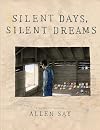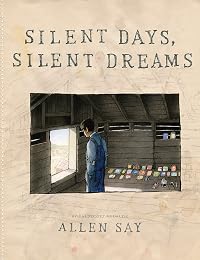
Silent Days, Silent Dreams
by Allen Say
On This Page
Description
A fictional biography of James Castle, a deaf, autistic artist whose drawings hang in major museums throughout the world.Tags
Recommendations









Member Reviews
Rating: 5* of five
The Publisher Says: James Castle was born two months premature on September 25, 1899, on a farm in Garden Valley, Idaho. He was deaf, mute, autistic and probably dyslexic. He didn't walk until he was four; he would never learn to speak, write, read or use sign language.
Yet, today Castle's artwork hangs in major museums throughout the world. The Philadelphia Museum of Art opened "James Castle: A Retrospective" in 2008. The 2013 Venice Biennale included eleven works by Castle in the feature exhibition "The Encyclopedic Palace." And his reputation continues to grow.
Caldecott Medal winner Allen Say, author of the acclaimed memoir Drawing from Memory, takes readers through an imagined look at Castle's childhood, allows them show more to experience his emergence as an artist despite the overwhelming difficulties he faced, and ultimately reveals the triumphs that he would go on to achieve.
My Review: I will never be able to thank my friend Joe enough for bringing this book, this artist, this art, into my life. I am so profoundly grateful to you, old friend.
James Castle with the tools of his trade. I don't know the date, but he died at 78 in 1977, so I'll venture a guess at early 1960s...? I'm actually surprised, given how very little the people he lived among seem to have liked him, that someone took his photo at all.
Artist and Caldecott Medalist Allen Say created this artwork at the request of an Idaho-based friend of his. It was his introduction to James Castle...he says of this amazing moment, "I opened the catalog and suddenly remembered the excitement of seeing a van Gogh for the first time." I rang like a bell when I read that. I had just had the same experience opening this book and seeing Say's artworks based on Castle's.
A spread from this gorgeous book.
I've got a reasonably sophisticated knowledge of art. I'm up to speed on "outsider art" and its importance in our visual vocabulary, to our aesthetic landscape. But there hasn't been an experience quite like discovering, via Artist Say, the astonishing work of James Castle in a very, very long time. The sheer breadth of the material he left behind is astounding! Sculptural constructions, drawings in their thousands, mobiles, it's like the man was working against a deadline that only he knew about and was determined to finish saying what he had no other way to say.
The publisher, Arthur Levine Books, is bringing this to us via a damned-near perfect design and production job. The aesthetics of the design you can see for yourself above. If you don't think that it's outstandingly lovely, look at it in person. If you still don't agree, okay, but why? What failing do you adduce to this presentation of two-color artwork mixed with four-color artwork and all presented in a beautiful matte-coated glowingly white space? What artistic flaw do you find with Artist Say's beautiful, spare evocations of the grim and terrible world of James Castle?
And it was a grim and terrible world, a kind of hell that I fear with all my wobbly, trembling emotional heart isn't unique except in its reasonably happy ending. Artist Say has gone as deep as one can into the little factual material of this ordinary life. His bibliography is quite substantial...and disturbingly complete...for someone who, absent Fate's intervention, would simply have vanished without a trace from the collective memory of US society. I knew I could trust Artist Say to tell me the truth about James Castle when I read:
Artist Say is the right one to lead us into James Castle's work, and his life and times insofar as any of us can know them.
The Seattle Times gives us the jacket of this glorious book in its native environment, the store where you'll be going to spend USD 21.99 (higher in Canada) to bring it home with you. And now you're able to do it legally, since a Federal judge ruled that Artist Say didn't violate Castle's estate's copyrights in offering us, in 28 cases from the 150 drawings in this book, his own artistic impression of specific Castle pieces.
Isn't that a sad statement of our current society's obsession with ownership? A beautiful illustrated biography would quite probably have pleased Castle, whose early relationship with books (despite being unable to read or write) was a loving and profound one. Not at issue were any facts, any alleged misrepresentations of Castle, his family, anything...just ownership of the images and therefore the right to profit from them.
Had I been related to Castle I'd've cringed in shame for the picture painted of a cold, uncaring, even cruel "family" that frankly seems to me to be culpably negligent and abusive of their child/sibling/educational charge. They sound like horrible people and I'm glad they're dead. show less
The Publisher Says: James Castle was born two months premature on September 25, 1899, on a farm in Garden Valley, Idaho. He was deaf, mute, autistic and probably dyslexic. He didn't walk until he was four; he would never learn to speak, write, read or use sign language.
Yet, today Castle's artwork hangs in major museums throughout the world. The Philadelphia Museum of Art opened "James Castle: A Retrospective" in 2008. The 2013 Venice Biennale included eleven works by Castle in the feature exhibition "The Encyclopedic Palace." And his reputation continues to grow.
Caldecott Medal winner Allen Say, author of the acclaimed memoir Drawing from Memory, takes readers through an imagined look at Castle's childhood, allows them show more to experience his emergence as an artist despite the overwhelming difficulties he faced, and ultimately reveals the triumphs that he would go on to achieve.
My Review: I will never be able to thank my friend Joe enough for bringing this book, this artist, this art, into my life. I am so profoundly grateful to you, old friend.
James Castle with the tools of his trade. I don't know the date, but he died at 78 in 1977, so I'll venture a guess at early 1960s...? I'm actually surprised, given how very little the people he lived among seem to have liked him, that someone took his photo at all.
Artist and Caldecott Medalist Allen Say created this artwork at the request of an Idaho-based friend of his. It was his introduction to James Castle...he says of this amazing moment, "I opened the catalog and suddenly remembered the excitement of seeing a van Gogh for the first time." I rang like a bell when I read that. I had just had the same experience opening this book and seeing Say's artworks based on Castle's.
A spread from this gorgeous book.
I've got a reasonably sophisticated knowledge of art. I'm up to speed on "outsider art" and its importance in our visual vocabulary, to our aesthetic landscape. But there hasn't been an experience quite like discovering, via Artist Say, the astonishing work of James Castle in a very, very long time. The sheer breadth of the material he left behind is astounding! Sculptural constructions, drawings in their thousands, mobiles, it's like the man was working against a deadline that only he knew about and was determined to finish saying what he had no other way to say.
The publisher, Arthur Levine Books, is bringing this to us via a damned-near perfect design and production job. The aesthetics of the design you can see for yourself above. If you don't think that it's outstandingly lovely, look at it in person. If you still don't agree, okay, but why? What failing do you adduce to this presentation of two-color artwork mixed with four-color artwork and all presented in a beautiful matte-coated glowingly white space? What artistic flaw do you find with Artist Say's beautiful, spare evocations of the grim and terrible world of James Castle?
And it was a grim and terrible world, a kind of hell that I fear with all my wobbly, trembling emotional heart isn't unique except in its reasonably happy ending. Artist Say has gone as deep as one can into the little factual material of this ordinary life. His bibliography is quite substantial...and disturbingly complete...for someone who, absent Fate's intervention, would simply have vanished without a trace from the collective memory of US society. I knew I could trust Artist Say to tell me the truth about James Castle when I read:
To emulate his unschooled style, I used the same kinds of odd materials he had used: soot and spit, liquid laundry bluing, and shoe polish, to name a few.
I had help. My wife meticulously made dolls and birds out of wastepaper and cardboard that I think the artist would have approved. I drew on ninety-year-old letters and envelopes that {his friend} found in an antique shop; and to mimic James's unsteady lines, I often switched lands—to my left hand, which hadn't learned to tell lies.
Artist Say is the right one to lead us into James Castle's work, and his life and times insofar as any of us can know them.
The Seattle Times gives us the jacket of this glorious book in its native environment, the store where you'll be going to spend USD 21.99 (higher in Canada) to bring it home with you. And now you're able to do it legally, since a Federal judge ruled that Artist Say didn't violate Castle's estate's copyrights in offering us, in 28 cases from the 150 drawings in this book, his own artistic impression of specific Castle pieces.
Isn't that a sad statement of our current society's obsession with ownership? A beautiful illustrated biography would quite probably have pleased Castle, whose early relationship with books (despite being unable to read or write) was a loving and profound one. Not at issue were any facts, any alleged misrepresentations of Castle, his family, anything...just ownership of the images and therefore the right to profit from them.
Had I been related to Castle I'd've cringed in shame for the picture painted of a cold, uncaring, even cruel "family" that frankly seems to me to be culpably negligent and abusive of their child/sibling/educational charge. They sound like horrible people and I'm glad they're dead. show less
Beautiful short biography of the artist James Castle, who was entirely self-taught, deaf from birth and in many ways isolated from recognized forms of communication. It's a terrible story and a beautiful one, because he created nonetheless, unstoppably.
Although he never learned to read or write, deaf artist James Castle communicated with the world through his art. He used scrap paper, soot, and any other materials he could find. He drew people, houses, and household objects. His art finally came to the attention of the art world, and his works can be found in galleries across the United States and beyond.
Author and illustrator Allen Say used materials that Castle might have used to emulate Castle's art in the illustrations for this book. He also made the unusual decision to write Castle's story from the perspective of Castle's nephew, Bob. Reader's don't learn that Say isn't really Castle's nephew until they reach the author's note at the end of the book. The book would have been just show more as powerful in third person as in first person, and it wouldn't leave readers questioning where the facts end and fiction begins. show less
Author and illustrator Allen Say used materials that Castle might have used to emulate Castle's art in the illustrations for this book. He also made the unusual decision to write Castle's story from the perspective of Castle's nephew, Bob. Reader's don't learn that Say isn't really Castle's nephew until they reach the author's note at the end of the book. The book would have been just show more as powerful in third person as in first person, and it wouldn't leave readers questioning where the facts end and fiction begins. show less
Beautifully executed homage to James Castle, a 20th century American artist who communicated only through his art. The original artwork by Mr. Say captures the character of Mr. Castle's art, and the narrative provides an imagined-glimpse into his life and motivation. This book combines prose and beautiful drawings to express the thoughts and emotions of someone who has autism and cannot hear, speak, or read, but still manages to reach other people through a diverse array of artistic media.
This is the artists take on what the life of James Castle might have been like from the pieces he could put together. This is an artist that was deaf and mute, possibly autistic and dyslexic. It explores the way we treat people who present differently to the world than others.
This is a beautiful, loving testament to a man who never had the resources he needed to make art, but who then used every tiny matchstick or scrap he could get his hands on to express himself through drawing. The illustrations are stunning, the story beautiful.
I think what will appeal to young readers here is the fact that James Castle was deaf, mute, autistic, possibly dyslexic, illiterate, and never learned to speak or use sign language, yet taught himself to draw. I was very amazed.This biography is a very inspiring story and can be the light in a childs life.
Members
- Recently Added By
Lists

Youth: Sexuality & Gender
119 works; 1 member
Author Information

35+ Works 11,538 Members
Allen Say was born in 1937 in Yokohama, Japan and grew up during the war, attending seven different primary schools amidst the ravages of falling bombs. His parents divorced in the wake of the end of the war and he moved in with his maternal grandmother, with whom he did not get along with. She eventually let him move into a one room apartment, show more and Say began to make his dream of being a cartoonist a reality. He was twelve years old. Say sought out his favorite cartoonist, Noro Shinpei, and begged him to take him on as an apprentice. He spent four years with Shinpei, but at the age of 16 moved to the United States with his father. Say was sent to a military school in Southern California but then expelled a year later. He struck out to see California with a suitcase and twenty dollars. He moved from job to job, city to city, school to school, painting along the way, and finally settled on advertising photography and prospered. Say's first children's book was done in his photo studio, between shooting assignments. It was called "The Ink-Keeper's Apprentice" and was the story of his life with Noro Shinpei. After this, he began to illustrate his own picture books, with writing and illustrating becoming a sort of hobby. While illustrating "The Boy of the Three-year Nap" though, Say suddenly remembered the intense joy I knew as a boy in my master's studio and decided to pursue writing and illustrating full time. Say began publishing books for children in 1968. His early work, consisting mainly of pen-and-ink illustrations for Japanese folktales, was generally well received; however, true success came in 1982 with the publication of The Bicycle Man, based on an incident in Say's life. "The Boy of the Three-Year Nap" published in 1988, and written by Dianne Snyder, was selected as a 1989 Caldecott Honor Book and winner of The Boston Globe-Horn Book Award for best picture book. (Bowker Author Biography) show less
Some Editions
Awards and Honors
Awards
Distinctions
Common Knowledge
- Original publication date
- 2017
- People/Characters
- James Castle
- Important places
- Idaho, USA
- Dedication
- For Cort
- First words
- James Castle was born on September 25, 1899, on a farm in Garden Valley, Idaho. I think I knew him as well as anyone could know him -- which wasn't very much -- but I want to tell how I remember him. He was my uncle.
- Last words
- (Click to show. Warning: May contain spoilers.)He worked in it for fifteen more years, in the same way he had when I was a kid -- drawing with soot and spit on scavenged paper. I think he was happy.
Classifications
Statistics
- Members
- 158
- Popularity
- 207,818
- Reviews
- 10
- Rating
- (4.27)
- Languages
- English
- Media
- Paper, Ebook
- ISBNs
- 4