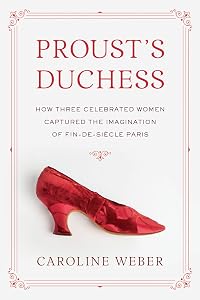
Proust's Duchess: How Three Celebrated Women Captured the Imagination of Fin-de-Siècle Paris
by Caroline Weber
On This Page
Description
"A brilliant look at the glittering world of turn-of-the-century Paris through the first in-depth study of the three women Proust used to create his supreme fictional character, the Duchesse de Guermantes. Geneviève Halévy Bizet Straus; Laure de Sade, Comtesse de Adhéaume de Chevigné; and Élisabeth de Riquet de Caraman-Chimay, the Comtesse Greffuhle--these were the three superstars of fin-de-siècle Parisian high society who, as Caroline Weber says, "transformed themselves, and were show more transformed by those around them, into living legends: paragons of elegance, nobility, and style." All well but unhappily married, these women sought freedom and fulfillment by reinventing themselves, between the 1870s and 1890s, as icons. At their fabled salons, they inspired the creativity of several generations of writers, visual artists, composers, designers, and journalists. Against a rich historical backdrop, Weber takes the reader into these women's daily lives of masked balls, hunts, dinners, court visits, nights at the opera or theater. But we see as well the loneliness, rigid social rules, and loveless, arranged marriages that constricted these women's lives. Proust, as a twenty-year-old law student in 1892, would worship them from afar, and later meet them and create his celebrated composite character for The Remembrance of Things Past"-- show lessTags
Recommendations
























Member Reviews
This dense nonfiction explores the lives of three women who Proust used as a composite to create his famous character, the Duchess of Guermantes, in [In Search of Lost Time]. Having recently read this novel, I knew I had to read this as soon as I saw it had been published.
The three women, Geneviève Bizet Straus, Laure de Chevigné, and Élisabeth Greffulhe, (I've shortened their names and titles significantly for convenience!) were staples of the French monde. They were known for their beauty and dominance of society. They were significantly different from each other, and Weber does a wonderful job of bringing them each to life separately. They do have things in common, such as loveless marriages, sometimes even abusive, and a show more shallowness that likely came with their focus on being popular. These traits were central to Proust's novel.
Geneviève Straus's first husband was the composer Bizet of Carmen fame. When he died young she never forgot him despite remarrying. She was an opium user, had a facial tick, and would often entertain in a comfortable but risque nightgown.
Laure de Chevigné was a descendant of the Marquis de Sade. She had an interesting way of speaking, using made up slang and also pursued typically male pursuits like hunting and putting herself in male circles.
Élisabeth Greffulhe was probably the most stereotypical example of a mondain superstar. She consistently made a splash at every ball with her eccentric and beautiful costumes. She gathered men to her, always having many men declaring love for her while she kept them at a distance. It seems she rarely if ever consummated any of these relationships, simply wanting the attention and adoration. She was a beauty, often compared to a swan and painted by many famous artists of the time.
Proust met these three in the order I've described them, at first being obsessed with meeting them and then becoming disillusioned with how boring he found their salons. Weber has written a book that strikes a great balance of describing these women and their lives with source material and also connecting them to Proust's famous novel as characters. She gets the balance between analyzing the book and separating these women from it just right.
I think this will mainly appeal to readers of [In Search of Lost Time], but those who have an interest in the lives of high society women in early 1900 France might also be interested. I loved it.
Original publication date: 2018
Author’s nationality: American
Original language: English
Length: 715 pages
Rating: 4 stars
Format/Where I acquired the book: library hardback
Why I read this: nonfiction relating to Proust show less
The three women, Geneviève Bizet Straus, Laure de Chevigné, and Élisabeth Greffulhe, (I've shortened their names and titles significantly for convenience!) were staples of the French monde. They were known for their beauty and dominance of society. They were significantly different from each other, and Weber does a wonderful job of bringing them each to life separately. They do have things in common, such as loveless marriages, sometimes even abusive, and a show more shallowness that likely came with their focus on being popular. These traits were central to Proust's novel.
Geneviève Straus's first husband was the composer Bizet of Carmen fame. When he died young she never forgot him despite remarrying. She was an opium user, had a facial tick, and would often entertain in a comfortable but risque nightgown.
Laure de Chevigné was a descendant of the Marquis de Sade. She had an interesting way of speaking, using made up slang and also pursued typically male pursuits like hunting and putting herself in male circles.
Élisabeth Greffulhe was probably the most stereotypical example of a mondain superstar. She consistently made a splash at every ball with her eccentric and beautiful costumes. She gathered men to her, always having many men declaring love for her while she kept them at a distance. It seems she rarely if ever consummated any of these relationships, simply wanting the attention and adoration. She was a beauty, often compared to a swan and painted by many famous artists of the time.
Proust met these three in the order I've described them, at first being obsessed with meeting them and then becoming disillusioned with how boring he found their salons. Weber has written a book that strikes a great balance of describing these women and their lives with source material and also connecting them to Proust's famous novel as characters. She gets the balance between analyzing the book and separating these women from it just right.
I think this will mainly appeal to readers of [In Search of Lost Time], but those who have an interest in the lives of high society women in early 1900 France might also be interested. I loved it.
Original publication date: 2018
Author’s nationality: American
Original language: English
Length: 715 pages
Rating: 4 stars
Format/Where I acquired the book: library hardback
Why I read this: nonfiction relating to Proust show less
This history captures a fascinating portrait of French high society at the end of the nineteenth century through the lives of three women who inspired Marcel Proust's character of the Duchess of Guermantes. The three women (none of whom were an actual duchess) - Geneviève Bizet Straus, Laure de Chevigné, and Élisabeth Greffulhe - all played a significant role in the French upper class. I enjoyed this history, which contains many details of life in France during this period, but I struggled with the length and the way the narrative seemed to expand (introducing new historical figures and only slowly shifting the focus to Proust). Overall, I would recommend this to anyone interested in the history of this era.
To my way of thinking, Proust's greatness comes from his transcending the world he so ardently observed. His point of view always was intertwined with his observations of art and character. The quality of his mind seen in his writing is where his "genius" lies, his overwhelming and keen artistic sensibilities.
Although I'm aware that many of his readers find the 'gossipy' societal aspect of his writing the most interesting--and indeed, Proust's 'social climbing' is behind the story--I find myself put off by a book that delves into the individuals whose characteristics were modified by Proust into the characters he created.
Well, to each his own, but I returned this book to the store.
Although I'm aware that many of his readers find the 'gossipy' societal aspect of his writing the most interesting--and indeed, Proust's 'social climbing' is behind the story--I find myself put off by a book that delves into the individuals whose characteristics were modified by Proust into the characters he created.
Well, to each his own, but I returned this book to the store.
Ratings
Members
- Recently Added By
Author Information

3+ Works 794 Members
Caroline Weber is assistant professor of Romance languages at the University of Pennsylvania.
Some Editions
Awards and Honors
Awards
Distinctions
Work Relationships
Is a study of
Common Knowledge
- Canonical title
- Proust's Duchess: How Three Celebrated Women Captured the Imagination of Fin-de-Siècle Paris
- Original title
- Proust's Duchess: How Three Celebrated Women Captured the Imagination of Fin-de-Siècle Paris
- Original publication date
- 2018
- People/Characters
- Marcel Proust; Geneviève Halévy; Élisabeth Greffulhe; Laure de Chevigné; Victor Hugo; Louis XIV, 1638-1715 (show all 39); Donatien Alphonse-François, Marquis de Sade; Edgar Degas; Guy de Maupassant; Henri de Toulouse-Lautrec; Gustave Flaubert; Oscar Wilde; James Joyce; Émile Zola; Leonardo da Vinci; Charles Haas; Napoleon III; Robert de Montesquiou; Georges de Porto-Riche; Georges Bizet; Célestine Galli-Marié; Arthur Meyer; Edward VII, King of the United Kingdom; Jean de Reszke; Hortense Schneider; José-Maria de Heredia; Edmond de Goncourt; James Mayer de Rothschild; Daniel Halévy; Adrien Proust; Robert Proust; Henri Greffulhe; Laura de Noves; Aristide Bruant; Robert Bulwer-Lytton, 1st Earl of Lytton; Juliette Récamier; Édouard Drumont; Alfred Dreyfus; Reynaldo Hahn
- Important places
- Paris, France; France
- Important events
- Fin de siècle; French Revolution; Dreyfus Affair; Franco-Prussian War; Renaissance; Italian Renaissance (show all 8); Impressionism; Post-Impressionism
Classifications
- Genres
- Literature Studies and Criticism, Fiction and Literature, Biography & Memoir
- DDC/MDS
- 843.912 — Literature & rhetoric French Literature French fiction 1900- 20th Century 1900-1945
- LCC
- PQ2631 .R63 .Z9818 — Language and Literature French, Italian, Spanish and Portuguese literatures French literature Modern literature 1900-1960
- BISAC
Statistics
- Members
- 140
- Popularity
- 233,538
- Reviews
- 3
- Rating
- (3.50)
- Languages
- English
- Media
- Paper, Audiobook, Ebook
- ISBNs
- 5
- ASINs
- 3