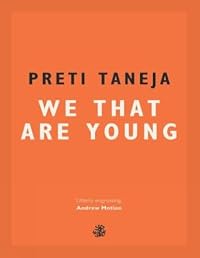
We That Are Young
by Preti Taneja
On This Page
Description
Fiction. Literature. HTML:When a billionaire hotelier and political operator attempts to pit his three daughters against one another, a brutal struggle for primacy begins in this modern-day take on Shakespeare's King Lear. Set in contemporary India, where rich men are gods while farmers starve and water is fast running out, We That Are Young is a story about power, status, and the love of a megalomaniac father. A searing exploration of human fallibility, Preti Taneja's remarkable novel show more reveals the fragility of the human heart—and its inevitable breaking point. show lessTags
Recommendations


















Member Reviews
This is an absolutely brilliant read. It's a rich Indian family saga which is also a retelling of King Lear. I read a precis of King Lear early on so I could do a better job of spotting the parallels, but in the end it inspired me to read King Lear as well. The descriptions of modern India are very vivid, the family are all terrible, and it's harrowing in places.
I'll be honest. I debated about whether or not to review this book. For that matter, I debated about whether or not to bail on reading the novel itself. I'd invested so much time reading, I kept thinking, surely I can keep going. Right?
In a word: no.
After spending several days wading through the book, being bored, and dreading the next time I had to open the cover, I bailed after 400 pages.
I suspect that a reader's response to this novel entirely depends on her/his level of tolerance/comfort for dense literary prose. It might also help if the reader is familiar with King Lear; I read that play in high school but can't remember much beyond the basic trope of father-pitting-daughters-against-each-other. Sibling rivalry, all that. I show more don't know how closely Taneja adhered to the original plot.
If literary fiction is your thing and you love lyrical writing, then you should stop reading my review. You might enjoy this book. Give it a try.
If you're a plot junkie, and prefer a bare-bones get-to-the-action narrative style, you won't like this book.
If you're not completely on either side, this review is for you. Maybe you like lyrical writing but you also like to have active, sympathetic characters. Or maybe you like Shakespeare retellings. My thoughts might help.
Before you say, "Oh, you just don't appreciate great writing!" or, "You just want fluffy entertainment!" I'll point out that I have a bachelor's and a master's degree in English lit. I've read plenty of great writing, lengthy books, and agonizing plots with horrible people populating the pages. I'm fine with all that to a certain extent. But my tolerance level has lowered. I want to be able to connect with someone in the book, preferably more than one, and I want to be interested in what they are doing, even if it is evil.
I didn't get that here.
I suspect that I would've been more tolerant of the prose had this been a translation, but it isn't. I'm not sure why, but knowing that a work is translated makes a difference. It's as if I realize that the work wasn't originally intended for someone of my demographic and I'm only eavesdropping on a different cultural's conversation. I expect to be slightly confused by geographic or political references and to be ignorant of the language or food or culture, and I'm willing to take the time to figure it out. But I really don't expect that in an English-language novel, even one about a different culture.
None of the sentences seem direct or to the point. There are no quotation marks. Certain passages are written in (presumably) Hindi (or some dialect) and not explained. If done sparingly, I would be okay with that. At length? Repeatedly? No. I realize this is a different culture, okay? I don't need a constant reminder of our differences. I need something that shows how we're connected as humans.
Absolutely none of the characters are likable, sympathetic, or even really interesting. They're not unique in how they act, either. They're doing a lot of what literary characters do in a lot of literary novels: cheat others, do drugs, drink too much, act miserable, etc. As best as I could tell, everyone hated and resented everyone else, including those they claimed (or believed) to love. I had high hopes when Jivan was introduced at the beginning, but after the initial section from his point of view, he wasn't as interesting anymore.
I wanted to like this book. I just couldn't. But I couldn't help but wonder what target audience Taneja thought she was aiming for. Apparently it wasn't me. I hate that. I really want to learn about other cultures and promote non-white authors, but this book alienated me no matter how I tried to embrace it.
In my opinion, it's not fair to rate a book that I didn't finish. I also hate being this negative in a review. Taneja obviously worked hard on this novel. If I run across another book of hers, I'll try to read it. Also, obviously some people like this novel (read the rave reviews on the back cover) so if you like more literary style writing, consider giving it a try. show less
In a word: no.
After spending several days wading through the book, being bored, and dreading the next time I had to open the cover, I bailed after 400 pages.
I suspect that a reader's response to this novel entirely depends on her/his level of tolerance/comfort for dense literary prose. It might also help if the reader is familiar with King Lear; I read that play in high school but can't remember much beyond the basic trope of father-pitting-daughters-against-each-other. Sibling rivalry, all that. I show more don't know how closely Taneja adhered to the original plot.
If literary fiction is your thing and you love lyrical writing, then you should stop reading my review. You might enjoy this book. Give it a try.
If you're a plot junkie, and prefer a bare-bones get-to-the-action narrative style, you won't like this book.
If you're not completely on either side, this review is for you. Maybe you like lyrical writing but you also like to have active, sympathetic characters. Or maybe you like Shakespeare retellings. My thoughts might help.
Before you say, "Oh, you just don't appreciate great writing!" or, "You just want fluffy entertainment!" I'll point out that I have a bachelor's and a master's degree in English lit. I've read plenty of great writing, lengthy books, and agonizing plots with horrible people populating the pages. I'm fine with all that to a certain extent. But my tolerance level has lowered. I want to be able to connect with someone in the book, preferably more than one, and I want to be interested in what they are doing, even if it is evil.
I didn't get that here.
I suspect that I would've been more tolerant of the prose had this been a translation, but it isn't. I'm not sure why, but knowing that a work is translated makes a difference. It's as if I realize that the work wasn't originally intended for someone of my demographic and I'm only eavesdropping on a different cultural's conversation. I expect to be slightly confused by geographic or political references and to be ignorant of the language or food or culture, and I'm willing to take the time to figure it out. But I really don't expect that in an English-language novel, even one about a different culture.
None of the sentences seem direct or to the point. There are no quotation marks. Certain passages are written in (presumably) Hindi (or some dialect) and not explained. If done sparingly, I would be okay with that. At length? Repeatedly? No. I realize this is a different culture, okay? I don't need a constant reminder of our differences. I need something that shows how we're connected as humans.
Absolutely none of the characters are likable, sympathetic, or even really interesting. They're not unique in how they act, either. They're doing a lot of what literary characters do in a lot of literary novels: cheat others, do drugs, drink too much, act miserable, etc. As best as I could tell, everyone hated and resented everyone else, including those they claimed (or believed) to love. I had high hopes when Jivan was introduced at the beginning, but after the initial section from his point of view, he wasn't as interesting anymore.
I wanted to like this book. I just couldn't. But I couldn't help but wonder what target audience Taneja thought she was aiming for. Apparently it wasn't me. I hate that. I really want to learn about other cultures and promote non-white authors, but this book alienated me no matter how I tried to embrace it.
In my opinion, it's not fair to rate a book that I didn't finish. I also hate being this negative in a review. Taneja obviously worked hard on this novel. If I run across another book of hers, I'll try to read it. Also, obviously some people like this novel (read the rave reviews on the back cover) so if you like more literary style writing, consider giving it a try. show less
This massive novel set in New Delhi and Kashmir features the financial wranglings of three sisters, two half-brothers, and a totally malevolent oligarch/crime boss/corruption magnate. Each of the siblings gets a chapter in their voice, and each is both sympathetic and pathetic in turn. It's too long by half, but its primary strength is the history of the city of Srinagar and of father Devraj, whose mother was a Maharini and whose wife was murdered during a time of ethnic violence. The plot centers on the opening of a family new hotel in the Kashmiri city of Amritsar, and on how each family member and their numerous employees are affected when the patriarch tries to divide the family holdings and force his youngest daughter to get show more married. The ending is too ambiguous, and the foreshadowing so slight that I had to go back and skim it again after finishing it. The writing is excellent, but an editor with a sharp knife would have been a blessing. show less
Update 21/6/18. Now the well-deserved winner of the Desmond Elliott Prize 2018. Congratulations to Preti Taneja and all at Galley Beggar.
This vibrant, epic, ambitious transplantation of King Lear to modern India is by far the longest book on the Republic of Consciousness Prize shortlist, and looks a potential winner. Taneja keeps the essential elements of the familiar Shakespeare version of the story in place, but allows herself plenty of scope to explore the issues, extremes of wealth and poverty, corruption and factionalism of modern India.
It is probably easiest to list the main players with their Shakespeare equivalents:
Devraj Bapuji (Lear) - a super-rich magnate and owner of one of India's biggest companies, his daughters Gargi show more (Goneril), Radha (Regan) and Sita (Cordelia), his henchmen Ranjit (Gloucester) and Kritik (Kent), Ranjit's sons Jeet (Edgar) and the illegitimate Jivan (Edmund). Albany and Cornwall become Surendra and Bubu.
The story is told in six parts. The first five are told from the perspectives of the younger protagonists, and at the end of each chapter Bapuji gets to speak for himself, getting increasingly incoherent as the story proceeds. This structure breaks up the linear narrative, and in some cases leads to events being described more than once, from different viewpoints. The last part is shorter and ties up the loose ends.
In the first and longest part Jivan returns from America, where he has been living with his now dead mother for 15 years, and arrives on Bapuji's "farm" near Delhi - every lavish excess is described, and this allows Taneja to introduce the rest of the cast and the nature of the family business, and to describe background events and his childhood memories. Bapuji is the son of a Maharaja from Kashmir who has lost his land, and his mother Nanu who is still alive at 90 - he has built up the family firm from almost nothing, initially by exploiting the skills of Kashmiri craftsmen. One of Bapuji's pet projects is to build a luxury hotel in Srinagar, the Kashmiri capital. Over the course of Jivan's first day there, Bapuji announces his retirement plans to the family over lunch, and puts his daughters to the test, and by the end of the day both Sita and Jeet have disappeared, and Kritik has been dismissed for defending Sita. In Sita's case this is because she does not want to be married off, but wishes to pursue her own career as an environmental campaigner. Jeet has been living a double life, acquiring ancient artefacts for the company while maintaining a secret gay relationship, he goes into hiding because he believes this is about to be exposed.
The second part revolves around Gargi, who is initially presented as a conscientious daughter and worthy heir to the business, frustrated by India's archaic and sexist property laws. She resolves to rid the business of corruption, and modernise it - she wants to maintain the unity of the company and refuses to sign the papers that legitimise Bapuji's plans to split the business. The disappointments of her marriage to the impotent and largely useless Surendra are also described. In this part Gargi argues with Bapuji and refuses to accommodate the regular parties of his 100 henchmen.
The third part is about Radha, who is vain and hedonistic. She has been partying in Goa, but she and Bubu head for Srinagar when they hear that Bapuji and Nanu are heading there, having started to amass popular support by denouncing the company's activities and blaming his daughters. Radha starts an affair with Jivan, who is now employed as a company security man. Bubu is a corrupt playboy who has been allowed to control Radha's share of the business. Bapuji arrives to find that one of Kritik's deputies has been beaten left chained in the sun, quarrels with Radha and walks away from the hotel. The section ends with the blinding of Ranjit and the murder of Bubu - no attempt has been made to spare any of the brutality of the original.
In the fourth part we meet Jeet in his guise of Rudra the Naph. He has also journeyed to Srinagar, living among the untouchables on the rubbish dump and surviving as a holy man and storyteller. This is perhaps the most interesting part of the story, in that it is almost the only part in which the action moves away from the elite owning class. He encounters Bapuji in the storm (the heath becomes the dump), and is entrusted with looking after his father, and instead of leading him to Amarnath (Dover Cliffs) he takes him back to Delhi and the farm.
The fifth part returns to Sita, who is the least realised of the main characters. Her escape to Sri Lanka is barely described, and by the time we meet her she is in a safe house in Kashmir with Kritik and the increasingly feeble Bapuji. Unlike Cordelia, she defends her unmarried status. The remainder of the book plays out the rest of Shakespeare's denouement.
The language of the book is interesting - the dialogue includes a lot of Hindi, much of it untranslated, which can be a little frustrating for the untrained reader, though there is never much doubt about the more important events.
I was a little disappointed by the number of typographical errors, mostly incorrect homophones, but overall I can't find a strong reason not to award this book the full five stars and encourage others to read it. show less
This vibrant, epic, ambitious transplantation of King Lear to modern India is by far the longest book on the Republic of Consciousness Prize shortlist, and looks a potential winner. Taneja keeps the essential elements of the familiar Shakespeare version of the story in place, but allows herself plenty of scope to explore the issues, extremes of wealth and poverty, corruption and factionalism of modern India.
It is probably easiest to list the main players with their Shakespeare equivalents:
Devraj Bapuji (Lear) - a super-rich magnate and owner of one of India's biggest companies, his daughters Gargi show more (Goneril), Radha (Regan) and Sita (Cordelia), his henchmen Ranjit (Gloucester) and Kritik (Kent), Ranjit's sons Jeet (Edgar) and the illegitimate Jivan (Edmund). Albany and Cornwall become Surendra and Bubu.
The story is told in six parts. The first five are told from the perspectives of the younger protagonists, and at the end of each chapter Bapuji gets to speak for himself, getting increasingly incoherent as the story proceeds. This structure breaks up the linear narrative, and in some cases leads to events being described more than once, from different viewpoints. The last part is shorter and ties up the loose ends.
In the first and longest part Jivan returns from America, where he has been living with his now dead mother for 15 years, and arrives on Bapuji's "farm" near Delhi - every lavish excess is described, and this allows Taneja to introduce the rest of the cast and the nature of the family business, and to describe background events and his childhood memories. Bapuji is the son of a Maharaja from Kashmir who has lost his land, and his mother Nanu who is still alive at 90 - he has built up the family firm from almost nothing, initially by exploiting the skills of Kashmiri craftsmen. One of Bapuji's pet projects is to build a luxury hotel in Srinagar, the Kashmiri capital. Over the course of Jivan's first day there, Bapuji announces his retirement plans to the family over lunch, and puts his daughters to the test, and by the end of the day both Sita and Jeet have disappeared, and Kritik has been dismissed for defending Sita. In Sita's case this is because she does not want to be married off, but wishes to pursue her own career as an environmental campaigner. Jeet has been living a double life, acquiring ancient artefacts for the company while maintaining a secret gay relationship, he goes into hiding because he believes this is about to be exposed.
The second part revolves around Gargi, who is initially presented as a conscientious daughter and worthy heir to the business, frustrated by India's archaic and sexist property laws. She resolves to rid the business of corruption, and modernise it - she wants to maintain the unity of the company and refuses to sign the papers that legitimise Bapuji's plans to split the business. The disappointments of her marriage to the impotent and largely useless Surendra are also described. In this part Gargi argues with Bapuji and refuses to accommodate the regular parties of his 100 henchmen.
The third part is about Radha, who is vain and hedonistic. She has been partying in Goa, but she and Bubu head for Srinagar when they hear that Bapuji and Nanu are heading there, having started to amass popular support by denouncing the company's activities and blaming his daughters. Radha starts an affair with Jivan, who is now employed as a company security man. Bubu is a corrupt playboy who has been allowed to control Radha's share of the business. Bapuji arrives to find that one of Kritik's deputies has been beaten left chained in the sun, quarrels with Radha and walks away from the hotel. The section ends with the blinding of Ranjit and the murder of Bubu - no attempt has been made to spare any of the brutality of the original.
In the fourth part we meet Jeet in his guise of Rudra the Naph. He has also journeyed to Srinagar, living among the untouchables on the rubbish dump and surviving as a holy man and storyteller. This is perhaps the most interesting part of the story, in that it is almost the only part in which the action moves away from the elite owning class. He encounters Bapuji in the storm (the heath becomes the dump), and is entrusted with looking after his father, and instead of leading him to Amarnath (Dover Cliffs) he takes him back to Delhi and the farm.
The fifth part returns to Sita, who is the least realised of the main characters. Her escape to Sri Lanka is barely described, and by the time we meet her she is in a safe house in Kashmir with Kritik and the increasingly feeble Bapuji. Unlike Cordelia, she defends her unmarried status. The remainder of the book plays out the rest of Shakespeare's denouement.
The language of the book is interesting - the dialogue includes a lot of Hindi, much of it untranslated, which can be a little frustrating for the untrained reader, though there is never much doubt about the more important events.
I was a little disappointed by the number of typographical errors, mostly incorrect homophones, but overall I can't find a strong reason not to award this book the full five stars and encourage others to read it. show less
Because so much of the story revolved around Indian culture and food, often I felt lost in the details of the story. Yet at the same time it allowed me to look into a very wealthy Indian family and compare their lives to those Indians living in poverty. But I slogged through this book having little compassion for any of the family and their struggles.
I’m just not lidderary enough for this one.
A [2] average is the best compromise as my rating sense ranged from [1] to [3].
Intro
It was a real challenge to read and finish this book and I was proceeding for only 10 or so pages a day for the longest time. There were only brief segments that were compelling enough to get through more. I still find it an interesting exercise to try to define what my problems were, even if they might only be my own and no one else’s.
Structure and Pacing
The book is divided into 6 sections, 5 are each assigned to the 5 major younger generation characters and a 6th general titular section represents a summing up. The patriarch character has occasional interjections into the younger generation sections. The show more beginning I “Jivan” and II “Gargi” sections were slow going, III “Radha” started to really pick it up, IV “Jeet” slowed it down all over again, V “Sita” crept to a tragic catharsis, VI “We That Are Young” seemed to just fizzle out into an obscurity where you are not quite sure what happened to everyone.
Characters
Since it is already telegraphed in the title (which is part of Edgar’s concluding speech) and as part of the synopsis and blurb information, there is no spoiler in saying that most of the WTAY characters have a parallel in Shakespeare’s King Lear. Depending on your level of familiarity with that play you can proceed without a refresher or do a quick survey through various online plot summaries. That of course may increase the predictability of the plot for some but I still found increased suspense from anticipating what the modern twists would be.
I rather enjoy The Fool as a favourite King Lear character so I was disappointed that there wasn’t an equivalent in WTAY. Bapuji’s mother Nanu is with him most of the way, but she doesn’t play anything like ‘the speaker of truth to power’ role.
Really, almost all of the characters were pretty shallow and unsympathetic most of the way through. Only Jivan in his ‘fish out of water’ character at the start and Jeet in his ‘Edgar at the end’ were at all enjoyable. That ratio of unlikeability seems like heavy odds. Although you'd assume that the Cordelia and King Lear characters are meant to invoke some sympathy and audience identification, I never felt that for Sita and Bapuji. It is possible that a more cynical view was intended though.
Untranslated language
There is hardly any concession to the reader here. Only very rarely is an interjected Hindi or Urdu word or expression explained right away with its English equivalent added to the text. Some of the untranslated words will have a identifiable meaning in context in that they are obviously a food or a drink. Many can be interpreted by a guess, e.g. “Chup” seemed to be the equivalent of “Shut up” because people were silenced by it. There are no footnotes or afterword notes to explain anything.
This might not seem that daunting if the reader is prepared to accept some degree of language immersion, but there is rarely a page where several such words or expressions did not occur. I started marking them with the intention of looking them up but that was so slow and frustrating and was delaying my reading progress so much further that I ended up going back to the blur of guessed definitions by context for most of the book. That may not matter to some readers, but not understanding what I am reading is quite a giant dislike for me.
Sidenote: I had a brief hope that the North American edition which is due to be published August 28, 2018 might include some footnotes for the non-UK non-India reader. Its now promised 496 page length doesn’t make that very likely. This present UK edition was 553 pages without footnotes.
#ThereIsAlwaysOne (or More)
With so many foreign words and expressions it is hard to judge the full extent of the typos and copy-editing errors but these ones jumped out for me i.e. were enough to stop my reading and cause me to go back to try to understand what was wrong with the sentence.
Pg. 140 “every grainstore and damn…” (s/b “dam”?, context seems to be that of building structures) Pg. 208 “And Deepak’s grins form his place on the floor…” (s/b “from”?, context seems to be what location he is at).
Pg. 339 “an almost infinite variety meanings” (s/b “variety of meanings”?)
Pg. 368 “First I will explain to you the crore value of beauty…” (s/b “core”?)
Pg. 388 “He tries to reach the forth circle…” (s/b “fourth” based on the context of the nine circles of the slum that are mentioned)
Pg. 397 “She gives harsh laugh.” (s/b “a harsh laugh”?)
Pg. 405 “Nanu’s hands at grab at him” (s/b one extra “at”?)
Pg. 437 “each doorway covered with a think crewl-work curtain” (s/b “thick”?)
Pg. 481 “Bend your head, licks your lips…” (s/b “lick your lips”?)
Pg. 543 “Radha brings folds herself up…” (double verb seems to indicate that an editing choice was never made)
10 or so errors may not seem like many in a 553 page book, but when each of them causes you to stop dead and take the time to decipher what is wrong they become a regular distraction that takes you away from the magic of immersing yourself in a book.
Conclusion
This is a rather extended review to try to pin down my problems with this book. It seems clear that I’m in the real minority here based on the many 4 and 5 star reviews and also the novel being shortlisted for several literary prizes so it is my own quirks and bugbears that took me out of this book. I applaud Preti Taneja for the ambition of her first novel and would certainly read her again. My thanks to the Republic of Consciousness 2017 Shortlist Perk donation incentive and to Galley Beggar Press for my book copy. Both organizations are to be commended for their propagation of new indie publishers and writers. show less
A [2] average is the best compromise as my rating sense ranged from [1] to [3].
Intro
It was a real challenge to read and finish this book and I was proceeding for only 10 or so pages a day for the longest time. There were only brief segments that were compelling enough to get through more. I still find it an interesting exercise to try to define what my problems were, even if they might only be my own and no one else’s.
Structure and Pacing
The book is divided into 6 sections, 5 are each assigned to the 5 major younger generation characters and a 6th general titular section represents a summing up. The patriarch character has occasional interjections into the younger generation sections. The show more beginning I “Jivan” and II “Gargi” sections were slow going, III “Radha” started to really pick it up, IV “Jeet” slowed it down all over again, V “Sita” crept to a tragic catharsis, VI “We That Are Young” seemed to just fizzle out into an obscurity where you are not quite sure what happened to everyone.
Characters
Since it is already telegraphed in the title (which is part of Edgar’s concluding speech) and as part of the synopsis and blurb information, there is no spoiler in saying that most of the WTAY characters have a parallel in Shakespeare’s King Lear. Depending on your level of familiarity with that play you can proceed without a refresher or do a quick survey through various online plot summaries. That of course may increase the predictability of the plot for some but I still found increased suspense from anticipating what the modern twists would be.
I rather enjoy The Fool as a favourite King Lear character so I was disappointed that there wasn’t an equivalent in WTAY. Bapuji’s mother Nanu is with him most of the way, but she doesn’t play anything like ‘the speaker of truth to power’ role.
Really, almost all of the characters were pretty shallow and unsympathetic most of the way through. Only Jivan in his ‘fish out of water’ character at the start and Jeet in his ‘Edgar at the end’ were at all enjoyable. That ratio of unlikeability seems like heavy odds. Although you'd assume that the Cordelia and King Lear characters are meant to invoke some sympathy and audience identification, I never felt that for Sita and Bapuji. It is possible that a more cynical view was intended though.
Untranslated language
There is hardly any concession to the reader here. Only very rarely is an interjected Hindi or Urdu word or expression explained right away with its English equivalent added to the text. Some of the untranslated words will have a identifiable meaning in context in that they are obviously a food or a drink. Many can be interpreted by a guess, e.g. “Chup” seemed to be the equivalent of “Shut up” because people were silenced by it. There are no footnotes or afterword notes to explain anything.
This might not seem that daunting if the reader is prepared to accept some degree of language immersion, but there is rarely a page where several such words or expressions did not occur. I started marking them with the intention of looking them up but that was so slow and frustrating and was delaying my reading progress so much further that I ended up going back to the blur of guessed definitions by context for most of the book. That may not matter to some readers, but not understanding what I am reading is quite a giant dislike for me.
Sidenote: I had a brief hope that the North American edition which is due to be published August 28, 2018 might include some footnotes for the non-UK non-India reader. Its now promised 496 page length doesn’t make that very likely. This present UK edition was 553 pages without footnotes.
#ThereIsAlwaysOne (or More)
With so many foreign words and expressions it is hard to judge the full extent of the typos and copy-editing errors but these ones jumped out for me i.e. were enough to stop my reading and cause me to go back to try to understand what was wrong with the sentence.
Pg. 140 “every grainstore and damn…” (s/b “dam”?, context seems to be that of building structures) Pg. 208 “And Deepak’s grins form his place on the floor…” (s/b “from”?, context seems to be what location he is at).
Pg. 339 “an almost infinite variety meanings” (s/b “variety of meanings”?)
Pg. 368 “First I will explain to you the crore value of beauty…” (s/b “core”?)
Pg. 388 “He tries to reach the forth circle…” (s/b “fourth” based on the context of the nine circles of the slum that are mentioned)
Pg. 397 “She gives harsh laugh.” (s/b “a harsh laugh”?)
Pg. 405 “Nanu’s hands at grab at him” (s/b one extra “at”?)
Pg. 437 “each doorway covered with a think crewl-work curtain” (s/b “thick”?)
Pg. 481 “Bend your head, licks your lips…” (s/b “lick your lips”?)
Pg. 543 “Radha brings folds herself up…” (double verb seems to indicate that an editing choice was never made)
10 or so errors may not seem like many in a 553 page book, but when each of them causes you to stop dead and take the time to decipher what is wrong they become a regular distraction that takes you away from the magic of immersing yourself in a book.
Conclusion
This is a rather extended review to try to pin down my problems with this book. It seems clear that I’m in the real minority here based on the many 4 and 5 star reviews and also the novel being shortlisted for several literary prizes so it is my own quirks and bugbears that took me out of this book. I applaud Preti Taneja for the ambition of her first novel and would certainly read her again. My thanks to the Republic of Consciousness 2017 Shortlist Perk donation incentive and to Galley Beggar Press for my book copy. Both organizations are to be commended for their propagation of new indie publishers and writers. show less
Good, but it felt long. It took me a little while to get through it, more because I had other things going on than because the book wasn't good.
Members
- Recently Added By
Lists

Ninja book club
8 works; 1 member

Kirkus Starred Fiction Reviews of Books Published in 2018
330 works; 3 members

Amazon best fictional genre picks monthly for 2018
418 works; 9 members

Retellings of Shakespeare Plays
42 works; 12 members
Author Information

3+ Works 197 Members
Preti Taneja was born in England. As a child, she spent most of her holidays in New Delhi. Her career has included human rights reporter, filmmaker in Iraq, Jordan, Rwanda, and Kosovo, and editor of Visual Verse, an online anthology of art and words. She is a research fellow in global Shakespeare at Queen Mary, University of London, and Warwick show more University. She is an author who writes about human rights, contemporary India, literature and culture. She was named an AHRC/BBC New Generation Thinker 2014. Her books include Assimilation, Exodus, Eradication: Iraq's Minority, and her first novel, We That are Young for which she won the 2018 Desmond Elliott Prize for first-time novelists. (Bowker Author Biography) show less
Awards and Honors
Awards
Notable Lists
Work Relationships
Was inspired by
Common Knowledge
- Original publication date
- 2017
- Important places
- India
Classifications
Statistics
- Members
- 164
- Popularity
- 198,735
- Reviews
- 8
- Rating
- (3.45)
- Languages
- English, German
- Media
- Paper, Audiobook, Ebook
- ISBNs
- 12
- ASINs
- 3