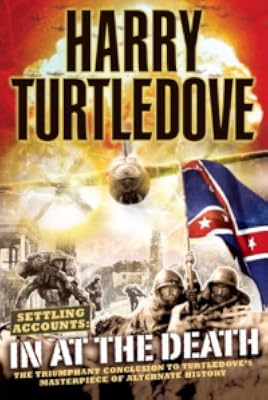
Settling Accounts: In at the Death
by Harry Turtledove
Settling Accounts Tetralogy (4), Timeline-191 (11)
On This Page
Description
Fiction. Literature. Science Fiction. Historical Fiction. HTML:Franklin Roosevelt is the assistant secretary of defense. Thomas Dewey is running for president with a blunt-speaking Missourian named Harry Truman at his side. Britain holds onto its desperate alliance with the USA’s worst enemy, while a holocaust unfolds in Texas. In Harry Turtledove’s compelling, disturbing, and extraordinarily vivid reshaping of American history, a war of secession has triggered a generation of madness. show more The tipping point has come at last.The third war in sixty years, this one yet unnamed: a grinding, horrifying series of hostilities and atrocities between two nations sharing the same continent and both calling themselves Americans. At the dawn of 1944, the United States has beaten back a daredevil blitzkrieg from the Confederate States–and a terrible new genie is out of history’s bottle: a bomb that may destroy on a scale never imagined before. In Europe, the new weapon has shattered a stalemate between Germany, England, and... show less
Tags
Recommendations


Member Reviews
Yes, this is the end. After eleven volumes, no more books are planned for this series, a look at how American history deviated from ours after a Confederate victory at the Battle of Antietam and how a diminished United States of America became ensnared in European wars earlier than in our time.
This book is the best in the series since the first, How Few Remain. Turtledove has had, from the very beginning of his career in alternate history, a sometimes annoying tendency to simply replay, in the context of an alternate history, events from our timeline. While there are plenty of WWII analogs throughout this series, the major ones being Jake Featherston equals Hitler, Pittsburgh equals Stalingrad, and death camps for blacks equals Jewish show more Holocaust, the story deviates from expectations in several ways which I will not spoil.
The lives of several characters are satisfyingly -- or, at least, conclusively -- resolved. Other characters, as you would expect taking any slice of historical time, are left with unpleasant memories or craving their old wartime lives. Through sheer accumulation of detail and revolving sections where the world is seen through the eyes of a viewpoint character, we've built up quite a lot of empathy for these characters. We understand them if not always approve of them. Two scenes stand out in that regard: Pinkard encounters an old black co-worker of his sent to the death camp that Pinkard directed, and a character we are fond of participates in a spur of the moment atrocity against civilians in the occupied Confederacy.
Given the title and trajectory of the series, it's hardly a spoiler to reveal that a great deal of the book is about what to do with the conquered Confederate States of America. Turtledove has explored this territory before with another story called "Must and Shall", but this book is even darker than that work. It is not at all clear that the former CSA will ever be integrated into the United States. And, while there is a logic to the casual slaughter of surrendered soldiers, the taking of civilian hostages and their occasional execution, that makes it no less jarring to see American troops in a very WWII context acting that way. And, with the question of "crimes against humanity, Turtledove reminds us not only of the necessity of rendering punishment but the hypocrisy of doing it in the framework of ex post facto law.
Towards the end of the novel, there is a nice scene where a character contemplates the contingency of history, what would have happened if Jake Featherston had simply taken another Richmond street and never fatefully encountered the Freedom Party his anger, drive, and intelligence almost made the equal of America.
It is a tribute to Turtledove's skill that, while I have complained about other books in this series, I will miss not visiting the future of this world and seeing how America fares in its quest to reunite its broken parts and find a secure place in the new international order. show less
This book is the best in the series since the first, How Few Remain. Turtledove has had, from the very beginning of his career in alternate history, a sometimes annoying tendency to simply replay, in the context of an alternate history, events from our timeline. While there are plenty of WWII analogs throughout this series, the major ones being Jake Featherston equals Hitler, Pittsburgh equals Stalingrad, and death camps for blacks equals Jewish show more Holocaust, the story deviates from expectations in several ways which I will not spoil.
The lives of several characters are satisfyingly -- or, at least, conclusively -- resolved. Other characters, as you would expect taking any slice of historical time, are left with unpleasant memories or craving their old wartime lives. Through sheer accumulation of detail and revolving sections where the world is seen through the eyes of a viewpoint character, we've built up quite a lot of empathy for these characters. We understand them if not always approve of them. Two scenes stand out in that regard: Pinkard encounters an old black co-worker of his sent to the death camp that Pinkard directed, and a character we are fond of participates in a spur of the moment atrocity against civilians in the occupied Confederacy.
Given the title and trajectory of the series, it's hardly a spoiler to reveal that a great deal of the book is about what to do with the conquered Confederate States of America. Turtledove has explored this territory before with another story called "Must and Shall", but this book is even darker than that work. It is not at all clear that the former CSA will ever be integrated into the United States. And, while there is a logic to the casual slaughter of surrendered soldiers, the taking of civilian hostages and their occasional execution, that makes it no less jarring to see American troops in a very WWII context acting that way. And, with the question of "crimes against humanity, Turtledove reminds us not only of the necessity of rendering punishment but the hypocrisy of doing it in the framework of ex post facto law.
Towards the end of the novel, there is a nice scene where a character contemplates the contingency of history, what would have happened if Jake Featherston had simply taken another Richmond street and never fatefully encountered the Freedom Party his anger, drive, and intelligence almost made the equal of America.
It is a tribute to Turtledove's skill that, while I have complained about other books in this series, I will miss not visiting the future of this world and seeing how America fares in its quest to reunite its broken parts and find a secure place in the new international order. show less
At last the interesting strand of Alternate History that began with "How Few Remain", is over. The South is definitively conquered and the USA is re-united at last. Featherstone is dead, and the world is left in an ugly scramble to obtain nuclear weapons. Japan bestrides the Western Pacific, and the American Federals are snarling at their erstwhile allies the Germans. But Turtledove lets go of the series at this point, as the probabilities are now beyond the interest of his audience, I suspect. I like this series best of Turtledove's works.
The conclusion of an alternate World War II in North America between the United States and the Nazi-like Confederate States, and supposedly the end of the entire Timeline-191 alternate history sequence. At the start of this book, the CSA has already suffered numerous defeats and US forces are driving towards Atlanta. Atomic bombs, or "superbombs" have already been used in Europe and both sides in America have their own programs to build the bombs and gain a decisive advantage.
The book tells a decent story, but dosn't offer much in the way of surprises. The standard flaws of repetition; long, irrelevant conversations; and some uninteresting characters who do nothing to advance the overall story are still present. The end result of the show more war has not been in much doubt since the end of Drive to the East, and nothing here changes that. The war finally ends a little over halfway through the book, and starts to drag on with a very extended conclusion of Nuremberg-style trials and the return of the various characters to peacetime life. What was disappointing for what is supposed to the the end of the entire Timeline-191 sequence is that it offers no clues of what the future might hold in a world that is now substantially different from our own post-WWII world. There is no mention of what will happen to the defeated Mormons in Utah, and no hint of how the US will sustain its massive occupations of the rest of North America. The book ends with a much more brutal and dangerous world than our own with the possibility of telling interesting stories that don't just copy from our own history, but that does not seem to be the direction Turtledove wants to take. The whole series does offer some interesting ideas on how the United States' long run of prosperity and freedom owes as much to luck as to anything else, but it does not take enough advantage of its interesting setting to make a truly interesting story. show less
The book tells a decent story, but dosn't offer much in the way of surprises. The standard flaws of repetition; long, irrelevant conversations; and some uninteresting characters who do nothing to advance the overall story are still present. The end result of the show more war has not been in much doubt since the end of Drive to the East, and nothing here changes that. The war finally ends a little over halfway through the book, and starts to drag on with a very extended conclusion of Nuremberg-style trials and the return of the various characters to peacetime life. What was disappointing for what is supposed to the the end of the entire Timeline-191 sequence is that it offers no clues of what the future might hold in a world that is now substantially different from our own post-WWII world. There is no mention of what will happen to the defeated Mormons in Utah, and no hint of how the US will sustain its massive occupations of the rest of North America. The book ends with a much more brutal and dangerous world than our own with the possibility of telling interesting stories that don't just copy from our own history, but that does not seem to be the direction Turtledove wants to take. The whole series does offer some interesting ideas on how the United States' long run of prosperity and freedom owes as much to luck as to anything else, but it does not take enough advantage of its interesting setting to make a truly interesting story. show less
I have read the entire series starting from "How Few Remain" and I found this book very enjoyable...there are some surprises, but nothing major...its ending was more or less expected (by myself)...Ethical issues play a big role (especially at the end of the book)and Turtledove does a nice job contrasting the behavior of the north and the south...there are also some great reflections on todays world and the issues of war in general...I hope this is not the end and we have another series move us along the timeline...
At last! The final volume of the Settling Accounts tetralogy which is the final section of the eleven volume Timeline-191 saga. One could argue that this book sees the end of two wars. The first is the "Second Great War", or World War Two, as we called it in our reality. It's the final conflict between the greater population and resources of the United States of America and whatever secret weapons the Confederate States of America might be able to pull out of their collective hat. This book also offers, one could say, the end of the War Between the States. There is a definite end of hostilities and after four wars of increasing intensity, both the North and the South realize that they cannot peacefully coexist on the continent. Like The show more Great War: Breakthroughs, this volume picks up the pace from its predecessor, bringing an end to the interweaving stories that recount American life during wartime. I'm pretty sure also that this is the end of the saga. I suppose Mr. Turtledove could create some tales from an alternate history cold war, I hope he'd refrain and turn his talents to some other endeavor. (like maybe that Kennedy story he had started on.)
--J. show less
--J. show less
The concluding volume of Turtledove's TL-191 series.
Members
- Recently Added By
Published Reviews
ThingScore 50
What follows from there is certainly more engaging than the comparative disappointment of The Grapple, which now appears to have been written because Turtledove had a bit too much for even three packed books, and not quite enough for four really satisfying ones. However, for all its imperfections, In at the Death delivers everything a reader familiar with the series can reasonably hope for, show more living up to the promise of finality implicit in its name and promised by its dust jacket. show less
added by sdobie
Author Information

279+ Works 43,267 Members
Harry Turtledove was born in Los Angeles, California on June 14, 1949. He received a Ph.D. in Byzantine history from UCLA in 1977. From the late 1970's to the early 1980's, he worked as a technical writer for the Los Angeles County Office of Education. He left in 1991 to become full-time writer. His first two novels, Wereblood and Werenight, were show more published in 1979 under the pseudonym Eric G. Iverson because his editor did not think people would believe that Turtledove was his real name. He used this name until 1985 when he published Herbig-Haro and And So to Bed under his real name. He has received numerous awards including the Homer Award for Short Story for Designated Hitter in 1990, the John Esthen Cook Award for Southern Fiction for Guns of the Southand in 1993, and the Hugo Award for Novella for Down in the Bottomlands in 1994. (Bowker Author Biography) show less
Awards and Honors
Distinctions
Series


Common Knowledge
- Canonical title
- Settling Accounts: In at the Death
- Original publication date
- 2007 (UK) (UK)
Classifications
Statistics
- Members
- 466
- Popularity
- 65,760
- Reviews
- 7
- Rating
- (3.72)
- Languages
- English
- Media
- Paper, Audiobook, Ebook
- ISBNs
- 10
- ASINs
- 2