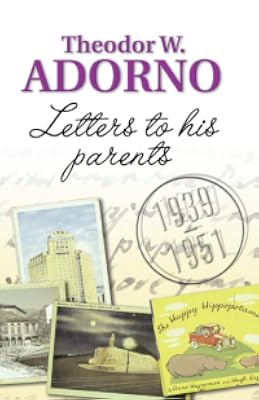
Letters to his Parents: 1939-1951
by Theodor W. Adorno
On This Page
Description
'My dears: this is but a brief note to welcome you to the new world, where you are now no longer all too far away from us. ' So begins Adorno's letter to his parents in May 1939, welcoming them to Cuba where they had just arrived after fleeing from Nazi Germany at the last minute. At the end of 1939 his parents moved again to Florida and then to New York, where they lived from August 1940 until the end of their lives. It is only with Adorno's move to California at the end of 1941 that his show more letters to his parents start arriving once more, reporting on work and living conditions as well as on friends, acquaintances and the Hollywood stars of his time. One finds reports of his collaborations with Max Horkheimer, Thomas Mann and Hanns Eisler alongside accounts of parties, clowning around with Charlie Chaplin, and ill-fated love affairs. But the letters also show his constant longing for Europe: Adorno already began to think about his return as soon as the USA entered the war. Adorno's letters to his parents - surely the most open and direct letters he ever wrote - not only afford the reader a glimpse of the experiences that gave rise to the famous Minima Moralia, but also show Adorno from a previously unknown, very personal side. They end with the first reports from the ravaged Frankfurt to his mother - who remained in New York - and from Amorbach, Adorno's childhood paradise show lessTags
Members
- Recently Added By
Author Information

323+ Works 14,297 Members
Theodor W. Adorno is the progenitor of critical theory, a central figure in aesthetics, and the century's foremost philosopher of music. He was born and educated in Frankfurt, Germany. After completing his Ph.D. in philosophy, he went to Vienna, where he studied composition with Alban Berg. He soon was bitterly disappointed with his own lack of show more talent and turned to musicology. In 1928 Adorno returned to Frankfurt to join the Institute for Social Research, commonly known as The Frankfurt School. At first a privately endowed center for Marxist studies, the school was merged with Frankfort's university under Adorno's directorship in the 1950s. As a refugee from Nazi Germany during World War II, Adorno lived for several years in Los Angeles before returning to Frankfurt. Much of his most significant work was produced at that time. Critics find Adorno's aesthetics to be rich in insight, even when they disagree with its broad conclusions. Although Adorno was hostile to jazz and popular music, he advanced the cause of contemporary music by writing seminal studies of many key composers. To the distress of some of his admirers, he remained pessimistic about the prospects for art in mass society. Adorno was a neo-Marxist who believed that the only hope for democracy was to be found in an interpretation of Marxism opposed to both positivism and dogmatic materialism. His opposition to positivisim and advocacy of a method of dialectics grounded in critical rationalism propelled him into intellectual conflict with Georg Hegel, Martin Heidegger, and Heideggerian hermeneutics. (Bowker Author Biography) show less
Some Editions
Classifications
Statistics
- Members
- 17
- Popularity
- 1,448,950
- Languages
- English, German, Spanish
- Media
- Paper, Ebook
- ISBNs
- 5