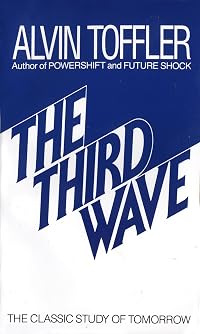
The Third Wave
by Alvin Toffler, Heidi Toffler
On This Page
Description
From the author of Future Shock comes a striking way out of today's despair ... a bracing, optimistic look at our new potentials.The Third Wave makes startling sense of the violent changes now battering our world. Its sweeping synthesis casts fresh light on our new forms of marriage and family, on today's dramatic changes in business and economics. It explains the role of cults, the new definitions of work, play, love, and success. It points toward new forms of twenty-first-century democracy.
.
Tags
Recommendations

























Member Reviews
Toffler (Alvin with his wife Heidi), of course, is one of the sages of the 20th century, and this book is another triumph of intuition, understanding, and a keen sense of ongoing processes. The main thesis is that the western world is coming to the end of the industrial revolution, and is transforming itself in many ways that amount toa Third Wave (the first was the Agricultural revolution, the second the Industrial). In this new dispensation, peoplemaree no longer dependent on society and their neighbours, they no longer want steady jobs, the economy gradually moves away from producing industrial and manufactured goods toward intellectual and knowledge products (and entertainment and creative works) for both production and consumption show more at the same time: the rise of the 'prosumer'. Many aspects of Toffler's scenario find ready resonance in our own experience: the younger generation not going after settled jobs, or residence, or marriage. But the question arises: is this a manifestation of a rise above a certain level of wealth, or is it something happening right across classes? The book, brilliant though it is, has certain drawbacks: its inordinate size (a very Second Wave character!), a frequent tendency to exaggerate and universalize, and the almost complete blind spot to religious fundamentalism and geopolitical hegemony. Hence the three stars. show less
Toffler's main thesis, that de-massification of production is leading to a kind of economy based upon home-based, independent, information-work contractors slash everyone has a home makerspace run by their off-grid, or perhaps, decentralized peer-peer networked alternative energy sources doesn't seem any more or less likely than any other imagined future. I think he'd be disappointed at how reactionary "Second Wavers" have been and how successfully they've caught the Third Wave. E.g., "school choice" to my knowledge is almost entirely the purview of the conservative religious movement, not progressives. Toffler does acknowledge that these historical Waves are amoral and spends some time talking about bad scenarios, though his show more overwhelming thrust is optimistic. I have to wonder how much of the pessimistic parts were a response to the general 70's malaise.
What always cracks me up about books like this is, here is someone that has come up with a comprehensive anthropological and historical explanation and framework for human history and future development, yet is neither an anthropologist nor a historian. Does his outsider status give him a clarity of vision, or is he essentially just a somewhat ponderous science fiction author? When picturing The book's scenarios, I kept thinking of SnowCrash and The Diamond Age, also The Dispossessed, which all imagine de-centralized, de-massified societies. show less
What always cracks me up about books like this is, here is someone that has come up with a comprehensive anthropological and historical explanation and framework for human history and future development, yet is neither an anthropologist nor a historian. Does his outsider status give him a clarity of vision, or is he essentially just a somewhat ponderous science fiction author? When picturing The book's scenarios, I kept thinking of SnowCrash and The Diamond Age, also The Dispossessed, which all imagine de-centralized, de-massified societies. show less
Toffler è stato considerato un "futurologo" e sotto molti punti di vista questo libro è profetico. Al di là della metafora delle tre ondate e di alcuni neologismi di successo (tecnosfera, sociosfera, infosfera), il testo include alcune sorprendenti previsioni sul presente, per esempio quelle legate alla progressiva demassificazione dei media (perfettamente rappresentata da internet), allo sviluppo delle organizzazioni di impresa o al riemergere del "prosumer". Il tutto è reso ancor più significativo dal fatto che il libro è del 1980.
The direct sequel to the remarkably prescient Future Shock, written a decade later as the 1970's came to a close. While inevitably a few sections are rather dated, the majority could just as easily been written in 2019 as 1979.
While the book by the author of Future Shock may seem not as forward-looking as it was in the 70's, there is still a wealth of societal insight contained here.
MUCH OF WHAT TOFFLER WROTE HAS FRIGHTENINGLY COME TO PASS THIS MAN COULD READ THE SIGNS OF THE TIME INTO THE FUTURE VERY WELL
An early look at what post-industrial society might look like.
Members
- Recently Added By
Lists

Speculative non-fiction
25 works; 2 members

Books in the Bibliography of The Alchemy of Us by Ainissa Ramirez
181 works; 1 member
Author Information

25+ Works 6,613 Members
Alvin Toffler was born in New York on October 4, 1928. He received a degree in English from New York University in 1950. While in college he helped register black voters in North Carolina. After graduating, he moved to Cleveland, Ohio with his wife Heidi and took a production job in a factory. He learned to weld and repair machinery. In 1954, he show more became a reporter for Industry and Welding. He went on to become a reporter for Labor's Daily and then as a labor editor and columnist for Fortune magazine. He left Fortune in 1962 and began a freelance-writing career covering politics, technology, and social science for scholarly journals and writing long interviews for Playboy magazine. He wrote 13 books during his lifetime including Future Shock, The Third Wave, and Powershift. He received a career achievement award in 2005 from the American Society of Journalists and Authors. In 1996, he and his wife formed Toffler Associates, a global forecasting and consulting company. He died on June 27, 2016 at the age of 87. (Bowker Author Biography) show less

6+ Works 6,223 Members
Work Relationships
Is a (non-series) sequel to
Common Knowledge
- Original title
- The Third Wave
- Original publication date
- 1980
- Epigraph
- Did we come here to laugh or cry?
Are we dying or being born?
Terra Nostra by Carlos Fuentes - Dedication
- For Heidi
Whose convincing arguments helped me decide to write The Third Wave. Her tough, tenacious criticism of my ideas and her professionalism as an editor are ... (show all)reflected on every page.
Her contributions to this book extend far beyond those one would expect of a colleague, an intellectual companion, a friend, lover and wife. - First words
- A new civilization is emerging in our lives, and blind men everywhere are trying to suppress it.
- Last words
- (Click to show. Warning: May contain spoilers.)Like the generation of the revolutionary dead, we have a destiny to create.
Classifications
- Genres
- Sociology, Nonfiction, General Nonfiction
- DDC/MDS
- 303.4 — Society, government, & culture Social sciences, sociology & anthropology Social processes Social change
- LCC
- HN17.5 .T643 — Social sciences Social history and conditions. Social problems. Social reform Social history and conditions. Social problems.
- BISAC
Statistics
- Members
- 1,493
- Popularity
- 15,580
- Reviews
- 15
- Rating
- (3.65)
- Languages
- 13 — Danish, Dutch, English, French, German, Italian, Farsi/Persian, Polish, Portuguese, Romanian, Spanish, Swedish, Turkish
- Media
- Paper, Audiobook, Ebook
- ISBNs
- 42
- UPCs
- 1
- ASINs
- 21