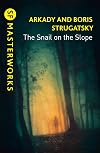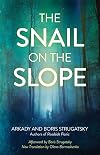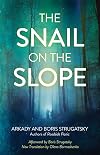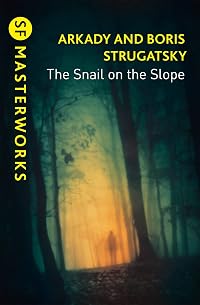
The Snail on the Slope
by Arkady Strugatsky, Boris Strugatsky
On This Page
Description
The Snail on the Slope takes place in two worlds. One is the Administration, an institution run by a surreal, Kafkaesque bureaucracy whose aim is to govern the forest below. The other is the Forest, a place of fear, weird creatures, primitive people and violence. Peretz, who works at the Administration, wants to visit the Forest. Candide crashed in the Forest years ago and wants to return to the Administration. Their journeys are surprising and strange, and readers are left to puzzle out the show more mysteries of these foreign environments. The Strugatskys themselves called The Snail on the Slope "the most complete and important" of their works. show lessTags
Recommendations





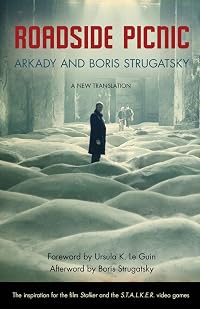













Member Reviews
This was a buddy read with my dad as a part of our science fiction in translation project, and whoo! did I accidentally choose a doozy! This book portrays two worlds: a Kafka-esque bureaucracy that exists to manage the Forest, and The Forest, which does not really seem like it is being managed at all. Peretz works in Administration, and wanted to get into the Forest, but has become disillusioned and would like to leave. Candide is in the Forest, and has been trying to leave but is stymied by one thing after another — potential guides putting him off until tomorrow (over and over again forever), deadlings, thieves, and dangerous moss.
Some of all of this is clearly metaphor and some just fantastic. Which bits are meant to be saying show more something about "the way things are" and which are purely imaginative? Reading the afterword, the authors clearly had a particular take in mind, but also acknowledge that readers have created wildly varied interpretations of the books' themes.
The Forest has LOST vibes at times. There is weird shit going on out there — is it real or illusion? Supernatural or man-made? (or woman-made?) hostile, benevolent, or indifferent? And I will say, while the ending doesn't wrap everything up neatly, it also doesn't let you down like Lost. show less
Some of all of this is clearly metaphor and some just fantastic. Which bits are meant to be saying show more something about "the way things are" and which are purely imaginative? Reading the afterword, the authors clearly had a particular take in mind, but also acknowledge that readers have created wildly varied interpretations of the books' themes.
The Forest has LOST vibes at times. There is weird shit going on out there — is it real or illusion? Supernatural or man-made? (or woman-made?) hostile, benevolent, or indifferent? And I will say, while the ending doesn't wrap everything up neatly, it also doesn't let you down like Lost. show less
I love the Strugatsky brothers. They have a way with words, a way with characters, and their stories are never remakes of the Marvel universe. They're just brilliant all over (yes, their butts too). But this particular nut was just a little too hard for this particular skull, at this particular meeting of skull and nut. No. I'm misunderstanding myself. It's rather that the squirrel of motivation is already too sated to spend its twilight years honing the sledgehammer of hunger into the nano probe of zen necessary to finesse this nut, even if there is a delicious baby squirrel inside, just a lifetime of honing and a moment's finesse away.
Nonsense? I'm just getting you in the mood. Because this book is epically full of nonsense, though show more evidently on purpose. It paints a picture of contact between completely alien species, one of which is ours (so it could have actually made even less sense than it did). Nothing about the aliens makes sense to the humans, and eventually nothing about the humans makes sense to the reader. In that sense, it's a more realistic estimate of first contact than your "humans in alien clothing" type encounters you get with most sci-fi, though I had to mentally distance myself a few billion light years from this book before risking to use the word "realistic" in its direction. The reality painted here is endlessly absurd, and that absurdity eventually makes you skip sentences, paragraphs, and pages, when the neurons responsible for generating the feeling of confusion commit suicide en masse, and the neurons responsible for telling your bladder it's full all rush to fill the void. Then you're at the end, and you don't feel at all bad about the words skipped because all you want to do is make the nonsense stop. Luckily it does. Oh yes, I promise you, this book does end. I'd be relieved if I wasn't so exhausted.
That said, I'm still excited to read their other stuff. I think I have one or two left. show less
Nonsense? I'm just getting you in the mood. Because this book is epically full of nonsense, though show more evidently on purpose. It paints a picture of contact between completely alien species, one of which is ours (so it could have actually made even less sense than it did). Nothing about the aliens makes sense to the humans, and eventually nothing about the humans makes sense to the reader. In that sense, it's a more realistic estimate of first contact than your "humans in alien clothing" type encounters you get with most sci-fi, though I had to mentally distance myself a few billion light years from this book before risking to use the word "realistic" in its direction. The reality painted here is endlessly absurd, and that absurdity eventually makes you skip sentences, paragraphs, and pages, when the neurons responsible for generating the feeling of confusion commit suicide en masse, and the neurons responsible for telling your bladder it's full all rush to fill the void. Then you're at the end, and you don't feel at all bad about the words skipped because all you want to do is make the nonsense stop. Luckily it does. Oh yes, I promise you, this book does end. I'd be relieved if I wasn't so exhausted.
That said, I'm still excited to read their other stuff. I think I have one or two left. show less
I'm not sure whether [b:The Snail on the Slope|1535134|The Snail on the Slope|Boris Natanovich Strugatskii|https://i.gr-assets.com/images/S/compressed.photo.goodreads.com/books/1390080563l/1535134._SY75_.jpg|1527250], a mysterious and incomprehensible novel, was appropriate or not for the circumstances under which I read it. It occupied me during part of an exhausting ten hour odyssey to visit my parents for Christmas by train. Due to storm Pia, the railways were in chaos and I ended up taking five trains rather than the intended three. Perhaps I would have gleaned more meaning from the Strugatsky's dystopian fable had I not been distracted by planning for missed connections and cancelled trains. I found it more oblique than [b:The show more Doomed City|27219742|The Doomed City (Rediscovered Classics)|Arkady Strugatsky|https://i.gr-assets.com/images/S/compressed.photo.goodreads.com/books/1460505874l/27219742._SY75_.jpg|1560368] (which lets the title set up the scenario), [b:Roadside Picnic|331256|Roadside Picnic|Arkady Strugatsky|https://i.gr-assets.com/images/S/compressed.photo.goodreads.com/books/1173812259l/331256._SY75_.jpg|1243896] (where aliens are more explicitly involved), and [b:Hard to Be a God|759517|Hard to Be a God|Arkady Strugatsky|https://i.gr-assets.com/images/S/compressed.photo.goodreads.com/books/1425850190l/759517._SX50_.jpg|41364467] (again, with a setup that is clearly explained). In [b:The Snail on the Slope|1535134|The Snail on the Slope|Boris Natanovich Strugatskii|https://i.gr-assets.com/images/S/compressed.photo.goodreads.com/books/1390080563l/1535134._SY75_.jpg|1527250], it seems like humans are colonising an alien planet with a strange and dangerous forest. But are they?
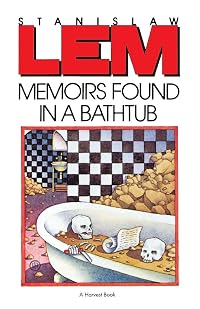
There are two protagonists, one of whom is trying to get into the forest and one of whom is trying to escape it. Both are foiled by bureaucracy and the strange psychic effects of their alien (?) surroundings. I did wonder about it as an allegory for nuclear power and the Chernobyl disaster, before remembering that it was written in 1965 so the latter is impossible. The combination of environmental weirdness and bureaucratic stonewalling makes the reading experience rather like a combination of [b:Annihilation|17934530|Annihilation (Southern Reach, #1)|Jeff VanderMeer|https://i.gr-assets.com/images/S/compressed.photo.goodreads.com/books/1403941587l/17934530._SX50_.jpg|24946895] (which might well have taken inspiration from it) and [b:Memoirs Found in a Bathtub|497121|Memoirs Found in a Bathtub|Stanisław Lem|https://i.gr-assets.com/images/S/compressed.photo.goodreads.com/books/1348416568l/497121._SY75_.jpg|485271] (or Kafka). The weird details are certainly vivid and unsettling, notably the deadlings and the pups birthed from the forest's cloaca:
Nothing is truly explained, but at the end a political allegory becomes more visible. There are some great moments of satire, as well as vividly bizarre interludes, but I don't think the whole coheres as well as the other novels by the Strutagatskys that I've read. The afterword offers some explanation for this: [b:The Snail on the Slope|1535134|The Snail on the Slope|Boris Natanovich Strugatskii|https://i.gr-assets.com/images/S/compressed.photo.goodreads.com/books/1390080563l/1535134._SY75_.jpg|1527250] was essentially written in two parts, with one of the protagonists added later. It had a somewhat confusing birth and is tackling a lot of themes. I can also see why it wasn't published until perestroika, given the mockery of bureaucracy in the depiction of the Administration. Perhaps I would have got more out of it had I not been reading in the midst of rail chaos. For train delays, you really need fast-paced and undemanding books that can be easily put aside and picked up again. show less
There are two protagonists, one of whom is trying to get into the forest and one of whom is trying to escape it. Both are foiled by bureaucracy and the strange psychic effects of their alien (?) surroundings. I did wonder about it as an allegory for nuclear power and the Chernobyl disaster, before remembering that it was written in 1965 so the latter is impossible. The combination of environmental weirdness and bureaucratic stonewalling makes the reading experience rather like a combination of [b:Annihilation|17934530|Annihilation (Southern Reach, #1)|Jeff VanderMeer|https://i.gr-assets.com/images/S/compressed.photo.goodreads.com/books/1403941587l/17934530._SX50_.jpg|24946895] (which might well have taken inspiration from it) and [b:Memoirs Found in a Bathtub|497121|Memoirs Found in a Bathtub|Stanisław Lem|https://i.gr-assets.com/images/S/compressed.photo.goodreads.com/books/1348416568l/497121._SY75_.jpg|485271] (or Kafka). The weird details are certainly vivid and unsettling, notably the deadlings and the pups birthed from the forest's cloaca:
Peretz stroked his swelling finger and watched the pups. The children of the forest. Or maybe the servants of the forest. Or maybe the excrement of the forest... They moved slowly and tirelessly in single file, seeming to flow along the ground, streaming over rotten tree trunks, over the ditches, across the stagnant puddles, through the tall grass, and through the thornbushes. The trail would disappear, plunging into the fragrant mud or hiding beneath the layers of hard grey mushrooms that crunched under their wheels, then it would reappear again, and the pups kept to the trail and managed to remain clean, white, smooth - no dust clung to them, no thorn left a mark on them, and they didn't get covered in the sticky black mud. They flowed forward with dull, unreflecting confidence, as if following a familiar road, one they knew well. There were forty-three of them.
[...]
"I've noticed one thing," said Quentin. "The size of the litter is always a prime: thirteen, forty-three, forty-seven..."
"Nonsense," objected Stoyan. "I've met groups of six or twelve in the forest."
"That's in the forest," said Quentin. "After a while, they split off in different directions. But the number of pups in a litter is always prime - you can check the logbook, I recorded every number..."
"And one time," said Randy, "me and my pals caught one of the local girls - that was a hoot!"
"Well, then, write a paper," said Stoyan.
"I've already written it," said Quentin. "It'll be my fifteenth."
"I've published seventeen," said Stoyan, "and I have another one due to appear. Who's going to be your coauthor?"
"I don't know yet," said Quentin. "Kim recommends the garage foreman - he says that transportation is essential nowadays - and Rita suggests the hotel manager."
Nothing is truly explained, but at the end a political allegory becomes more visible. There are some great moments of satire, as well as vividly bizarre interludes, but I don't think the whole coheres as well as the other novels by the Strutagatskys that I've read. The afterword offers some explanation for this: [b:The Snail on the Slope|1535134|The Snail on the Slope|Boris Natanovich Strugatskii|https://i.gr-assets.com/images/S/compressed.photo.goodreads.com/books/1390080563l/1535134._SY75_.jpg|1527250] was essentially written in two parts, with one of the protagonists added later. It had a somewhat confusing birth and is tackling a lot of themes. I can also see why it wasn't published until perestroika, given the mockery of bureaucracy in the depiction of the Administration. Perhaps I would have got more out of it had I not been reading in the midst of rail chaos. For train delays, you really need fast-paced and undemanding books that can be easily put aside and picked up again. show less
Strange book following two characters in the same universe. Some parts contain a strong satire of soviet habits, rules, institutions, done for people that have previous background in that part of history. The book does not try to explain anything, even more than that it makes everything terribly hard to make any sense of, but creates a certain feeling in the process which is part of why it is interesting. Touches many archetypes such as nature, village/town, hierarchy, human relations but all is a blur from which it is hard to discern clear ideas.
It may be science fiction, but first and foremost it is a satire on the Soviet system. I guess you would have to live through it to fully appreciate it, but I was chuckling all the way from the beginning to the end.
I can't do it. I read two chapters of this and can't take the nonsense dialogue and repetition any more. You might say that two chapters isn't enough but it was almost fifty pages and it really was that bad. Maybe if I hadn't been struggling with books lately I would have tried harder. Maybe. Probably not.
Yes, this is different but brilliant...just sit back and go along for the ride.
Members
- Recently Added By
Lists

Books Read in 2015
3,299 works; 126 members

Bureaucracies
25 works; 2 members

Books Read in 2019
4,052 works; 110 members

SF Masterworks
193 works; 8 members

Books Read in 2021
5,361 works; 114 members
Author Information

287+ Works 12,047 Members
Popular science-fiction writers, the Strugatsky brothers have used the genre since the 1960s to comment on contemporary society, at times provoking major controversy. It's Hard to Be a God (1964) is a dysutopia with commentary on historical theories. The Snail on the Slope (1966--68) features a KGB-like organization and an extraordinarily show more oppressive atmosphere. Pre-glasnost, glasnost, some of the Strugatskys' major works had to be circulated in samizdat, but the brothers' situation is now dramatically better. (Bowker Author Biography) show less

90+ Works 11,508 Members
Popular science-fiction writers, the Strugatsky brothers have used the genre since the 1960s to comment on contemporary society, at times provoking major controversy. It's Hard to Be a God (1964) is a dysutopia with commentary on historical theories. The Snail on the Slope (1966--68) features a KGB-like organization and an extraordinarily show more oppressive atmosphere. Pre-glasnost, glasnost, some of the Strugatskys' major works had to be circulated in samizdat, but the brothers' situation is now dramatically better. (Bowker Author Biography) show less
Some Editions
Awards and Honors
Notable Lists
Series
Belongs to Publisher Series
Work Relationships
Is contained in
Is an adaptation of
Common Knowledge
- Canonical title
- The Snail on the Slope
- Original title
- Улитка на склоне
- Original publication date
- 1968 (original edition) (original edition); 1980 (English translation) (English translation)
- Original language
- Russian
Classifications
- Genres
- Science Fiction, Fiction and Literature
- DDC/MDS
- 891.73 — Literature & rhetoric Literatures of other languages East Indo-European and Celtic literatures Russian and East Slavic languages Russian fiction
- LCC
- PG3476 .S78835 .U413 — Language and Literature Slavic languages and literatures. Baltic languages. Albanian language Slavic. Baltic. Albanian Russian literature Individual authors and works 1917-1960
- BISAC
Statistics
- Members
- 405
- Popularity
- 76,246
- Reviews
- 8
- Rating
- (3.68)
- Languages
- 10 — Catalan, Danish, English, Estonian, German, Italian, Japanese, Polish, Russian, Turkish
- Media
- Paper, Audiobook, Ebook
- ISBNs
- 32
- ASINs
- 7