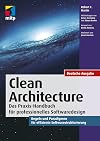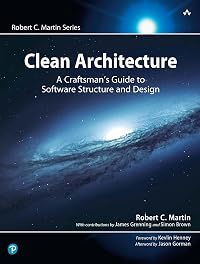
Clean Architecture: A Craftsman's Guide to Software Structure and Design
by Robert C. Martin
Robert C. Martin Series
On This Page
Description
By applying universal rules of software architecture, you can dramatically improve developer productivity throughout the life of any software system. Now, building upon the success of his best-selling books Clean Code and The Clean Coder, legendary software craftsman Robert C. Martin ("Uncle Bob") reveals those rules and helps you apply them. Martin's Clean Architecture doesn't merely present options. Drawing on over a half-century of experience in software environments of every imaginable show more type, Martin tells you what choices to make and why they are critical to your success. As you've come to expect from Uncle Bob, this book is packed with direct, no-nonsense solutions for the real challenges you'll face-the ones that will make or break your projects. - Learn what software architects need to achieve-and core disciplines and practices for achieving it - Master essential software design principles for addressing function, component separation, and data management - See how programming paradigms impose discipline by restricting what developers can do - Understand what's critically important and what's merely a "detail" Implement optimal, high-level structures for web, database, thick-client, console, and embedded applications - Define appropriate boundaries and layers, and organize components and services - See why designs and architectures go wrong, and how to prevent (or fix) these failures Clean Architecture is an essential book for every current or aspiring software architect, systems analyst, system designer, and software manager-and for every programmer who must execute someone else's designs. show lessTags
Recommendations
Member Reviews
I've read the other two books of Bob Martin - Clean Code and Clean Coder and I absolutely enjoyed both of them; this one, not so much.
There were some interesting concepts that I got to learn from this book - Reuse/Release Equivalence Principle, Common Closure Principle and Common Reuse Principle. Reading them made me feel that these were the guiding principles for SOLID principles to come by. So that was definitely enlightening.
There a lot of review of SOLID principles. I was okay with it, just okay, not impressed.
Personally felt that most of the 'back in my day, this is how we did' part could've been condensed if not removed. It feels quite dry and archaic.
There were some interesting concepts that I got to learn from this book - Reuse/Release Equivalence Principle, Common Closure Principle and Common Reuse Principle. Reading them made me feel that these were the guiding principles for SOLID principles to come by. So that was definitely enlightening.
There a lot of review of SOLID principles. I was okay with it, just okay, not impressed.
Personally felt that most of the 'back in my day, this is how we did' part could've been condensed if not removed. It feels quite dry and archaic.
Apparently I was looking for a book on Clean "Code" and ended up reading this by accident (architecture is synonymous with code right?!). Since I have read few coding books (despite nearly 40 years self-taught) I learned a bunch of things. Nevertheless, I should read his book on Code. Probably the biggest takeaway is that res-usability is the single biggest concept in software - nothing new, but nice to know it's easy to be a pro. Also, not to leave commented-out code laying around, get rid of most comments, and keep reducing function size is a never ending process. With the advent of AI, I can ask to redo functions in "clean code" style - might not follow the results exactly, but it teaches what clean code can look like vs. in theory show more from a book. show less
Clean Architecture is basically one idea repeated over and over for 30 chapters. The idea is that the business logic should be self-contained. It should not depend on the database or sockets or frameworks or GUI. It is a really, really good idea, and it is not easy to actually follow. However, the idea could have been explained in a lot less than 300 pages.
At the end there is a 50-pages appendix where Robert Martin describes many of the projects he worked on, from the early 1970s to the 1990s. Many of the problems from those projects are interesting case studies that you can learn from - I quite enjoyed reading those stories (somewhat to my own surprise).
At the end there is a 50-pages appendix where Robert Martin describes many of the projects he worked on, from the early 1970s to the 1990s. Many of the problems from those projects are interesting case studies that you can learn from - I quite enjoyed reading those stories (somewhat to my own surprise).
Surprisingly clairvoyant
Ratings
Members
- Recently Added By
Lists

Books Read in 2017
4,249 works; 130 members

Books Read in 2021
5,361 works; 114 members
Author Information

Series

Common Knowledge
- Canonical title
- Clean Architecture: A Craftsman's Guide to Software Structure and Design
Classifications
- Genres
- Technology, Nonfiction, General Nonfiction
- DDC/MDS
- 004.2 — Computer science, information & general works Computer science, knowledge & systems Computer science Systems analysis and design, architecture, performance evaluation
- LCC
- QA76.76 .D47 — Science Mathematics Mathematics Instruments and machines Calculating machines Electronic computers. Computer science Computer software
- BISAC
Statistics
- Members
- 389
- Popularity
- 79,890
- Reviews
- 4
- Rating
- (4.14)
- Languages
- 5 — English, German, Italian, Japanese, Polish
- Media
- Paper, Audiobook, Ebook
- ISBNs
- 13
- ASINs
- 5